


Sign In to Your Account
Subscribers have complete access to the archive.
Sign In Not a Subscriber?Join NowACROSS THE ATLANTIC THROUGH THE AIR
Lord Northcliffe, who offers $50,000 to the aviator who first accomplishes this feat, has forecast most of the notable long distance flights. His previous offers of prices for seemingly impossible feats—for flying across the channel and for flying from London to Manchester — were won within a year after they were made.
HENRY WOODHOUSE
ON MARCH 31 last the world was somewhat startled by the announcement that Lord Northcliffe, the owner of the London Daily Mail had offered a $50,000 prize for the first person who should make a transatlantic flight in a hydroaeroplane or flying boat in seventy-two consecutive hours, between any point in the United States, Canada, or Newfoundland, and any point in Great Britain or Ireland, in either direction.
Many people shook their heads on reading the news particularly those who had crossed the Atlantic and were not familiar with the progress of aviation. To them the thought of a flimsy thing like the average aeroplane crossing the 3000 miles of water seemed absurd, and they pitied the aviator who should undertake to accomplish it. But the more thoughtful, those acquainted with the rapid development of aviation, reflected.
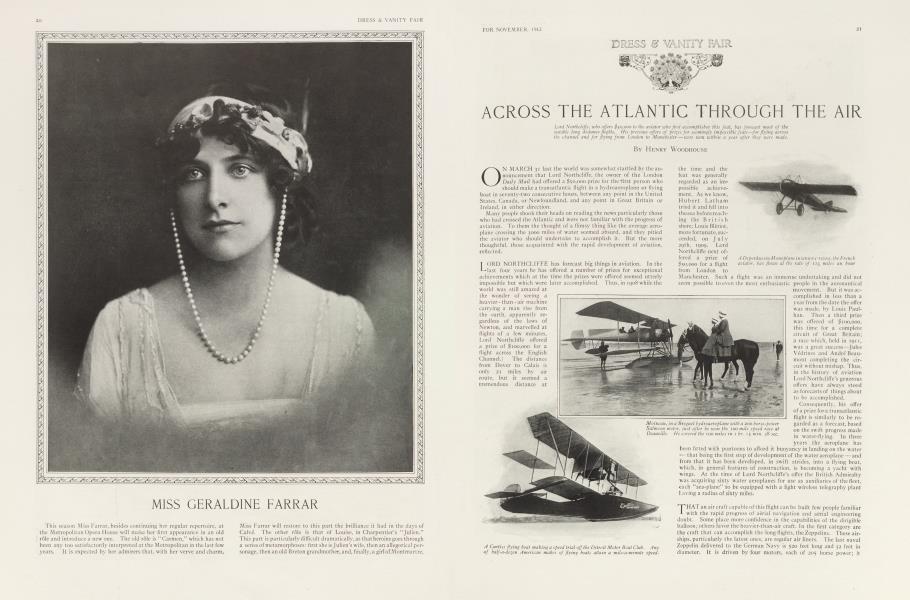
LORD NORTHCLIFFE has forecast big things in aviation. In the last four years he has offered a number of prizes for exceptional achievements which at the time the prizes were offered seemed utterly impossible but which were later accomplished. Thus, in 1908 while the world was still amazed at the wonder of seeing a heavier-than-air machine carrying a man rise from the earth, apparently regardless of the laws of Newton, and marvelled at flights of a few minutes, Lord Northcliffe offered a prize of $100,000 for a flight across the English Channel.) The distance from Dover to Calais is only 21 miles by air route, but it seemed a tremendous distance at the time and the feat was generally regarded as an impossible achievement. As we know, Hubert Latham tried it and fell into thesea before reaching the British shore; Louis Blèiot, more fortunate, succeeded, on July 29th, 1909. Lord Northcliffe next offered a prize of A Deperdussin Monoplane in which rrcvosi, the French $50,000 for a flight aviator, has flown at the rate of 125 miles an hour from London to Manchester. Such a flight was an immense undertaking and did not seem possible to even the most enthusiastic people in the aeronautical
movement. But it was accomplished in less than a year from the date the offer was made, by Louis Paulhan. Then a third prize was offered of $100,000, this time for a complete circuit of Great Britain; a race which, held in 1911, was a great success—Jules V£drines and Andr£ Beaumont completing the circuit without mishap. Thus, in the history of aviation Lord Northcliffe's generous offers have always stood as forecasts of things about to be accomplished.
Consequently, his offer of a prize for a transatlantic flight is similarly to be regarded as a forecast, based on the swift progress made in water-flying. In three years the aeroplane has been fitted with pontoons to afford it buoyancy in landing on the water that being the first step of development of the water aeroplane —and from that it has been developed, in swift strides, into a flying boat, which, in general features of construction, is becoming a yacht with wings. At the time of Lord Northcliffe's offer the British Admiralty was acquiring sixty water aeroplanes for use as auxiliaries of the fleet, each "sea-plane" to be equipped with a light wireless telegraphy plant having a radius of sixty miles.
THAT an air craft capable of this flight can be built few people familiar with the rapid progress of aerial navigation and aerial engineering doubt. Some place more confidence in the capabilities of the dirigible balloon; others favor the heavier-than-air craft. In the first category are the craft that can accomplish the long flights, the Zeppelins. These airships, particularly the latest ones, are regular air liners. The last naval Zeppelin delivered to the German Navy is 520 feet long and 52 feet in diameter. It is driven by four motors, each of 205 horse power; it promises a speed of fifty-five miles an hour and a capability for continuous flight of over fifty hours. The exact weight of this dirigible we have not been able to learn, but it is probably eighteen tons, while its lifting capacity may be as high as twenty-eight tons, giving a carrying capacity of ten tons for passengers and equipment.
To send a Zeppelin across the Atlantic would, however, involve an expenditure of a large sum, possibly one million dollars. Moreover, all the Zeppelin dirigibles of that type are acquired and controlled by the German army and navy which for the present, at least, would hardly enter into the transatlantic experiment. Therefore there is little likelihood that one could be secured to attempt the cross Atlantic trip.
NO TYPE of dirigible other than the rigid Zeppelin can aspire to the honors. The semi-rigid and non-rigid craft cannot be made of such a size as to lift the amount of fuel and equipment necessary for such a trip; nor could they face a moderately stiff ocean breeze. These limitations would make an experiment rather costly and risky —as has been shown by the attempts of Wellman and Brücker, both of whose dirigibles were so battered by the elements that their attempted voyages had to be abandoned.
ON THE other hand, the heavier-than-air craft, the water aeroplane—whether a boat with wings or an aeroplane with floats—offers greater possibilities. That is the reason why Lord Northcliffe in offering the prize of $50,000 specified that the flight should be made with a hydroaeroplane. A heavier-than air machine can be made to travel at any speed up to 100 miles an hour (one of this type even attained 117 miles an hour), it can face some very stiff winds, and it can be piloted by two or three men. To construct one large enough to carry the required amount of fuel and equipment would not involve great expenditure. Just how large such a machine would have to be will be considered further on.
CROSSING THE ATLANTIC IN SEVENTY-TWO HOURS
THE first thing to be considered in selecting a route is that the seventy-two hour limit precludes taking any course involving a distance of over 3,500 miles, because, while it may be possible to make a craft which can attain a speed of between sixty and a hundred miles an hour, the possible draft and other unknown quantities make it necessary to have a broad margin of time. Therefore, the shortest routes are the best and a single sustained flight is more likely of success than a series of flights with landings on the water.
This map shows various routes that may be chosen for air travel between the North or South American Continents with their adjacent islands, and Europe. The South American Routes traverse the African Coast. Distances are given approximately to nearest ten (land or English statute) miles. One such mile is equal to 1.61 kilometers. This map is on the Gnomic Projection, and is compiled with reference more to the geographical location of the land masses than to the topographical or meteorological conditions obtaining. Of the above routes two have been selected by the Vaniman and "Suchard" expeditions, both of which are nearly ready. The favorable routes shown in heavy lines are suitable Jor both motor planes and motor balloons. The alternative and other routes are shown in lighter lines
The possible routes of this flight are as follows:
1 From Newfoundland to Ireland, about 1,900 miles .
2 From Newfoundland to the Azores, about 1,200 miles.
3 From New York to Paris, via Labrador, Greenland, Iceland, Faroe Islands, and Scotland—about 4,500 miles, (compared with 3,500 miles via steamer and rail) and with the longest necessary stretch of water 270 miles.
4 A similar southern route via the West Indies, South America, Cape Verde Islands, Africa, and Spain — about 9,400 miles with one water stretch of 1,280 miles.
And, by the use of a large scow, ship, or float, as a supply station anchored in shoal water off Newfoundland Bank:
5 Newfoundland Bank (Flemish Cap) to the Azores, 870 miles.
6 Flemish Cap to a similar scow anchored off Porcupine Bank (to the west of Ireland), about 1400 miles.
DIFFERENT pilots will favor different routes, according to the methods they have in mind and their knowledge of the difficulties to be overcome. But a general consideration of all factors shows more promises of success in the St. JohnFlemish Cap routes using a craft that will be self-sufficient in every way for a sustained flight of 2,000 miles.
AN ECONOMIC RATHER THAN A MECHANICAL PROBLEM
THE building of a suitable craft is in difficulty an economic rather than a mechanical problem. The leading constructors of aeroplanes would, no doubt, consider it easier to put wings to the Detroit, the little power boat which crossed the Atlantic last year, and make it fly at a mile a minute speed, than to finance the proposition of constructing it entirely and equipping it for the trip. Likewise the securing of suitable motors would be simply an economic proposition — to the extent of between $20,000 and $30,000 if four 160 horse power motors were used, two as reserve.
Continued on page 104
Continued from page 23
The aeroplane should be capable of flying at a minimum speed of fifty miles an hour with a load of about 4000 pounds of fuel and equipment Over 3000 pounds of this weight would be fuel, which being consumed would lighten the aeroplane and thereby increase the speed to possibly 90 miles an hour. To carry such a weight an aeroplane would have to have a spread of about 120 feet; and it would have to be biplane, for the double set of wings would afford a greater lifting capacity.
To drive an aeroplane of this size, with such a load, would require a minimum of 300 horse power, which would have to be doubled so as to assure an independent reserve to be used in case of an accident.
To construct such an aeroplane is, as we have said before, not beyond the possibility of present day engineering. The size is not quite double that of the largest aeroplane in existence, the Sykorsky biplane, which holds the record of carrying seven passengers in a flight of nearly two hours, duration at an altitude of 6,000 feet.
THE aeroplane that will eventually make this flight will be a boat with wings. This we infer from the trend of development of aircraft in the past two years. The most efficient aeroplane today is the air-boat. This was developed by first putting floats to an aeroplane to keep it from sinking in the water; then in 1911, Glenn H. Curtis replaced the floats with a pontoon; in 1912 he replaced the pontoon with a body shaped like a boat. This has been developing in size and shape to such an extent that the next step promises to be a regular air-yacht.
THE MAIN PROBLEM
THE main problem of the enterprise will be the flight itself, facing the weather conditions, operating the aeroplane, and navigating it across the Atlantic. The difficulties involved are due principally to the fact that this air voyage has never been made before; the obstacle to be conquered is unfamiliarity, not impossibility.
Granting that an aeroplane can be constructed that can fly for forty hours continuously at a speed ranging between 50 miles with full load and 70 miles with less load, the next problem is to have the human factor to keep the aeroplane in flight for that length of time. Flying, keeping the aeroplane in the air, is a psychologic process; it depends entirely on the pilot's feeling. A lack of confidence on his part, or worse yet, a temporary lapse of consciousness, invariably ends with his drifting down and landing as best he can; for if he becomes at all unnerved or befuddled he will be unable to operate the rudders which control the ascent and descent in such a way as to keep the machine in the air. In fact, it has been repeatedly demonstrated that an aviator cannot fly after he has once lost his feeling of security of control.
Consequently, for a flight of forty hours it would be necessary to have three pilots, with two always on duty, and one resting at intervals, in the cabin. This would insure continuous efficient service at the wheel, as well as constant attention to the motors. Of course, the pilots necessary to undertake this flight would have to be good navigators as well as good operators of aeroplanes. To secure such men in America would be somewhat difficult at present, unless naval officers were employed; but in Europe it would be less difficult. However, good seamen could readily be secured and trained to accomplish the flight.
IN SAYING that an aeroplane flight lacross the Atlantic is a possibility I have in mind also the wonderful progress made in flying across country in the past year. Flights of from 500 to 1,000 miles are now too common in Europe to be reported by the press.
The accompanying list gives some of the flights of from 283 to 1,375 miles made within the last three months. In all these flights the aviator flew entirely by compass direction.
CONSIDERING all these feats it does not require undue prescience to prophesy that the crossing of the Atlantic by air will be accomplished within a year.
LONG FLIGHTS WITHIN THE PAST THREE MONTHS
AVIATOR DIST. IN MILES
Guillaux Paris-Merignac
Letort Paris-Berlin .... 674 350
Janoir Etampes-Namur 220
Gilbert Paris-Vittoria (Spain)
Guillaux Paris-Caceres (Spain) 800 470
Janoir Etampes-Berlin 700
S6quin Biarritz-Bremen 800
D. Marmier Paris-Aix-la-Chapelle
Letort Berlin-Paris .... 674 300
Guillaux Biarritz-Brackal (near Hamburg)
Letort Paris-Dantzig ..... 800
Jansen Valenciennes-Peterswald (Frontier village of
Bohemia) ....
D. Marmier Biarritz-Paris-Biarritz 450
Lord Cadbery Paris-London 287 900
Baron Pasquier Etampes-Bordeaux-Paris. .... 670
Janoir Etampes-Berlin-Seelow-Riga-Pakow-St. Peters-
burg .
Levasseur Paris-London-Dunkerque-Rotterdam-Amsterdam1239
Emden-Ostend-Revin-Paris (in hydroaeroplane) 1094
Commander Felix. London-Paris Emden-Ostend-Revin-Paris ...... (in hydroaeroplane) 1094 287
Grahame-White London-Paris (in hydroaeroplane) . 287
Chemet London-Paris (in hydroaeroplane) . 287
Audemars Paris-Berlin ....... 674
U'UL . . . 674 Havens Chicago-Detroit-Buffalo (in airboat)
Friedrich Berlin-Paris ....... 674 523
Lieut. Scarpis Turin-Pordenone ...... 280
Stoeffler Mulhausen-Insterburg ..... 850
Colonial Aviators. Biskra-Tunis-Algier .....
Colonial Aviators. Casablanca-Foz and a score of flights across the 750
Sahara Desert ...... 500
Garros Fréjus, Sahara near Desert Cannes, ...... France, across the Adriatic 500
Sea :o Tunis, Africa ..... 500
Thulin Across Sea :o the Tunis, Baltic Africa from Landskrona ..... to Stralsund, 500
in two hours, or at a rate of 156 miles an hour 312
Stoeffler Flight in two ending hours, at or Mulhausen, at a rate of Germany 156 miles an hour 312
Subscribers have complete access to the archive.
Sign In Not a Subscriber?Join Now


