Sign In to Your Account
Subscribers have complete access to the archive.
Sign In Not a Subscriber?Join NowDOGS AND THEIR OWNERS
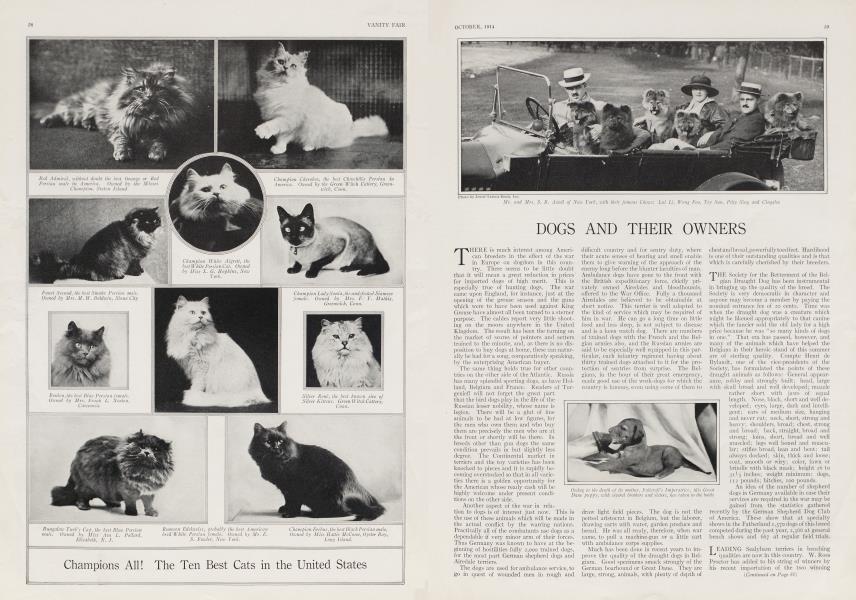
THERE is much interest among American breeders in the effect of the war in Europe on dogdom in this country. There seems to be little doubt that it will mean a great reduction in prices for imported dogs of high merit. This is especially true of hunting dogs. The war came upon England, for instance, just at the opening of the grouse season and the guns which were to have been used against King Grouse have almost all been turned to a sterner purpose. The cables report very little shooting on the moors anywhere in the United Kingdom. The result has been the turning on the market of scores of pointers and setters trained to the minute, and, as there is no disposition to buy dogs at home, these can naturally be had for a song, comparatively speaking, by the enterprising American buyer.
The same thing holds true for other countries on the other side of the Atlantic. Russia has many splendid sporting dogs, as have Holland, Belgium and France. Readers of Turgenieff will not forget the great part that the bird dogs play in the life of the Russian lesser nobility, whose name is legion. There will be a glut of fine animals to be had at low figures, for the men who own them and who buy them are precisely the men who are at the front or shortly will be there. In breeds other than gun dogs the same condition prevails in but slightly less degree. The Continental market in terriers and the toy varieties has been knocked to pieces and it is rapidly becoming overstocked so that in all varieties there is a golden opportunity for the American whose ready cash will be highly welcome under present conditions on the other side.
Another aspect of the war in relation to dogs is of interest just now. This is the use of these animals which will be made in the actual conflict by the warring nations. Practically all of the combatants use dogs as a dependable if very minor arm of their forces. Thus Germany was known to have at the beginning of hostilities fully 2,000 trained dogs, for the most part German shepherd dogs and Airedale terriers.
The dogs are used for ambulance service, to go in quest of wounded men in rough and difficult country and for sentry duty, where their acute senses of hearing and smell enable them to give warning of the approach of the enemy long before the blunter faculties of man. Ambulance dogs have gone to the front with the British expeditionary force, chiefly privately owned Airedales and bloodhounds, offered to the War Office. Fully a thousand Airedales are believed to be obtainable at short notice. This terrier is well adapted to the kind of service which may be required of him in war. He can go a long time on little food and less sleep, is not subject to disease and is a keen watch dog. There are numbers of trained dogs with the French and the Belgian armies also, and the Russian armies are said to be especially well equipped in this particular, each infantry regiment having about thirty trained dogs attached to it for the protection of sentries from surprise. The Belgians, in the hour of their great emergency, made good use of the work-dogs for which the country is famous, even using some of them to draw light field pieces. The dog is not the petted aristocrat in Belgium, but the laborer, drawing carts with water, garden produce and bread. He was all ready, therefore, when war came, to pull a machine-gun or a little cart with ambulance corps supplies.
Much has been done in recent years to improve the quality of the draught dogs in Belgium. Good specimens smack strongly of the German boarhound or Great Dane. They are large, strong, animals, with plenty of depth of chest and broad, powerfully toedfeet. Hardihood is one of their outstanding qualities and is that which is carefully cherished by their breeders.
THE Society for the Betterment of the Belgian Draught Dog has been instrumental in bringing up the quality of the breed. The Society is very democratic in character and anyone may become a member by paying the nominal entrance fee of 20 cents. Time was when the draught dog was a creature which might be likened appropriately to that canine which the fancier sold the old lady for a high price because he was "so many kinds of dogs in one." That era has passed, however, and many of the animals which have helped the Belgians in their heroic stand of this summer are of sterling quality. Compte Henri de Bylandt, one of the vice-presidents of the Society, has formulated the points of these draught animals as follows: General appearance, cobby and strongly built; head, large with skull broad and well developed; muzzle rather short with jaws of equal length. Nose, black, short and well developed; eyes, large, dark and intelligent; ears of medium size, hanging and never cut; neck, short, strong and heavy; shoulders, broad; chest, strong and broad; back, straight, broad and strong; loins, short, broad and well muscled; legs well boned and muscular; stifles broad, lean and bent; tail always docked; skin, thick and loose; coat, smooth or wiry; color, fawn or brindle with black mask; height 26 to 31½ inches; weight minimum: dogs, 112 pounds; bitches, 100 pounds.
An idea of the number of shepherd dogs in Germany available in case their services are required in the war may be gained from the statistics gathered recently by the German Shepherd Dog Club of America. These show that at specialty shows in the Fatherland 1,570 dogs of this breed competed during the past year, 2,366 at general bench shows and 667 at regular field trials.
LEADING Sealyham terriers in benching qualities are now in this country. W. Ross Proctor has added to his string of winners by his recent importation of the two winning bitches, Champion Gessima and Birkdale Bess. Gessima has been almost as great a winner for her sex as Caradoc, for which Mr. Proctor paid the record price for the breed, has been for his. Gessima has been twice awarded the prize for the best dog of her breed, irrespective of sex, and has never been beaten in the brace class when shown with her daughter, Birkdale Bess. These dogs and others of related blood lines now in the American breeders kennels are expected to make history in the coming shows in this country.
Continued on Page 88
Continued from page 59
THE first dog show of the Kennel Club of Atlantic City last month brought out some excellent qualities although the entries were not very numerous. The President's Cup, offered by James H. Hayes, Jr., for the best dog in the show went to the international champion greyhound, Lansdowne Butcher Boy, owned by Benjamin F. Lewis. He also carried oil two more trophies. J. A. Devlin's cup for the best bitch in the show was won by Imma Kennel's collie, Seedlcy Blue Girl. A cup for the best brace went to George Quintard's wire-haired fox terriers, one of which, Ridge Mog Corker, also took the cup for the best terrier. B. H. Throop was a winner in German shepherd dogs with his Apollo Von Hunestein and Herta Von Hunestein, Mrs. Rubino taking the reserve ribbons. Some good Bostons were out, including a finely shaped small one in Herman Benning's Derby Boy's Ben.
Two coming shows of interest are those at Lancaster and at Danbury. The Lancaster meeting to be held October i, will be judged by a number of the leading ring experts, including Vinton Breese, Mrs. J. C. Hadley, J. Chandler Barnard, Dr. J. E. Dunwoody, Drew S. Tinsman, Benjamin H. Throop, M. A. Horn, J. A. McBride and W. H. Mulford. The show in connection with the exhibition of the Danbury Agricultural Society, the oldest showing club but one in America, is to be held on October 7, 8 and 9. The premium list contains four hundred and five classes of which ninety are winners' classes. Classes for Russian wolfhounds, foxhounds, beagles, otterhounds, Irish wolfhounds and greyhounds will be held each day in connection with the Bryn Mawr Horse Show, where the whippet racing, mentioned in the last issue of Vanity Fair, will also be held. The Philadelphia Airedale Club is to hold a specialty show late in November at the Bellevue Stratford, for which several special prizes have been already offered.
THERE are indications that the appealing Japanese spaniel is soon to come into his own again. His nose, short enough already, has been rather out of joint of late because of the fad for Pekingese and other toys, but while the popularity of the Pekes is in no wise likely to wane, from present indications the black and white, and lemon and white spaniels of the Flowery Kingdom may be expected to attract increased attention. For one thing their_importation will be considerably facilitated with the'opening of the Panama Canal. The best ones now find their way to the East, in great measure, by way of California.
Vanity Fair invites correspondence concerning dogs, and how to care for them. For further particulars see pages 17,18 and 19 of the " Dog Mart." If you wish to buy a dog you can find most breeds represented there, but, if the breed you seek is not to be found, just write to Vanity Fair*. Men long interested in dogs, who know every phase of the sport, will be your advisers. This service is free of charge.
Subscribers have complete access to the archive.
Sign In Not a Subscriber?Join Now
