Sign In to Your Account
Subscribers have complete access to the archive.
Sign In Not a Subscriber?Join NowFASHION STAGES A FANTASY
In the Picturesque Setting of Monte Carlo Appear the Devotees of the Mode Wearing Costumes More Fanciful than This Generation Has Yet Looked Upon
BYANNE RITTENHOUSE
FASHIONS in Monte Carlo are subordinate to the beauty of the place. No one can pay attention to clothes in this bijou city until the senses are a bit drugged. After the first exhilaration is over, one can take in the fact that here are women wearing splendid jewels, new frocks, daring hats, and wonderful, dashing wraps. The original impression is so vivid that the women and their frocks are a part of the white and gold, of the purple and blue, of the green and crystal, that it is only after imagination has been divorced from reality that one grasps the essential fact that the brunette who is standing in front of the shop window is wearing a wonderfully well-cut white gabardine suit, and that the exquisite blond, playing with thousand franc notes at the Sporting Club, is wearing a frock of sequins that demands a closer view.
ONE has unconsciously put them down in the mind as decorative features of the landscape. They could not exist anywhere else. But they are real living creatures. They belong to Paris, to Vienna, to St. Petersburg. They are the citizens of the world, and if you do not know them, everyone else does. But everyone did not know the woman who wore the gown of sequins at the Sporting Club. Interest was rife about her.
Her gown was slightly short in front to show a slim foot in white and silver brocade, and the bodice was best described as "a souvenir." Not content with the glitter of her sequin robe which flashed like a hundred chandeliers when she walked, she added to her neck a high dog-collar of pearls and diamonds and a string of matched pearls that was caught at the left side of her bodice with a great emerald. On her head was a fitted turban of black velvet, across the front of which was the largest tiara ever worn.
Continued on page 74
Continued from page 61
So MANY white satin gowns are worn at Monte Carlo in the evening that it is a relief to see some
note of color splashed against them. It may be a jewel, a cape of brilliant tone, a belt of crystals or merely a pair of vivid slippers and stockings; but our eyes have become so accustomed to colors during the three years just passed that the all-white costume no longer satisfies.
It seems strange that in this fantastic town with its white minarets, the minaret tunic should be missing. There is not as much suggestion of the Persian and the Turkish in the fashions as one expected. The short tunic evidently has lived its day, and a good riotous day it was, and now it must make way for the longer, more dignified tunic that drops to the shoetops over a plain, narrow skirt. One sees many tunics of this kind in the morning and afternoon costumes, but they are not repeated in the evening gowns. In the latter there is much fulness at the waist and over the hips, and the only intimation of a tunic is afforded by the fulness of the material caught up around the hips by silk ribbons or cords tied about the figure. This is an odd fashion, but it dominates a certain type of evening gowns, especially those of taffeta or thin silk. One can describe the effect in a commonplace manner by saying that it resembles the rough treatment that a washerwoman gives her full skirt when she wants to tuck it up out of harm's way. And this effect is greatly heightened by the excessive shortness of the skirts. Possibly our ancestors wore skirts with hems cavorting above the shoetops, but this generation has never seen the like.
HERE and there one secs a train, but it is a mere panel of material which slopes down from the shortened front. Other skirts, worn for dancing, do not have the encumbrance of a train. They are merely tucked up around the hips with silk cords, and show at least eight inches of the legs in front. But you must know that the new trick is to allow your petticoat to drop below your skirt. This does not sound attractive, but there are those who think it is better than the display of stockings which the short skirt necessitates. The petticoat is narrow, sometimes made of muslin, again of handsome lace, or gold or silver tissue, which hangs below the hem for three inches and is irregular in its outline, as though it were dropping off.
One of these short skirts measured five yards at the hem. It was scalloped and plaited and tried to hang closer to the figure, tilting up a little in the back. Below it were three inches of lace and silver ribbon. Mind you, the petticoat was very much narrower than the outer skirt, so that one was not quite sure whether the lady was wearing pantalettes, or whether her petticoat was falling off. No matter which way you decided, you were thrilled with the discovery of this new fashion, and after you had conquered the temptation to whisper to the lady a fact that would send her back to the dressing room for pins, you did nothing but stare and stare. By nightfall you found that it was a brand new fashion, exploited suddenly and without warning. It may lead to better things, but at present the kindest critic could not bestow upon it much approval.
ALL skirts are short. There is no getting away from that. They are not slashed, and it is well that they are not, for there would be nothing left. One smart woman who was seen walking over to Ciro's for lunch wore a dark blue gabardine gown, with a skirt boasting three ruffles which was six inches from the ground on the left side and nine inches on the right side. Between its hem and the ground there stretched a pair of slim legs covered with dove-gray gaiters, ending in patent. leather vamps. The coat to this amazing skirt was cut on the order of an old-fashioned jacket with slender shoulders that dropped into wide three-quarterlength sleeves, short straight fronts, a little turtle point in the middle of the back and all the edges scalloped and bound with black silk braid. What a conception! To put that eccentric ultra-modern skirt in combination with that quaint little jacket that looked like a daguerreotype.
WITH this suit was worn a white book-muslin blouse, fastened with white crocheted buttons down the front, and ending in a high starched collar that rolled over just under the ears and stretched out in two sharp points. These collars are much in evidence in Monte Carlo. They are attached to the Vshaped necks of one-piece gowns as well as to plain white blouses worn with the coats. The collars are more or less high and more or less wide, but they all follow the same idea of rolling outward and downward. They are guiltless of boning, depending on a good dose of starch to keep them in position. Colored blouses to match the suits are conspicuous through absence. When the blouse is not of white muslin, it is of white voile embroidered in plaids or stripes of a color that matches the skirt. Another smart idea is to apply to a white voile bodice circles of the skirt material, which are heavily embroidered at the edges to the foundation fabric.
The ultra note struck in coat suits is the use of striped gabardine, which is like flannel without the nap, combined with the same cloth in a brilliant color, such as sulphur or blue. One gown had the lower skirt of sulphur, with the upper skirt and bodice in Roman stripes, and a long incroyable coat of the sulphur with a broad waistcoat of white pique.
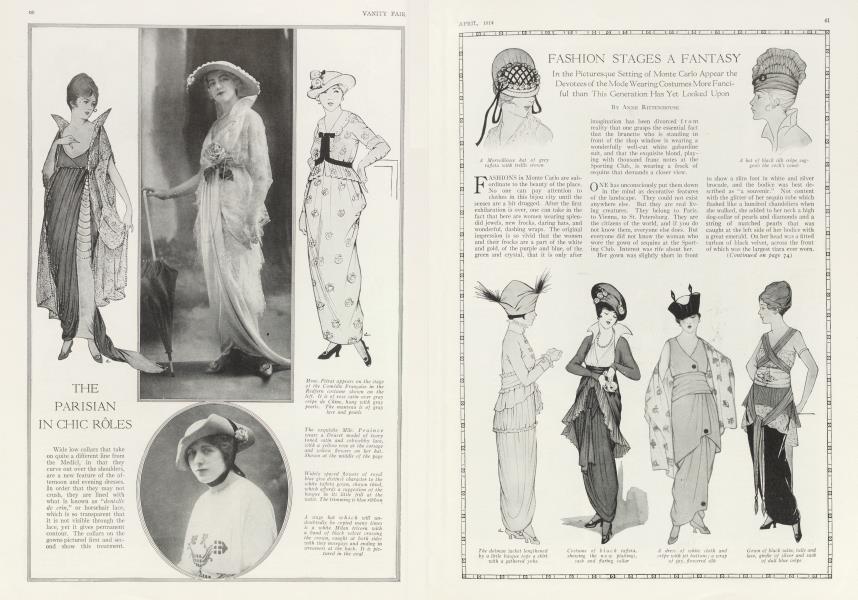
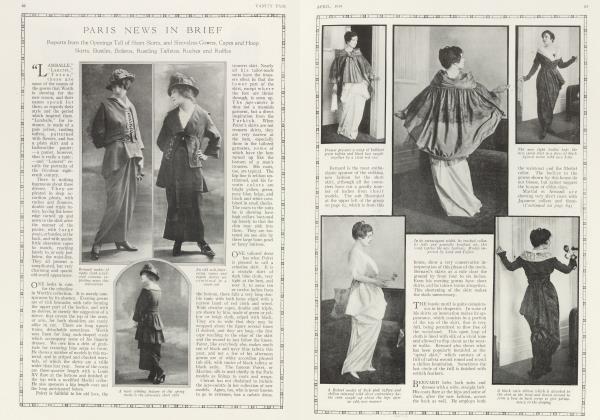
THE southern season is essentially a white one— white taffeta predominates, although there are a few tailor-made gowns of white broadcloth. Of the latter one stood out particularly from the rest. It is pictured second to the right on page 61. It was of whiten cloth with the skirt draped over in front, and fastened with a large jet button, the tunic following the same line. The hips were swathed in a draped belt to give the new long-waisted effect. The short bolero was very novel in that it had a sack back and transparent white tulle sleeves.
Continued on page 86
Continued from page 74
ANOTHER attractive frock worn one night at the Sporting Club, was of white satin made with a short skirt, tucked up at the back, and a low blouse of white lace and chiffon which was hidden at the back by a swinging, gathered Neapolitan cape of flowered chiffon edged with marabou. The shoulder straps were of marabou, and there was an immense marabou muff to match.
THESE short, full capes are among the novelties of the season. Madame Cheruit introduced them last August at Deauville on afternoon gowns, but they were not pronounced. In truth, her capes were merely a suggestion of those of to-day. The modern garment is exploited in various lengths, fabrics, and colors. One sees it night and day at Monte Carlo. Here will come a slim figure down the white steps back of the Hotel Metropole, which are decidedly Italian in appearance, wearing a regulation Neapolitan coat, such as the carabineers wear in Italy. Its dark blue cloth folds hang nearly to her ankles and the right side is thrown carelessly over the left shoulder, half muffling her chin. It is the right note in the right place, for there is something strongly reminiscent of Naples and Venice in these stretches of steps bordered with terraces of stone and cypress.
THAT night at the Casino, where you can play with silver instead of gold, there appeared an evening gown of white satin with a jeweled belt of crystals and emeralds, which was ornamented with a swinging cape of white chiffon heavily embroidered in discs of crystals and brilliants. Earlier in the evening a woman who was dining at the Hotel de Paris wore over her bare shoulders a Neapolitan cape of orange chiffon, faced with a five-inch ribbon of brown velvet which toned in well with her frock of golden brown tulle, with a huge topaz catching its draperies at the waist.
THE same afternoon a woman in a motor car wore two capes made in one. The cloth was golden brown and the collar was of sable. This is quite enough to give an idea of the popularity of the Neapolitan cape. The smartest of French women are wearing it and the best of dressmakers are showing it, and by this time probably America has seen it and made up its mind as to its suitability for the American climate. The dressmakers have been very clever in utilizing the idea for evening gowns. It gives a high neck in the back and a slight covering to the arms, and is a far more graceful bit of drapery than the ordinary scarf. When it is attached to a house gown it is transparent and made of rich embroidery or hand-painted or figured fabrics. Chiffon with great roses hand-painted on it is a fabric favored for this purpose.
A LOVELY costume of Ottoman silk in a red-violet tone, pictured on page 61, had a skirt of a new type. It was, if anything, tighter than many of the skirts we have seen this winter, and it had no freedom-giving slash. The upper part, round the hips, which was very full, was set into a gathered heading, so that it gave somewhat the impression of a tunic. Here again the coat was short, but it was by no means a bolero. It was more like the dolman jacket of our ancestors, tightly buttoned from the waist to the neck in front by black silk brandenburgs, and flowing out in a short basque.
Subscribers have complete access to the archive.
Sign In Not a Subscriber?Join Now

