Sign In to Your Account
Subscribers have complete access to the archive.
Sign In Not a Subscriber?Join NowWHISPERS FROM THE WINGS
Concerning a Song Which Has Helped Elsie Janis in London, Its Prolific Composer, and Other People of the Theatre
Acton Davies
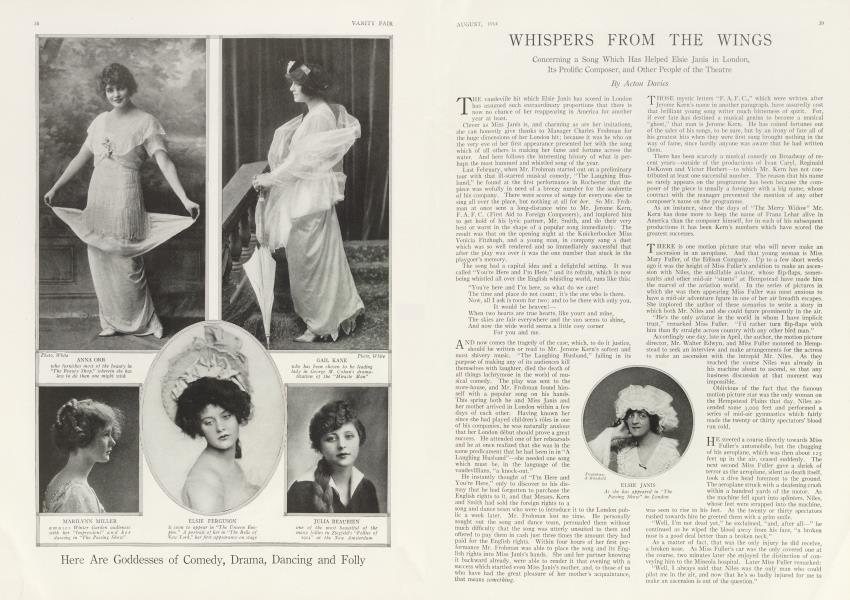
THE vaudeville hit which Elsie Janis has scored in London has assumed such extraordinary proportions that there is now no chance of her reappearing in America for another year at least.
Clever as Miss Janis is, and charming as are her imitations, she can honestly give thanks to Manager Charles Frohman for the huge dimensions of her London hit; because it was he who on the very eve of her first appearance presented her with the song which of all others is making her fame and fortune across the water. And here follows the interesting history of what is perhaps the most hummed and whistled song of the year.
Last February, when Mr. Frohman started out on a preliminary tour with that ill-starred musical comedy, "The Laughing Husband," he found at the first performance in Rochester that the piece was wofully in need of a breezy number for the soubrette of his company. There were scores of songs for everyone else to sing all over the place, but nothing at all for her. So Mr. Frohman at once sent a long-distance wire to Mr. Jerome Kern, F. A. F. C. (First Aid to Foreign Composers), and implored him to get hold of his lyric partner, Mr. Smith, and do their very best or worst in the shape of a popular song immediately. The result was that on the opening night at the Knickerbocker Miss Venicia Fitzhugh, and a young man, in company sang a duet which was so well rendered and so immediately successful that after the play was over it was the one number that stuck in the playgoer's memory.
The song had a capital idea and a delightful setting. It was called "You're Here and I'm Here," and its refrain, which is now being whistled all over the English whistling world, runs like this:
"You're here and I'm here, so what do we care!
The time and place do not count; it's the one who is there. Now, all I ask is room for two; and to be there with only you. It would be heaven! —
When two hearts are true hearts, like yours and mine,
The skies are fair everywhere and the sun seems to shine, And now the wide world seems a little cosy corner For you and me.
AND now comes the tragedy of the case, which, to do it justice, should be written or read to Mr. Jerome Kern's softest and most shivery music. "The Laughing Husband," failing in its purpose of making any of its audiences kill themselves with laughter, died the death of all things lachrymose in the world of musical comedy. The play was sent to the store-house, and Mr. Frohman found himself with a popular song on his hands.
This spring both he and Miss Janis and her mother arrived in London within a few days of each other. Having known her since she had played children's roles in one of his companies, he was naturally anxious that her London debut should prove a great success. He attended one of her rehearsals and he at once realized that she was in the same predicament that he had been in in "A Laughing Husband"—she needed one song which must be, in the language of the vaudevillians, "a knock-out."
He instantly thought of "I'm Here and You're Here," only to discover to his dismay that he had forgotten to purchase the English rights to it, and that Messrs. Kern and Smith had sold the foreign rights to a song and dance team who were to introduce it to the London public a week later. Mr. Frohman lost no time. He personally sought out the song and dance team, persuaded them without much difficulty that the song was utterly unsuited to them and offered to pay them in cash just three times the amount they had paid for the English rights. Within four hours of her first performance Mr. Frohman was able to place the song and its English rights into Miss Janis's hands. She and her partner knowing it backward already, were able to render it that evening with a success which startled even Miss Janis's mother, and, to those of us who have had the great pleasure of her mother's acquaintance, that means something.
THOSE mystic letters "F. A. F. C.," which were written after Jerome Kern's name in another paragraph, have assuredly cost that brilliant young song writer much bitterness of spirit. For, if ever fate has destined a musical genius to become a musical "ghost," that man is Jerome Kern. He has coined fortunes out of the sales of his songs, to be sure, but by an irony of fate all of his greatest hits when they were first sung brought nothing in the way of fame, since hardly anyone was aware that he had written them.
There has been scarcely a musical comedy on Broadway of recent years—outside of the productions of Ivan Caryl, Reginald DeKoven and Victor Herbert—to which Mr. Kern has not contributed at least one successful number. The reason that his name so rarely appears on the programme has been because the composer of the piece is usually a foreigner with a big name, whose contract with the manager prevented the mention of any other composer's name on the programme.
As an instance, since the days of "The Merry Widow" Mr. Kern has done more to keep the name of Franz Lehar alive in America than the composer himself, for in each of his subsequent productions it has been Kern's numbers which have scored the greatest successes.
THERE is one motion picture star who will never make an ascension in an aeroplane. And that young woman is Miss Mary Fuller, of the Edison Company. Up to a few short weeks ago it was the height of Miss Fuller's ambition to make an ascension with Niles, the unkillable aviator, whose flip-flaps, somersaults and other mid-air "stunts" at Hempstead have made him the marvel of the aviation world. In the series of pictures in which she was then appearing Miss Fuller was most anxious to have a mid-air adventure figure in one of her air breadth escapes. She implored the author of these scenarios to write a story in which both Mr. Niles and she could figure prominently in the air.
"He's the only aviator in the world in whom I have implicit trust," remarked Miss Fuller. "I'd rather turn flip-flaps with him than fly straight across country with any other bird man."
Accordingly one day, late in April, the author, the motion picture director, Mr. Walter Edwyn, and Miss Fuller motored to Hempstead to seek an interview and make arrangements for the actress to make an ascension with the intrepid Mr. Niles. As they reached the course Niles was already in his machine about to ascend, so that any business discussion at that moment was impossible.
Oblivious of the fact that the famous motion picture star was the only woman on the Hempstead Plains that day, Niles ascended some 3,000 feet and performed a series of mid-air gymnastics which fairly made the twenty or thirty spectators' blood run cold.
HE steered a course directly towards Miss Fuller's automobile, but the chugging of his aeroplane, which was then about 125 feet up in the air, ceased suddenly. The next second Miss Fuller gave a shriek of terror as the aeroplane, silent as death itself, took a dive head foremost to the ground. The aeroplane struck with a deafening crash within a hundred yards of the motor. As the machine fell apart into splinters, Niles, whose feet were strapped into the machine, was seen to rise to his feet. As the twenty or thirty spectators rushed towards him he greeted them with a grim smile.
"Well, I'm not dead yet," he exclaimed, "and, after all—" he continued as he wiped the blood away from his face, "a broken nose is a good deal better than a broken neck."
As a matter of fact, that was the only injury he did receive, a broken nose. As Miss Fuller's car was the only covered one at the course, two minutes later she enjoyed the distinction of conveying him to the Mineola hospital. Later Miss Fuller remarked:
"Well, I always said that Niles was the only man who could pilot me in the air, and now that he's so badly injured for me to make an ascension is out of the question."
Subscribers have complete access to the archive.
Sign In Not a Subscriber?Join Now