Sign In to Your Account
Subscribers have complete access to the archive.
Sign In Not a Subscriber?Join NowTHE MAP OF EUROPE, IN 1915
Frederick James Gregg
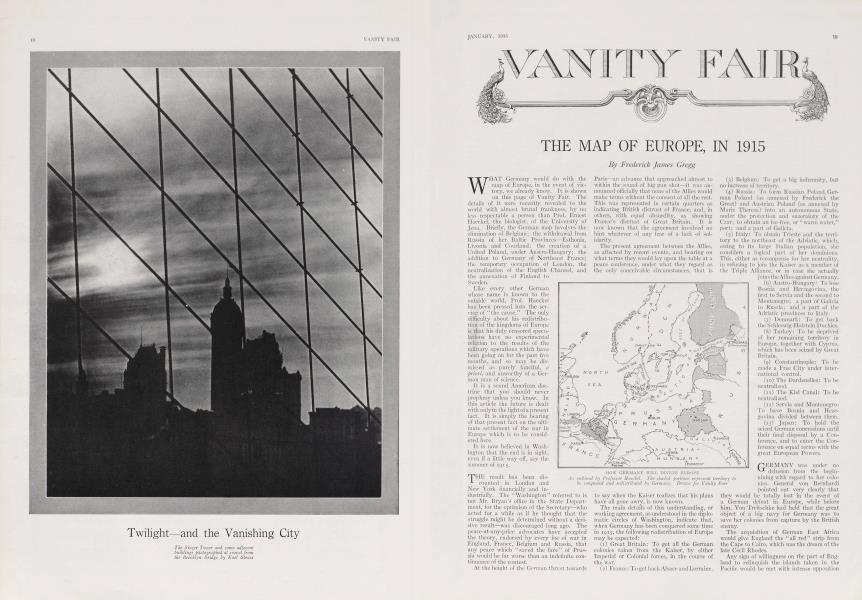
WHAT Germany would do with the map of Europe, in the event of victory, we already know. It is shown on this page of Vanity Fair. The details of it were recently revealed to the world with almost brutal frankness, by no less respectable a person than Prof. Ernest Haeckel, the biologist, of the University of Jena. Briefly, the German map involves the elimination of Belgium; the withdrawal from Russia of her Baltic Provinces—Esthonia, Livonia and Courland: the creation of a United Poland, under Austro-Hungary; the addition to Germany of Northeast France; the temporary occupation of London, the neutralization of the English Channel, and the annexation of Finland to Sweden.
Like every other German whose name is known to the outside world, Prof. Haeckel has been pressed into the service of "the cause." The only difficulty about his redistribution of the kingdoms of Europe is that his duly censored speculations have no experimental relation to the results of the military operations which have been going on for the past five months, and so may be dismissed as purely fanciful, a priori, and unworthy of a German man of science.
It is a sound American doctrine that you should never prophesy unless you know. In this article the future is dealt with only in the light of a present fact. It is simply the bearing of that present fact on the ultimate settlement of the war in Europe which is to be considered here.
It is now believed in Washington that the end is in sight, even if a little way off, say the summer of 1915.
THE result has been discounted in London and New York financially and industrially. The "Washington" referred to is not Mr. Bryan's office in the State Department, for the optimism of the Secretary—who acted for a while as if he thought that the struggle might be determined without a decisive result—was discouraged long ago. The peace-at-any-price advocates have accepted the theory, endorsed by every foe of war in England, France, Belgium and Russia, that any peace which "saved the face" of Prussia would be far worse than an indefinite continuance of the contest.
At the height of the German thrust towards Paris—an advance that approached almost to within the sound of big gun shot—it was announced officially that none of the Allies would make terms without the consent of all the rest. This was represented in certain quarters as indicating British distrust of France, and, in others, with equal absurdity, as showing France's distrust of Great Britain. It is now known that the agreement involved no hint whatever of any fear of a lack of solidarity.
The present agreement between the Allies, as affected by recent events, and bearing on What terms they would lay upon the table at a peace conference, under what they regard as the only conceivable circumstances, that is to say when the Kaiser realizes that his plans have all gone awry, is now known.
The main details of this understanding, or working agreement, as understood in the diplomatic circles of Washington, indicate that, when Germany has been conquered some time in 1915, the following redistribution of Europe may be expected:
(1) Great Britain: To get all the German colonies taken from the Kaiser, by either Imperial or Colonial forces, in the course of the war.
(2) France: To get back Alsace and Lorraine.
(3) Belgium: To gel a big indemnity, but no increase of territory.
(4) Russia: To form Russian Poland,German Poland (as annexed by Frederick the Great) and Austrian Poland (as annexed by Marie Theresa) into an autonomous State, under the protection and suzerainty of the Czar; to obtain an ice-free, or "warm water," port; and a part of Galicia.
(5) Italy: To obtain Trieste and the territory to the northeast of the Adriatic, which, owing to its large Italian population, she considers a logical part of her dominions. This, either as recompense for her neutrality, in refusing to join tin1 Kaiser as a member of the Triple Alliance, or in case she actually joins the Allies against Germany.
(6) Austro-Hungary: To lose Bosnia and Herzegovina, the first to Servia and the second to Montenegro; a part of Galicia to Russia; and a part of the Adriatic provinces to Italy.
(7) Denmark: To get back the Schleswig-Holstein Duchies.
(8) Turkey: To be deprived of her remaining territory in Europe, together with Cyprus, which has been seized by Great Britain.
(9) Constantinople: To be made a Free City under international control.
(10) The Dardenelles: To be neutralized.
(11) The Kiel Canal: To be neutralized.
(12) Servia and Montenegro: To have Bosnia and Hezegovina divided between them.
(13) Japan: To hold the seized German concessions until their final disposal by a Conference, and to enter the Conference on equal terms with the great European Powers.
GERMANY was under no delusion from the beginnining with regard to her colonies. General von Bernhardi pointed out very clearly that they would be totally lost in the event of a German defeat in Europe, while before him, Von Treitschke had held that the great object of a big navy for Germany was to save her colonies from capture by the British enemy.
The acquisition of German East Africa would give England the "all red" strip from the Cape to Cairo, which was the dream of the late Cecil Rhodes.
Any sign of willingness on the part of England to relinquish the islands taken in the Pacific would be met with intense opposition in Australia, the forces of which were instrumental in their capture.
That to France the recovery of Alsace and Lorraine was a sine qua non, and a passionate determination, was indicated by the reckless haste with which the troops of the French Republic were poured into that region at the beginning of the war, at a time when, as it turned out, neither the English nor the French were yet in a position to back up the Belgians in their retarding opposition to the German right wing. This occupation of Alsace is now believed to have been prompted by popular or political, rather than by military, considerations.
The cession of any added territory to Belgium would be bound to upset the equilibrium of political ]dirties in that country, which is divided, almost equally, between the French-speaking and the Flemish-speaking populations, now united, as never before, in cordial opposition to an external enemy, and unalter, ably attached to the idea of Belgian nationality. Besides, one of the objects of the Allies is to bring to an end the system, or rather lack of system, under which men in Europe have been forced to take the field, because of the fact of territorial jurisdiction, against those speaking the same language as themselves and belonging to the same race. Frenchmen forced to serve in the army of Germany; Italians and .Serbs compelled to light under the Austrian colors, and in the Eastern struggle—Poles made to face other Poles, are examples of this unnatural state of affairs which is the result of old wars of conquest and subjugation, without regard to any ethnological considerations whatever.
THE old British dread of allowing Russia to have an outlet by sea, which was the mainspring of Disraelian diplomacy, caused the Powers, at the Berlin Congress, to deprive her of the fruits of victory won in the war with Turkey. This drove the Czars to try to accomplish their purpose by way of the Far East, only to be blocked again by Japanese opposition. Since the Portsmouth Peace Conference, Russia, Great Britain and Japan have been in the best of reciprocal treaty relations. For the mass of Englishmen, even those carrying on the Victorian Tory tradition, the Muscovite bogy has been laid, and "the bear that walks like a man" is no longer, or not for the time being at least, an object of distrust in the passes to the north of India.
As a revolution in Austro-Hungary had been expected in the event of the death of the old Emperor, it is not unreasonable to suppose that defeat will hasten the destruction of the Empire brought into existence by Napoleon I, who found the continuance of the Holy Roman Empire of the Hapsburgs incompatible with his magniloquent ideas on the subject of the "Empire of the French" that he had set up, with Paris for its centre.
There will be no dispute between Montenegro and Servia as to their respective shares of territory. It was for years the policy of Austria to stimulate enmity between them. In addition the dual monarchy of Franz Josef insisted on the maintenance of a dividing strip of territory. The Balkan war with Turkey did away Ith that and brought these kinsmen definitely together, so that last year the Montenegrin Assembly formally passed a resolution to the effect that it stood for whatever its fellow Serbs in Servia desired. These turbulent Balkans can hardly be expected to regret that it was a Serb protest against a direct slight to racial prejudices—the interference with a nationalist celebration by the heir to the Austrian throne—which was the immediate cause of his assassination. 'This was the assassination which furnished the excuse for the Austrian ultimatum to Servia—approved of by Berlin—which led to the World War.
No suggestion could be more absurd than that the majority of the Allies desire the disintegration of Germany. It would be poor economics to impose a huge money fine on that Empire and, at the same time, so ruin her as to make it impossible for her to pay it. Besides, France and England may well consider that United Germany may be needed as a buffer towards Russia. Only the hotheads commit themselves to the barbarous theory of Ddcnda est Germania! a sentiment that is no more to be justified than the Teutonic sentiments, "France must go," and "England must go."
Besides, the enemies of to-day may be the friends of to-morrow, and the other way about. You may upset a dynasty which has committed a country to a dangerous course of policy—France learned that lesson when an: other set of Allies made St. Helena famous as a royal place of residence—but it is impossible to wipe out a nation. You may kill a man, but you cannot kill an idea, and nationality is the most vital sort of idea. There are no multitidinous stockings in Germany to give up their hoards, like those of France, which astonished ' Bismarck after 1871, and made him regret that he had not demanded twice as much as he asked for, and got, in the way of indemnity.
If Germany is kept busy for years to come ■ with the job of recovering the solvency which i she has lost through the great but tragical adI venture forced upon her by her military class, she may be left to herself to decide on the desirability or undesirability of keeping up such a war machine as that which turned out, in practise, to be quite different from what was expected. It is even likely that she may be compensated for the loss of her Polish subjects in the East, and her French subjects In the West, by the addition of some millions of German-speaking people who will desire to break away from the ruins of Austro-Hungary.
AND now let us ask: when is the beginning of the end of any war in sight? Surely,—unless the nation, or nations, which began it, are under the control of a madman,—when every object which prompted it has failed of realization. The drive at Paris failed, in spite of the exhortation and command to "get the city, or die." The Germans died, but they did not get the city. Again, the attempt to obtain possession of the coast of the Channel failed, once more in spite of the Imperial "you must." The Russians, who were to be met by victorious armies flushed from a parade through the Champs Elysees, were faced, instead, by troops many of whom had been astonished to find themselves opposed to an impregnable line of French and English in Flanders, and who had learned to respect the claws of the Belgian lion. Every German calculation was upset. British, French, and Russian internal political dissensions vanished before the " German peril." The Kaiser found himself, to his astonishment—he has expressed it himself, and his heir has echoed his words—with only one active friend in Europe—outside of Austria—and that the "unspeakable Turk." Even strict neutrals, who, out of politeness, took no sides in the struggle, took such an active and sympathetic interest in the troubles of Belgium that their behaviour was virtually an open condemnation of German military policy.
BERNHARDI'S plans of campaign provided for no war of defense such as has been made necessary for the Germans by the untoward course of events. The push back, East and West, prevented, except in the case of the Belgians, the putting in practise of the delicate Treitschke scheme for making the war pay for itself by huge levies on every square inch of foreign territory occupied by the forces of the Fatherland, Instead of acting as joyous bill collectors the Junkers have been worried by the peril to which their East Prussian manor houses were exposed from the on-coming Cossacks. The German bankers who had been held up by the heels while the cash was shaken out of their clothes have continued to contribute, sending good money after bad, firstly, because they had to, and secondly because they were informed that they might as well be cheerful about it, if they wanted to get any of their money back.
But, it may be asked, why should Lord Kitchener be actively preparing for a fight of many years' duration, if the end is really in sight? Why should he be intent on placing with the colors an army of two million men, if the betting at Lloyd's Is even the war will be over by money that July i, 1915?
It is obvious that the head of the English war office is preoccupied as much by the problem of ultimate settlement as by the present operations in the field. It is like the case of our old friend Li Hung Chang, who, when he was invited on a certain occasion, to go to Peking, replied that he would be delighted— if he could take his troops with him. Even in the case of a war waged on the highest moral grounds it is just as well to be backed up by the prestige that comes, not merely from the possession of unlimited financial resources and a big fleet, but from having an adequate land force, both present and prospective, at your disposal.
THE slowness of the public mind in this war has been shown in nothing more than In its failure to grasp the true function ot a great and conquering fleet. Treitschke advocated a powerful navy for Germany—not for the purpose of deciding a war, which he regarded as impossible—but "as a protection of a country's merchant marine and colonies."
Well, what happened in Europe? Within a week of the declaration of war by Great Britain, the French squadrons were released from all responsibility, as far as the English Channel was concerned, and left free to operate in the Mediterranean; the Kaiser's fleet was bottled up; within three weeks, the Kaiser's merchant marine, built up at an infinite cost, disappeared from the seas, and the Atlantic was made as safe for the conveyance of contraband supplies to the Allies as is the Hudson river in summer for the traffic of excursion boats. It is true that a few German cruisers, manned by brilliant captains and gallant crews, continued to terrorize restricted areas of the sea. But they were more a cause of irritation than anything else. They created no such dismay as Capt. Paul Jones did when he threw the British coast into convulsions. It is also true that isolated German submarines have been managed with incomparable skill, and have struck effectual blows, galling to Anglican pride. But the fact remains that, through the placing of new ships in commission, the chief navy of the Allies has been continually growing in usefulness.
And now what is the lesson for America, and, particularly the naval lesson; the lesson on the high seas? How will the terms of peace affect America and Americans? The answer is that it will affect us only remotely, and then, of course, chiefly as a problem for our Navy Department. It will be wise for us all to remember that Treitschke closes his great essay on "The Army" with this remark: "The importance of any people will finally depend on the share it takes in the rule of the trans-Atlantic world. It is on account of this fact, that the importance of a fleet has so largely increased during our day."
Was Treitschke thinking of the Monroe Doctrine?
Subscribers have complete access to the archive.
Sign In Not a Subscriber?Join Now
