Sign In to Your Account
Subscribers have complete access to the archive.
Sign In Not a Subscriber?Join NowWHEN LOVELY WOMAN STOOPS TO LETTERS
Henry Brinsley
STRATTON-PORTER
(With apologies to Rossetti)
Oh have you read the Stratton flood
That burst the press to-day?
You mustn't call it prose, Lord Sands,
It's simply new mown hay.
SECOND later Douglas Bruce [sometime stroke of the Oxford Varsity eight] entered and rushing across, caught Leslie to his breast roughly and with a strong hand pressed her ear against his heart.
"'I love you, Leslie! Every beat, every stroke, love for you. I claim you! My mate! My wife! I want you! '
"He held her from him and looked into her eyes.
"'Now Leslie, the answer!' he cried. 'May I listen to it or will you tell me? Is there any answer? What is your heart saying? May I hear or will you tell me?' [the "me" is to be pronounced "meh," throughout].
"'I want to tell you!' said the girl. 'I love you, Douglas! Every beat, every stroke, love for you. I want you! I claim you!'
[Presently they proceed to gather wild flowers.] "Farther! Let us go farther!" she urged.
"Her cry closed the man's arms around her.
"'Oh my Heavenly Father!' breathed the girl.
"'Dear Lord!' said Douglas.
[Presently a wild-bird sings.] "'But don't you recognize it?' she cried.
"'It does seem familiar, but I am not sufficiently schooled in music—'" etc., etc.
—No, my favorite authoress, Miss Libbey, did not write this, nor Mrs.
Florence Barclay, nor Miss Mildred Champagne, nor any of the tender lutanists who have plucked at my heart-strings so long.
No, a new lutanist with more searching fingers has plucked a wilder note from my innermost being —a new star has arisen beside whose quivering refulgence these lesser lights pale—a new flower in the field of letters has sprung up in a night and twined its exquisitely scented tendrils round my critical gorge with so thrilling a clutch that I sit helpless with blurred eyes and cease to struggle. Need I say that I refer to Mrs. Gene .Stratton-Porter, whose new novel, "Mickey O'Halloran," will sell, like her last one, "Laddie," in the millions, will gladden the heart of the Great American People, will denude whole forests in its manufacture, and will, undoubtedly, like all of Mr. Hall Caine's transcendent fiction, be translated even into Japanese. Thoughts like these fill me with awe. For it's a glad-book, a joy-book (even if another lady writer has copyrighted these terms as a trade-mark), and, oh! it's a NatureBook, full of the love of flowers which Mrs. Stratton-Porter caresses with such loving fingers that poor Thoreau must turn nightly in his lonely Walden grave, grieving that he did not live to see Nature handled with this reverent, vibrant care.
And lovers of children (who of us is not one?) will weep over little Mickey, the newsboy, and Peaches, the little cripple whom he guards with such manful tenderness. " Dearest lady," says Mickey, who has lived all his brief life on the streets of "Multiopolis" (a pleasant, natureloving mingling of Latin and Greek roots)— "Dearest lady, when you see a little white girl that hasn't ever walked, smiling up at you shy and timid, like a baby-bird peeping from under a leaf, you'll just pick her up tender and lay her on your heart, and you'll want to stick to her just like I do." Surely Paul Dombey, Little Nell, Little Eva, all the children one has hitherto so loved, never in their most lyric moments talked with such a tender beauty of feeling 'neath the seemingly rough phrase.—I cannot tell you the plot of "Mickey O'Halloran"; I cannot criticize the book, for criticism is an impertinence in the face of a novel that will sell in the millions; I can only try to give you some idea of its flavor, a flavor that has hung round me for several days now, like a benediction.
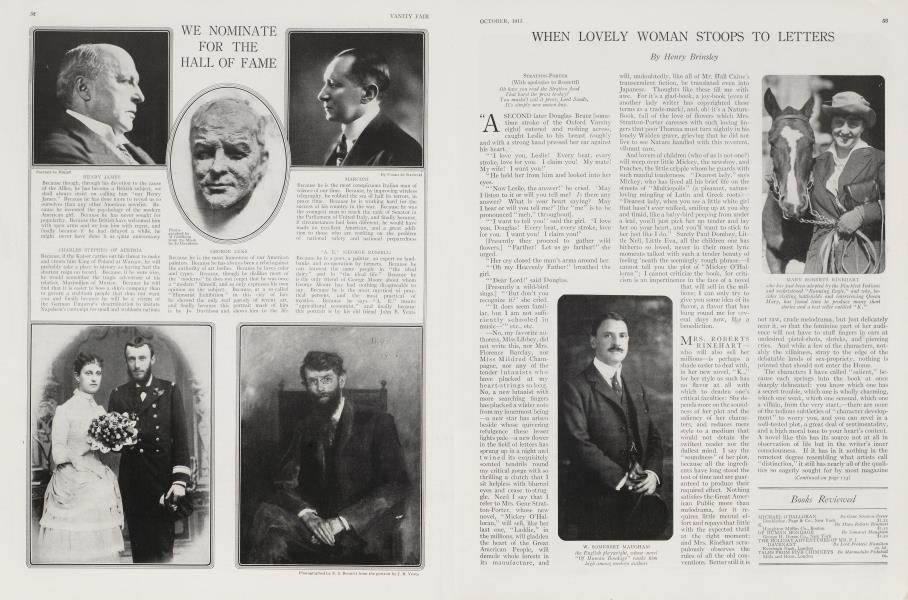
MRS. ROBERTS RINEHART — who will also sell her millions—is perhaps a shade easier to deal with, in her new novel, "K.," for her style as such has no flavor at all with which to deaden one's critical faculties: She depends more on the soundness of her plot and the saliency of her characters, and reduces mere style to a medium that would not detain the swiftest reader nor the dullest mind. I say the "soundness" of her plot, because all the ingredients have long stood the test of time and are guaranteed to produce their required effect. Nothing satisfies the Great American Public more than melodrama, for it requires little mental effort and repays that little with the expected thrill at the right moment: and Mrs. Rinehart scrupulously observes the rules of all the old conventions. Better still it is not raw, crude melodrama, but just delicately near it, so that the feminine part of her audience will not have to stuff fingers in ears at undesired pistol-shots, shrieks, and piercing cries. And while a few of the characters, notably the villainess, stray to the edge of the debatable lands of sex-propriety, nothing is printed that should not enter the Home.
The characters I have called "salient," because each springs into the book at once sharply delineated: you know which one has a secret trouble, which one is wholly charming, which one weak, which one sensual, which one a villain, from the very start,—there are none of the tedious subtleties of " character development" to worry you, and you can revel in a well-tested plot, a great deal of sentimentality, and a high moral tone to your heart's content. A novel like this has its source not at all in observation of life but in the writer's inner consciousness. If it has in it nothing in the remotest degree resembling what artists call "distinction," it still has nearly all of the qualities so eagerly sought for by most magazine editors, by all up-to-date publishers, and, subsequently, by the great, and very wonderful, American reading public. (The singularly ugly page headings of the book make me feel that of late some strangely "artistic" soul has been playing pranks with the publishers.)
Continued on page 114
Continued from page 53
MR. SOMERSET MAUGHAM, the successful playwright, challenges astonished attention with his new novel "Of Human Bondage,"—the most wholly admirable fiction I have read since Mr. Conrad's "Victory." The study of a youth from the age of ten to thirty, it falls into the same genre with Mr. Mackenzie's brilliant but blighted "Sinister Street" and Mr. Beresford's warmly sympathetic but somewhat fumbled "Jacob Stahl." There is nothing blighted or fumbled about "Of Human Bondage," and if it is done with a style of less immediately obvious distinction than the one and less surface warmth than the other, it shows a quiet mastery, a steadiness and sureness of touch that keeps its own fine level far more consistently. Little in the book, other than its philosophic poise, gives the effect of springing from the writer's inner consciousness; rarely in fiction does one get, as from Mr. Maugham, so vivid an effect of things keenly "observed" in their three dimensions.
The novel swarms with people and places: the country vicar and his wife, the denizens of a German pension, the clerks of a London counting-house, students in the Latin Quarter of Paris—there is an astonishing richness of portraiture, with Philip always in focus among his fortuitous associates, guardians, tutors, employers, mistresses, friends, and all equally real, obsessingly alive. I have not seen so richly full, so crowded a canvas, since Mr. Dreiser's "Titan"; but while Mr. Dreiser's work is in little more than grisaille, Mr. Maugham's is in full color, and while Mr. Dreiser's effect is, to me at least, static, Mr. Maugham's is to a degree dynamic. In short, "Of Human Bondage" is immensely stimulating. And although in reading so large a book it is difficult to apperceive an underlying beauty of design, in retrospect the pattern grows clearer and its success more and more cumulative. There is only Mr. Maugham's deliberate personal reticence, his quietly guarded air of detachment, slightly to wonder at.
LORD FREDERIC HAMILTON has written a delightful little book of detective stories called "The Holiday Adventures of Mr. P. J. Davenant," the proceeds of which are to go to the Marchioness of Lansdown's "Officers' Families Fund." The tales concern a gentleman serving during the war as an Assistant Commissioner at Scotland Yard, who enlists "P. J.," an English schoolboy, as his junior aide. Together, but chiefly owing to P. J.'s singular knack for the work, they ferret out a number of plots and bring to book a gang of German spies. The stories are very ingenious little things, and P. J. is drawn with much charm. It's amusing to see Lord Frederic endow him with several overpersistent mannerisms analogous to those of Sherlock Holmes, but at the same time he never forgets to keep him sheer boy. That he is preternaturally clever is, if a trifle disconcerting, a permissible convention in this kind of story. The book as a whole is a light affair, but one of exceptionally clean workmanship,— pleasantly interesting and thoroughly engaging.
"TALES FROM FIVE CHIMNEYS," by Mr. Marmaduke Pickthall, will notably appeal to those who have traveled in the near East, because of the author's intimate knowledge of the Mohammedan mind, his alert eye for native color, his keen dramatic sense, and his gift of clear, neat, swiftly-moving style. His stories, especially the oriental ones which comprise the first half of the collection, have a definiteness and sureness of effect that rank them well above the average.
Subscribers have complete access to the archive.
Sign In Not a Subscriber?Join Now
