

Sign In to Your Account
Subscribers have complete access to the archive.
Sign In Not a Subscriber?Join NowA MIRACLE AMONG GOLF COURSES
The Lido, a New and Remarkable Links. With Hitherto Unpublished Photographs
Eugene Barrington
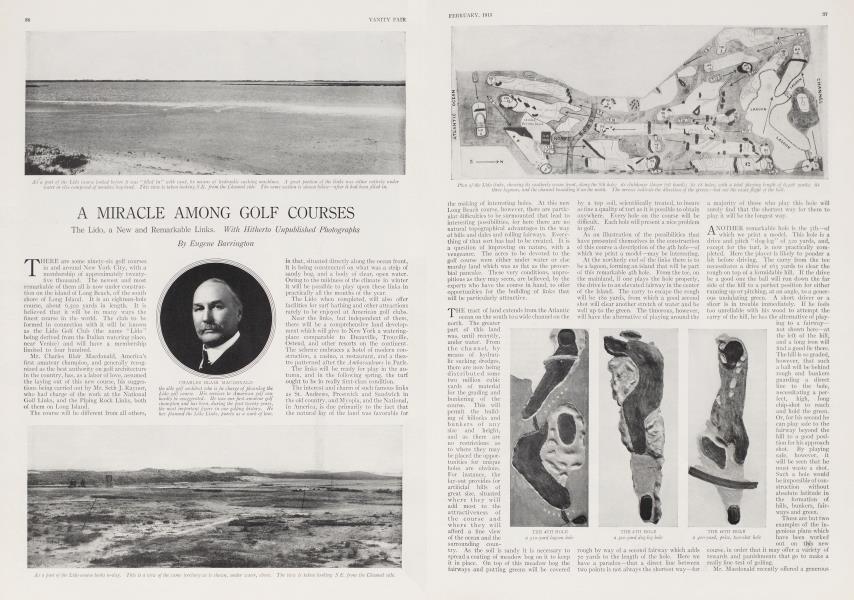
THERE are some ninety-six golf courses in and around New York City, with a membership of approximately twentyfive thousand. The newest and most remarkable of them all is now under construction on the island of Long Beach, off the south shore of Long Island. It is an eighteen-hole course, about 6,500 yards in length. It is believed that it will be in many ways the finest course in the world. The club to be formed in connection with it will be known as the Lido Golf Club (the name "Lido" being derived from the Italian watering place, near Venice) and will have a membership limited to four hundred.
Mr. Charles Blair Macdonald, America's first amateur champion, and generally recognized as the best authority on golf architecture in the country, has, as a labor of love, assumed the laying out of this new course, his suggestions being carried out by Mr. Seth J. Raynor, who had charge of the work at the National Golf Links, and the Piping Rock Links, both of them on Long Island.
The course will be different from all others, in that, situated directly along the ocean front, it is being constructed on what was a strip of sandy bog, and a body of clear, open water. Owing to the mildness of the climate in winter it will be possible to play upon these links in practically all the months of the year.
The Lido when completed, will also offer facilities for surf bathing and other attractions rarely to be enjoyed at American golf clubs.
Near the links, but independent of them, there will be a comprehensive land development which will give to New York a wateringplace comparable to Deauville, Trouville, Ostend, and other resorts on the continent. The scheme embraces a hotel of modern construction, a casino, a restaurant, and a theatre patterned after the Ambassadeurs in Paris.
The links will be ready for play in the autumn, and in the following spring, the turf ought to be in really first-class condition.
The interest and charm of such famous links as St. Andrews, Prestwick and Sandwich in the old country, and Myopia, and the National, in America, is due primarily to the fact that the natural lay of the land was favorable for the making of interesting holes. At this new Long Beach course, however, there are particular difficulties to be surmounted that lead to interesting possibilities, for here there are no natural topographical advantages in the way of hills and dales and rolling fairways. Everything of that sort has had to be created. It is a question of improving on nature, with a vengeance. The acres to be devoted to the golf course were either under water or else marshy land which was as flat as the proverbial pancake. These very conditions, unpropitious as they may seem, are believed, by the experts who have the course in hand, to offer opportunities for the building of links that will be particularly attractive.
THE tract of land extends from the Atlantic ocean on the south to a wide channel on the north. The greater part of this land was, until recently, under water. From the channel, by means of hydraulic sucking dredges, there are now being distributed some two million cubic yards of material for the grading and bunkering of the course. This will permit the building of hillocks and bunkers of any size and height, and as there are no restrictions as to where they may be placed the opportunities for unique holes are obvious.
For instance, the lay-out provides for artificial hills of great size, situated where they will add most to the attractiveness of the course and where they will afford a fine view of the ocean and the surrounding country. As the soil is sandy it is necessary to spread a coating of meadow bog on it to keep it in place. On top of this meadow bog the fairways and putting greens will be covered
by a top soil, scientifically treated, to insure as fine a quality of turf as it is possible to obtain anywhere. Every hole on the course will be difficult. Each hole will present a nice problem in golf.
As an illustration of the possibilities that have presented themselves in the construction of this course a description of the 4th hole—of which we print a model—may be interesting.
At the northerly end of the links there is to be a lagoon, forming an island that will be part of this remarkable 4th hole. From the tee, on the mainland, if one plays the hole properly, the drive is to an elevated fairway in the center of the island. The carry to escape the rough will be 180 yards, from which a good second shot will clear another stretch of water and be well up to the green. The timorous, however, will have the alternative of playing around the rough by way of a second fairway which adds 70 yards to the length of the hole. Here we have a paradox—that a direct line between two points is not always the shortest way—for a majority of those who play this hole will surely find that the shortest way for them to play it will be the longest way.
ANOTHER remarkable hole is the 5th—of which we print a model. This hole is a drive and pitch "dog-leg" of 320 yards, and, except for the turf, is now practically completed. Here the player is likely to ponder a bit before driving. The carry from the tee necessitates a drive of 165 yards to clear the rough on top of a formidable hill. If the drive be a good one the ball will run down the far side of the hill to a perfect position for either running up or pitching, at an angle, to a generous undulating green. A short driver or a sheer is in trouble immediately. If he feels too unreliable with his wood to attempt the carry of the hill, he has the alternative of playing to a fairway— not shown here—at the left of the hill, and a long iron will find a good lie there. The hill is so graded, however, that such a ball will be behind rough and bunkers guarding a direct line to the hole, necessitating a perfect, high, long chip-shot to reach and hold the green. Or, for his second he can play safe to the fairway beyond the hill to a good position for his approach shot. By playing safe, however, it will be seen that he must waste a shot. Such a hole would be impossible of construction without absolute latitude in the formation of hills, bunkers, fairways and green.
These are but two examples of the ingenious plans which have been worked out on this new course, in order that it may offer a variety of rewards and punishments that go to make a really fine test of golfing.
Mr. Macdonald recently offered a generous prize (in English "Country Life") for the best design of a twoshot hole. The winning design is to be used, with some modifications, for the eighteenth hole of the Lido course. By referring to the model—which we print in this article—it will be seen that there are three different routes —left, center, and right —open to you as a driver, and all of them interesting. The direction and force of the wind will be an important factor in selecting your route. By way of the island—at the left—can get home in two, but the drive must be straight, for the island is not wide. The ground rises toward the end of the island, however, to stop a ball from running over into the sand beyond. The best course is, of course, a carry from the tee to the most advantageous point on the central fairway, a distance of 190 yards, and it will be noted that the drive must be mighty straight at that. As the prevailing winds in the summer months will be against the drive it is fair to assume that many a golfer will arrive at the eighteenth tee with a fair score, only to wind up with perhaps a six or seven for this ingeniously arranged and trapped hole. Even the redoubtable Edward Ray, with his long but sky-scraping drives, might, in a cross wind, find himself in a bit of trouble. The straight long drivers of a low ball will get their reward—drivers like the later Willie Anderson, of whom it is said that, on a bet, he once drove a dozen balls between two stakes set twenty feet apart and 200 yards from the tee.
The distances, in yards, of the holes on the Lido golf course are as follows: Hole 1, 375; 2, 405; 3, 160; 4, 510; 5, 320; 6, 466; 7, 440; 8, 220; 9, 340; 10, 400; 11, 390; 12, 420; 13, 300; 14, 130; 15, 400; 16, 190; 17, 540; 18, 400; total distance, 6,406 yards.
The line of play of the 220-yard eighth hole—of which we have no model to print here —is along the Atlantic ocean front, the beach being the hazard for a badly sliced ball. This golf hole will be beyond doubt the most expensive one in the world, as the ocean frontage necessary for its construction is valued at over two hundred thousand dollars.
Subscribers have complete access to the archive.
Sign In Not a Subscriber?Join Now

