Sign In to Your Account
Subscribers have complete access to the archive.
Sign In Not a Subscriber?Join NowTHE NEW ATTITUDE TOWARD RUSSIA
VANITY FAIR
Frederick James Gregg
THE strangest result of the Great War is the sudden disappearance of the Russian Bogy. Until the war Sweden, for example, was in constant dread of her neighbor. Then, the other day, there was the meeting of the three Scandinavian sovereigns at Malmo. Norway and Sweden—separated by a famous and peaceful revolution— are now, as a result of the meeting, more friendly than ever they were when united in unwilling and discordant matrimony. They have joined with the Danes, and are giving the world an example of a Triple Alliance having for its object, not war, but peace; not aggressive conquest, but Scandinavian safety.
These three northern nations are in sympathy with the Allies: all responsible Scandinavia agrees on that. Consequently the German offer to free Finland, and attach that country to Sweden, is about as likely to meet with acceptance as the other Teutonic proposal to free Ireland and set it up as an independent State under a governor general appointed from Berlin.
The change of opinion in Norway, Sweden, and Denmark, on the subject of Russia, is symptomatic of what has been going on in other parts of Europe. People now see that, just as "the Russian peril" was formerly a working political theory—made in England— so, later, was it a convenient political theory —made in Germany—to be used with all the thoroughness and earnestness for which its latest discoverers are so justly famous.
England was committed for years to an anti-Russian policy by the pro-Turkish Orientalism of Benjamin Disraeli; Germany is now committed to an anti-Russian policy by the pro-Turkish Orientalism of the Kaiser. It is significant that neither Great Britain nor Germany is self-supporting. But Russia is. She might be cut off completely from the rest of world. It would affect her trade, but she could no more be starved than the United States could be starved, if all her ports were shut tight by an effectual blockade.
The dog-in-the-manger policy which led England to block Russia to the South, and in the Far East, is at an end. Russia is no longer regarded in London as a conquering nation, simply because she desires, very naturally, to have an ice-free or warm-water port. With boundless undeveloped territory in Asia she has no such problem as the one that confronts Germany with her rapidly growing population.
THERE is no military caste in Russia, nothing which can be compared with the Prussian aristocracy of the sabre and spiked helmet. The profession of arms is not regarded as superior to other methods of making a living. A boy usually goes into the army because his father happened to send him to a military instead of to a civilian school, and when he gets his commission it doesn't enter his head to regard himself as superior to his brothers who have decided to adopt less exciting vocations, as surgeons, or lawyers, or agriculturists. Even in the fashionable regiments of the Guards there is very little snobbery. An example of simplicity is set by the Emperor, who always appears in public in the uniform of a plain colonel.
When Russia began to wake up in earnest, after the Crimean War, the military took a great part in the intellectual and Liberal revival. There were Liberal clubs composed of officers of all branches, and it is a fact that the chief office for the distribution of Herzen's secret newspaper Kolokol was organized by the military Academy of the General Staff.
Every great war in which Russia has been engaged has been followed by political changes of the Liberal sort. Every war has been popular with the general population. It is plain then that war has not strengthened the army chiefs at the expense of the rest of the nation. On the contrary the best of the fighting men have been in favor of reforms of all kinds, in administration, in land laws, and so on.
Here is the great Russian paradox. The better the army, the better for the nation, and the better for Russia's neighbors and for the general peace of Europe. The true foe of efficiency is the Bureaucrat, the civil office holder. He has been the great obstacle to Liberalism. He has been a thief and a robber of the Government of which he was supposed to be a servant. It was because of him that troops went without proper supplies against the enemy in Crimea, in Turkey and in Manchuria. He has been known to welcome war in order that he might escape the consequences of his misdeeds in times of peace. Now every struggle with a foreign enemy has tended to reduce the influence of the Bureaucrats until, at last, the looters and grafters have all been got in hand.
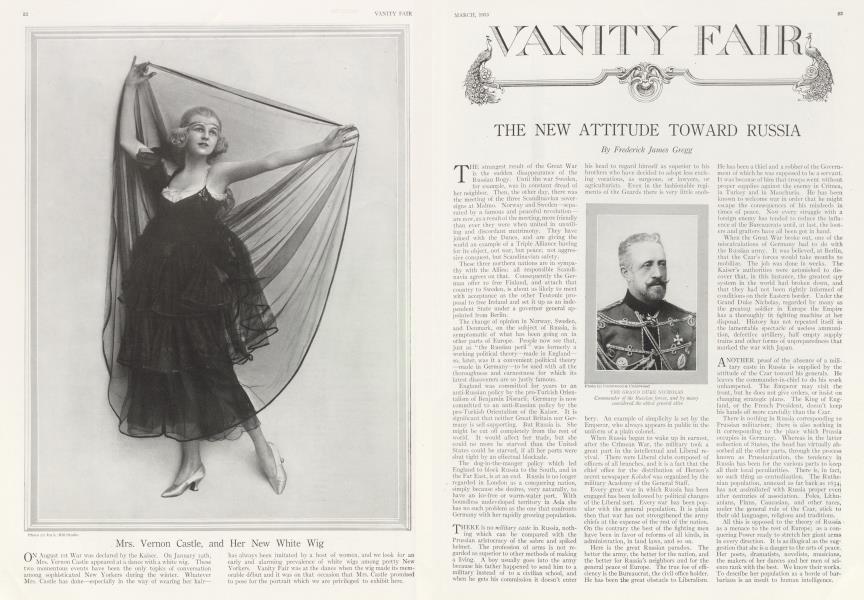
When the Great War broke out, one of the miscalculations of Germany had to do with the Russian army. It was believed, at Berlin, that the Czar's forces would take months to mobilize. The job was done in weeks. The Kaiser's authorities were astonished to discover that, in this instance, the greatest spy system in the world had broken down, and that they had not been rightly informed of conditions on their Eastern border. Under the Grand Duke Nicholas, regarded by many as the greatest soldier in Europe the Empire has a thoroughly fit fighting machine at her disposal. History has not repeated itself in the lamentable spectacle of useless ammunition, defective artillery, half empty supply trains and other forms of unpreparedness that marked the war with Japan.
ANOTHER proof of the absence of a military caste in Russia is supplied by the attitude of the Czar toward his generals. He leaves the commander-in-chief to do his work unhampered. The Emperor may visit the front, but he does not give orders, or insist on changing strategic plans. The King of England, or the French President, doesn't keep his hands off more carefully than the Czar.
There is nothing in Russia corresponding to Prussian militarism; there is also nothing in it corresponding to the place which Prussia occupies in Germany. Whereas in the latter collection of States, the head has virtually absorbed all the other parts, through the process known as Prussianization, the tendency in Russia has been for the various parts to keep all their local peculiarities. There is, in fact, no such thing as centralization. The Ruthenian population, annexed as far back as 1654, has not assimilated with Russia proper even after centuries of association. Poles, Lithu-. anians, Finns, Caucasian, and other races, under the general rule of the Czar, stick to their old languages, religions and traditions.
All this is opposed to the theory of Russia as a menace to the rest of Europe; as a conquering Power ready to stretch her giant arms in every direction. It is as illogical as the suggestion that she is a danger to the arts of peace. Her poets, dramatists, novelists, musicians, the makers of her dances and her men of science rank with the best. We know their works. To describe her population as a horde of barbarians is an insult to human intelligence.
Subscribers have complete access to the archive.
Sign In Not a Subscriber?Join Now