Sign In to Your Account
Subscribers have complete access to the archive.
Sign In Not a Subscriber?Join NowFROM TOP TO TOE OF THE PARISIENNE
Paris Has Winnowed the Modes of the Openings and Organdy Collars Come Out on Top with Zouave Jackets a Close Second—It's a Short, Short Way to the Bottom of the Skirt, but a Long, Long Way Around
What They Wear in Vanity Fair
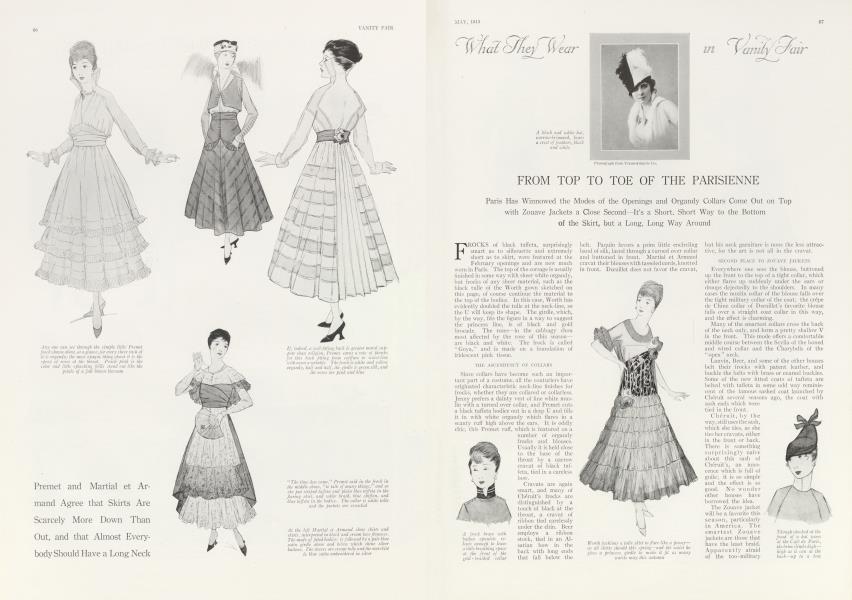
FROCKS of black taffeta, surprisingly smart as to silhouette and extremely short as to skirt, were featured at the February openings and are now much worn in Paris. The top of the corsage is usually finished in some way with sheer white organdy, but frocks of any sheer material, such as the black tulle of the Worth gown sketched on this page, of course continue the material to the top of the bodice. In this case, Worth has evidently doubled the tulle at the neck-line, so the U will keep its shape. The girdle, which, by the way, fits the figure in a way to suggest the princess line, is of black and gold brocade. The roses—in the cabbagy chou most affected by the rose of this season— are black and white. The frock is called "Goya," and is made on a foundation of iridescent pink tissue.
THE ASCENDENCY OF COLLARS
Since collars have become such an important part of a costume, all the couturiers have originated characteristic neck-line finishes for frocks, whether they are collared or collarless. Jenny prefers a dainty vest of fine white muslin with a turned over collar, and Premet cuts a black taffeta bodice out in a deep U and fills it in with white organdy which flares in a scanty ruff high above the ears. It is oddly chic, this Premet ruff, which is featured on a number of organdy frocks and blouses. Usually it is held close to the base of the throat by a narrow cravat of black taffeta, tied in a careless bow.
Cravats are again smart, and many of Chéruit's frocks are distinguished by a touch of black at the throat, a cravat of ribbon tied carelessly under the chin. Beer employs a ribbon stock, tied in an Alsatian bow in the back with long ends that fall below the belt. Paquin favors a prim little encircling band of silk, laced through a turned over collar and buttoned in front. Martial et Armand cravat their blouses with tasseled cords, knotted in front. Dœuillet does not favor the cravat, but his neck garniture is none the less attractive, for the art is not all in the cravat.
SECOND PLACE TO ZOUAVE JACKETS
Everywhere one sees the blouse, buttoned up the front to the top of a tight collar, which either flares up suddenly under the ears or droops dejectedly to the shoulders. In many cases the muslin collar of the blouse falls over the tight military collar of the coat; the crepe de Chine collar of Dœuillet's favorite blouse falls over a straight coat collar in this way, and the effect is charming.
Many of the smartest collars cross the back of the neck only, and form a pretty shallow V in the front. This mode offers a comfortable middle course between the Scylla of the boned and wired collar and the Charybdis of the "open" neck.
Lanvin, Beer, and some of the other houses belt their frocks with patent leather, and buckle the belts with brass or enamel buckles. Some of the new fitted coats of taffeta are belted with taffeta in some odd way reminiscent of the famous sashed coat launched by Cheruit several seasons ago, the coat with sash ends which were tied in the front.
Cheruit, by the way, still uses the sash, which she ties, as she ties her cravats, either in the front or back. There is something surprisingly naive about this sash of Chéruit's, an innocence which is full of guile; it is so simple and the effect is so good. No wonder other houses have borrowed the idea.
The Zouave jacket will be a favorite this season, particularly in America. The smartest Zouave jackets are those that have the least braid. Apparently afraid of the too-military effect of much braid, the Paris designers have gone to the other extreme, and have used very little braid. Nor is the Zouave jacket truly military in shape. On the contrary, instead of being severe, it is coquettish; instead of being businesslike it is frivolous. The skirt below the Zouave coat is usually plaited at the waist and very wide at the hem.
In contrast to the popular Zouave jacket is the long coat with long sleeves and a high collar; this coat entirely conceals the frock worn beneath it. Made of cloth, satin, or brocade, belted, or semifitted and flaring, this coat is very new and very smart. Jenny has several long coats of this character and one sees similar models everywhere—scattered through the various salons.
The princess line, after no one knows how many seasons spent in seclusion, has timidly reappeared and is making a somewhat faltering bid for recognition. But so far we seem to prefer the basque-like model with its close draped line in front and its loose back. The belted basque presented this season by Cheruit differs from the others in that it is closely belted all round and draped not at all. Also, the Cheruit basque differs from the skirt in color and material; for instance, a basque of changeable mauve taffeta may be worn over a skirt of soft black satin.
As to sleeves, there is an enormous variety. New and exceedingly pretty are the very short sleeves of taffeta which adorn—adorn is the word—the evening bodice. Paquin's short sleeves, with their accompanying knots of flowers, are the most bewitching little sleeves in all Paris. Many of the new taffeta coats are finished with three-quarter-length or even shorter sleeves, while others are quite long and flare over the hand. Beer shows taffeta sleeves that extend not quite to the elbow, and many of his coat sleeves are in three-quarter length. However, generally speaking, sleeves for daytime wear are long. A few show a slight widening at the elbow, and some are sewn in on the old kimono lines.
Skirts are wide. In taffeta, they measure six yards, and some of the cloth and gabardine skirts are equally wide. Four yards is considered extremely moderate, and a skirt less than three yards wide is called narrow.
Skirts are trimmed with ruffles, and are often cut in scallops or points at the bottom. Sometimes they are cut extremely short on the sides, or shorter in the front than in the back. There are skirts with yokes, flounces, plaits, and gores; skirts with tunics, and skirts with drapings; but all skirts are short.
Doucet's skirts, while not long, are probably the longest in Paris, but Doucet's models never—well hardly ever—sponsor extremes. This year they are extremely pretty and quite different from the models shown by other houses; there is a vague new line about them which will bear watching. Incidentally, Doucet still shows the loose line at the waist—the moyen age effect brought out last season by Cheruit, Doucet, and Callot, and which was brought to an untimely end by the war. Cheruit showed only one or two frocks this season which featured the loose line at the waist. In order to preserve the proportion with the very short skirt, the waist-line is slightly raised. This makes the bodice very short, but imparts not the slightest "Empire" effect to the frock. The line is quite different from that.
(Continued on page 76)
(Continued from page 68)
With the short skirt the ordinary boot top is plainly visible, and to avoid this rather ugly line, a new and very high-topped boot has been devised. It is of Russian leather and laces down the side over the ankle; it wrinkles easily about the instep. Jenny's manikins wear this boot, which appears also in one or two other houses. Paquin's manikins, however, were shod with strapped sandals of bronze leather, and somewhere else boots of blue kid tipped and heeled with black varnished leather were quite prominently featured.
Summer frocks of organdy are quite without trimming save for ruffles, fluted or scalloped, and bound with organdy. This manner of trimming is exceedingly pretty in all-white, and colored bindings are often very effective also. A frock of maize colored organdy is prettily bound with dull blue organdy; a frock of peach pink organdy bound with the same blue is dainty also. The peach pink frock was also girdled with soft blue taffeta ribbon, and was worn with a quaint hat of blue straw with trailing ribbons.
SUN SCREENS OF GOSSAMER
SUMMER parasols of white organdy are airy as gossamer and can best be described as "just sweet." Some of these parasols are of plain muslin bound with white or with some delicately colored material, and some are tinted. One of the prettiest is made of snowy ruffles of crisp organdy, with pink roses tucked in carelessly here and there. The effect is charming.
Among the many new ornaments of dull and polished jet which have appeared since the war, there is a flexible bow-knot of jet. It is made of small faceted beads strung on slender wires and attached firmly to a strong pin. This bow-knot, which may be pinned to the corsage and bent in any desired way, has proved to be a most satisfactory and inexpensive ornament. Jet buckles and buttons, chains, brooches, and earrings have appeared by the score in old and new designs. Bags of dull moire are beaded with jet, and black cravats are finished with black bead tassels.
Pretty jet hairpins and ornaments for the cciffure are being displayed in the shop windows on the rue de la Paix and the rue de Castiglione.
Subscribers have complete access to the archive.
Sign In Not a Subscriber?Join Now

