
Sign In to Your Account
Subscribers have complete access to the archive.
Sign In Not a Subscriber?Join NowTHE SAD DECLINE OF THEATRICAL ROAD COMPANIES
A Brief Consideration of the Causes That Have Led to It
LEANDER RICHARDSON
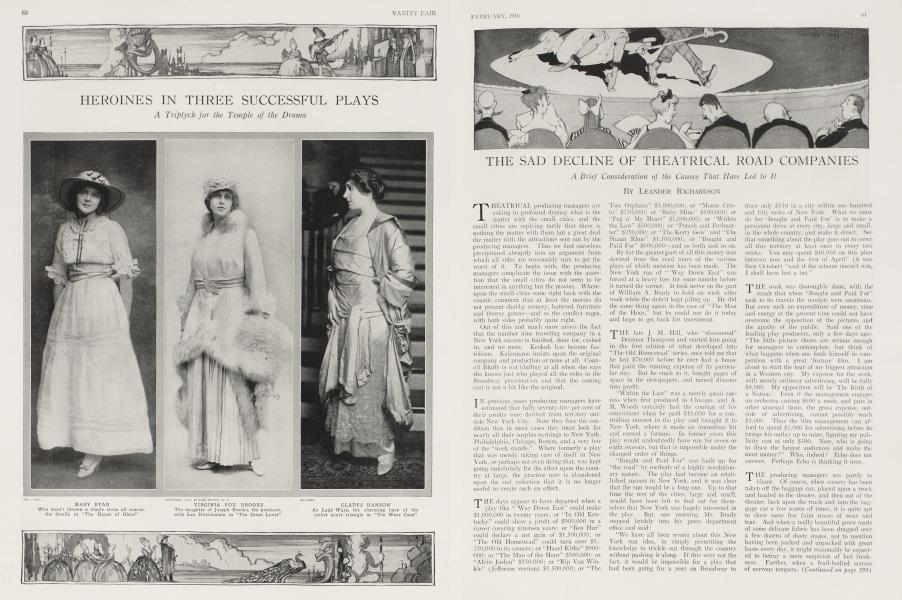
THEATRICAL producing managers are asking in profound dismay what is the matter with the small cities, and the small cities are replying tartly that there is nothing the matter with them but a great deal the matter with the attractions sent out by the producing managers. Thus we find ourselves precipitated abruptly into an argument from which all sides are reasonably sure to get the worst of it. To begin with, the producing managers complicate the issue with the assertion that the small cities do not seem to be interested in anything but the movies. Whereupon the small cities come right back with the caustic comment that at least the movies do not present shabby scenery, battered furniture and frowsy gowns—and so the conflict rages, with both sides probably quite right.
Out of this and much more arises the fact that the number nine traveling company in a New York success is finished, done for, cashed in, and no more. Keokuk has become fastidious. Kalamazoo insists upon the original company and production or none at all. Council Bluffs is not bluffing at all when she says she knows just who played all the roles in the Broadway presentation and that the coming cast is not a bit like the original.
IN previous years producing managers have estimated that fully seventy-five per cent of their profits were derived from territory outside New York City. Now they face the condition that in most cases they must look for nearly all their surplus earnings to New York, Philadelphia, Chicago, Boston, and a very few of the "week stands." Where formerly a play that was merely taking care of itself in New York, or perhaps not even doing that, was kept going indefinitely for the effect upon the country at large, the practice now is abandoned upon the sad reflection that it is no longer useful to create such an effect.
THE days appear to have departed when a play like " 'Way Down East" could make $1,000,000 in twenty years; or "In Old Kentucky" could show a profit of $900,000 in a career covering nineteen years; or "Ben Hur" could declare a net gain of $1,500,000; or "The Old Homestead" could turn over $1,250,000 to its owners; or "Hazel Kirke" $900000; or "The Man of the Hour" $500,000; or "Alvin Joslyn" $750,000; or "Rip Van Winkle" (Jefferson version) $1,500,000; or "The Two Orphans" $1,000,000; or "Monte Cristo" $750,000; or "Baby Mine" $500,000; or "Peg o' My Heart" $1,000,000; or "Within the Law" $500,000; or "Potash and Perlmutter" $250,000; or "The Kerry Gow" and "The Shaun Rhue" $1,500,000; or "Bought and Paid For" $600,000—and so forth and so on.
By far the greater part of all this money was derived from the road tours of the various plays of which mention has been made. The New York run of " 'Way Down East" was forced at a heavy loss for some months before it turned the corner. It took nerve on the part of William A. Brady to hold on week after week while the deficit kept piling up. He did the same thing again in the case of "The Man of the Hour," but he could not do it today and hope to get back his investment.
THE late J. M. Hill, who "discovered" Denman Thompson and started him going in the first edition of what developed into "The Old Homestead" series, once told me that he lost $70,000 before he ever had a house that paid the running expense of its particular day. But he stuck to it, bought pages of space in the newspapers, and turned disaster into profit.
"Within the Law" was a merely quasi success when first produced in Chicago, and A. H. Woods certainly had the courage of his convictions when he paid $10,000 for a controlling interest in the play and brought it to New York, where it made an immediate hit and earned a fortune. In former years this play would undoubtedly have run for seven or eight seasons, but that is impossible under the changed order of things.
"Bought and Paid For" was built up for "the road" by methods of a highly revolutionary nature. The play had become an established success in New York, and it was clear that the run would be a long one. Up to that time the rest of the cities, large and small, would have been left to find out for themselves that New York was hugely interested in the play. But, one morning Mr. Brady stepped briskly into his press department office and said:
"We have all been wrong about this New York run idea, in simply permitting the knowledge to trickle out through the country without pushing it along. If this were not the fact, it would be impossible for a play that had been going for a year on Broadway to draw only $150 in a city within one hundred and fifty miles of New York. What we must do for 'Bought and Paid For' is to make a persistent drive at every city, large and small, in the whole country, and make it direct. See that something about the play goes out to cover all this territory at least once in every two weeks. You may spend $10,000 on this plan between now and the first of April" (it was then October) "and if the scheme doesn't win, I shall have lost a bet."
THE work was thoroughly done, with the result that when "Bought and Paid For" took to its travels the receipts were enormous. But even such an expenditure of money, time and energy at the present time could not have overcome the opposition of the pictures and the apathy of the public. Said one of the leading play producers, only a few days ago: "The little picture shows are serious enough for managers to contemplate, but think of what happens when one finds himself in competition with a great 'feature' film. I am about to start the tour of my biggest attraction in a Western city. My expense for the week, with merely ordinary advertising, will be fully $4,000. My opposition will be 'The Birth of a Nation.' Even if the management engages an orchestra costing $600 a week, and puts in other unusual items, the gross expense, outside of advertising, cannot possibly reach $1,000. Thus the film management can afford to spend $.3,000 for advertising before he brings his outlay up to mine, figuring my publicity cost at only $300. Now, who is going to draw the largest audiences and make the most money?" Who, indeed? Echo does not answer. Perhaps Echo is thinking it over.
THE producing managers are partly to blame. Of course, when scenery has been taken off the baggage car, placed upon a truck and hauled to the theater, and then out of the theater, back upon the truck and into the baggage car a few scores of times, it is quite apt to show some few faint traces of wear and tear. And when a really beautiful gown made of some delicate fabric has been dragged over a few dozens of dusty stages, not to mention having been packed and unpacked with great haste every day, it might reasonably be expected to betray a mere suspicion of lost freshness. Further, when a frail-bodied actress of nervous temperament has spent a conservative three or four months' time in sleeping half the night in a musty berth or sitting for hours at a stretch in a murky station at a railway junction; going to bed at midnight and getting up at five in the morning; eating at all sorts of hours all sorts of food, mostly unfit for human consumption, shall we commit her to the scaffold because her impersonation of the leading part is slightly lacking in zest and spirit? Then too, in addition to all the unavoidable obstacles, many a manager looking for the best immediate financial results has sent extra companies "on the road" that were grotesquely incompetent. There was a time when these could go on making profits.
(Continued on page 104)
(Continued from page 61)
But the Alan Dale of Niles, Mich., is with us, and the Acton Davies of Connellsville, Pa., and the Louis De Foe of Gary, Ind., and the Lawrence Reamer of Penn Yan, N.Y.—and believe me, there are some criticisms hurtling through the small city atmosphere!
THE old manager, observing the collapse of the number nine traveling company, says: "The pictures have it on us, for many reasons. Their variety is infinite, their scenery is real instead of being painted on canvas, and where we could not possibly show more than four or five scenes with a single play, they can show a hundred. The pictures are cheap for they have very little running expense, while our daily outlay at best is high. But the most deadly comparison is that a picture is always just as it started, while there is no such thing as keeping a theatrical performance up to its best mark.
"This is true in New York and a hundred times more so elsewhere. Every little while the late Augustin Daly, with his perfectly organized and carefully disciplined company, used to give out word that he was leaving for Boston or some other point, and then slip up into his gallery to watch the performance. There was usually a vigorous rehearsal next morning.
"But a man cannot do this with several companies scattered all over the country, if he has any other occupation. So, when an actor in Kankakee, receiving a letter from his wife at home kicking about the last remittance, lets down with his performance, how can I help it in New York? And if the leading lady in Texarkana does not have a reception upon her first entrance, and sulks through the whole evening, what can I do, a thousand miles away?
"There is no denying that traveling companies deteriorate for the reasons enumerated, but they would fare no better if they were always at concert pitch. The people have been taught to look upon the traveling show with suspicious eyes.
"The San Francisco critics have an idea that we are all wrong because we do not find it convenient to go out there and make our productions. In Chicago—at least we Eastern managers feel it to be so—a production originating in New York is not accepted as being nearly as good as it would have been if made in Chicago. In Boston and Philadelphia the New York trademark carries no more weight than a very small bubble.
"In all these places and many more there are newspapers of great circulations and carrying undoubted weight. Some of these deride traveling companies and cry out for the originial cast until they set the general country to clamoring for more than it is possible to give.
"It is all folly to say that any thoroughly competent actor cannot be suitably replaced by another quite as good, or that any well painted scene cannot be duplicated, or that any beautiful gown cannot be copied—which disposes of the theory that an original stage presentation cannot be reproduced perfectly in every detail. Keeping it in that condition is another matter, at least when the patronage has become depleted to an extent that precludes a profit."
ALL having now been said, let us leave the question of what is the matter with the small cities— and also with the number nine traveling company— precisely where we found it. We know they are very, very ill, and we are aware of some of the causes of their illness, but probably not all. We trust they will recover, but we fear not, for they have moving picture-itis at its worst, and old Dr. Drama has lost his grip upon them. He is a back number, charged with being a quack, and many believe the accusation to be true.
Subscribers have complete access to the archive.
Sign In Not a Subscriber?Join Now
