Sign In to Your Account
Subscribers have complete access to the archive.
Sign In Not a Subscriber?Join NowANOTHER DOGGED TEUTONIC DRIVE
The German Shepherd Dog in Peace and War
THE Dog Mart of Vanity Fair is a reliable guide to the best Kennels in the country. You will find it in this issue beginning at page 19. If you want to buy a dog, or if there is any information you desire concerning dogs, write to the Dog Mart, Vanity Fair, New York
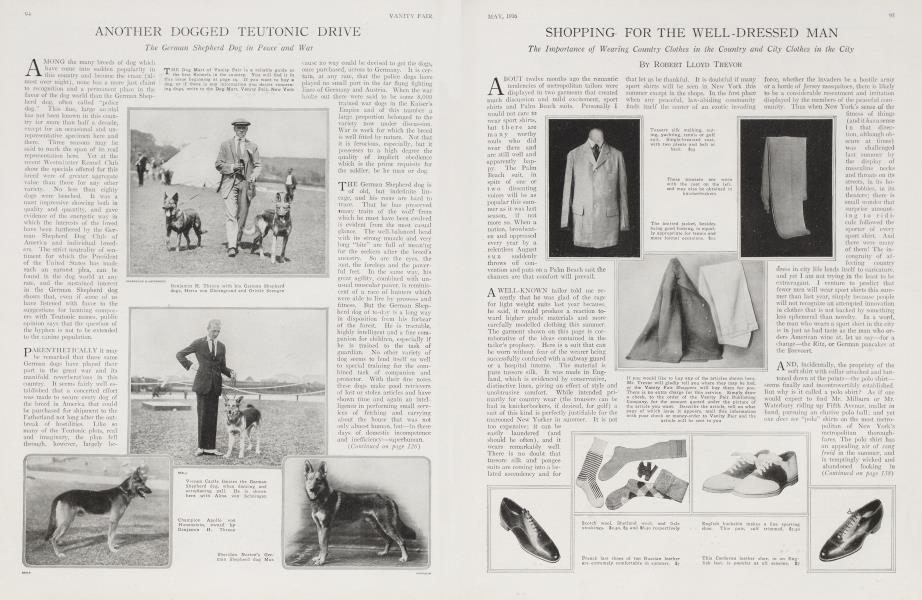
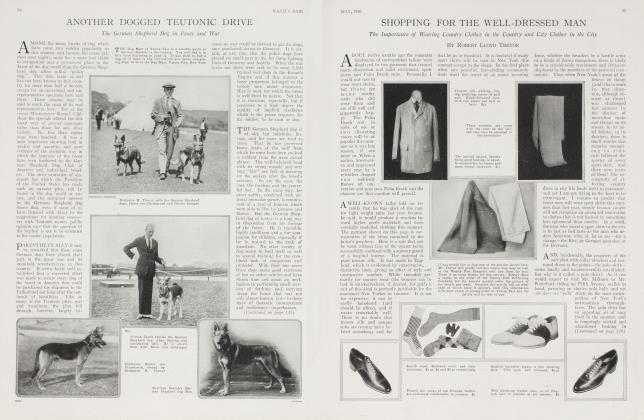
AMONG the many breeds of dog which have come into sudden popularity in this country and become the craze (almost over night) none has a more just claim to recognition and a permanent place in the favor of the dog world than the German Shepherd dog, often called "police dog." This fine, large animal has not been known in this country for more than half a decade, except for an occasional and unrepresentative specimen here and there. Three seasons may be said to mark the span of its real representation here. Yet at the recent Westminster Kennel Club show the specials offered for this breed were of greater aggregate value than those for any other variety. No less than eighty dogs were benched. It was a most impressive showing both in quality and quantity, and gave evidence of the energetic way in which the interests of the breed have been furthered by the German Shepherd Dog Club of America and individual breeders. The strict neutrality of sentiment for which the President of the United States has made such an earnest plea, can be found in the dog world at any rate, and the sustained interest in the German Shepherd dog shows that, even if some of us have listened with favor to the suggestions for banning composers with Teutonic names, public opinion says that the question of the hyphen is not to be extended to the canine population.
PARENTHETICALLY it may be remarked that these same German dogs have played their part in the great war and its manifold reverberations in this country. It seems fairly well established that a concerted effort was made to secure every dog of the breed in America that could be purchased for shipment to the Fatherland not long after the outbreak of hostilities. Like so many of the Teutonic plots, real and imaginary, the plan fell through, however, largely because no way could be devised to get the dogs, once purchased, across to Germany. It is certain, at any rate, that the police dogs have played no small part in the far flung fighting lines of Germany and Austria. When the war broke out there were said to be some 8,000 trained war dogs in the Kaiser's Empire and of this number a large proportion belonged to the variety now under discussion. War is work for which the breed is well fitted by nature. Not that it is ferocious, especially, but it possesses to a high degree the quality of implicit obedience which is the prime requisite for the soldier, be he man or dog.
THE German Shepherd dog is of old, but indefinite lineage, and his roots are hard to trace. That he has preserved many traits of the wolf from which he must have been evolved is evident from the most casual glance. The well-balanced head with its strong muzzle and very long "bite" are full of meaning for the seekers after the breed's ancestry. So are the eyes, the coat, the forelegs and the powerful feet. In the same way, his great agility, combined with unusual muscular power, is reminiscent of a race of hunters which were able to live by prowess and fitness. But the German Shepherd dog of to-day. is a long way in disposition from his forbear of the forest. He is tractable, highly intelligent -and a fine companion for children, especially if he is trained to the task of guardian. No other variety of dog seems to lend itself so well to special training for the combined task of companion and protector. With their fine noses these dogs make good retrievers of lost or stolen articles and have shown time and again an intelligence in performing small services of fetching and carrying about the house that was not only almost human, but—in these days of domestic incompetence and inefficiency—superhuman.
Continued on page 126
Continued from page 94
IT is a question whether for ordinary use as companions these dogs are benefited by a full course of training at one of the several schools for breaking them into police work which are now available. For its special purpose this training is wonderful, and these schools—as well as the kennels of the breeders—can give modified courses which are of high value, but it is questionable whether one wants a dog so imbued with the idea of his duties as bodyguard that he will not permit a friend to slap you on the back or take your arm without instant, and often violent protest. This is a matter for the individual owner to decide but it must be patent to everyone that the dog which can be trained to protect his master effectively and without specific command is an animal of the highest intelligence that can be shaped into any special channels which may be desired. There are, moreover, a number of different methods of training these dogs for attack and defense. In some cases they are taught to bite and to spring for the throat, a method which obviously does not adapt itself to the pet. In other cases they are trained never to bite, but merely to threaten and sometimes to knock down the undesirable person. This is better when it is a matter of private ownership but it will be found that the mere presence of one of these thoroughly competent looking dogs trotting along at heel is sufficient to make all unwelcome characters keep their distance.
With those they know, these dogs are affectionate, trustworthy in the highest degree, and entirely loyal. As dogs for the country place, they can be easily taught not to bark at every disturbing scent or distant sound. They are the best sort of burglar alarm at night, and are frequently so trained that they will touch no food except when it is given them by certain specified persons, thus avoiding the danger common to most watch dogs of succumbing to the temptation of a bit of poisoned or drugged meat. You can leave your front door unlocked in the country, whatever section it may be, provided your German Shepherd dog is unleashed and in charge of the lower floor of the house. A house guarded by such a reliable watchman is about as unhealthy a place for a burglar or a sneak thief as one could well imagine. If the police dogs are doing good work for the Teutonic forces in the field as scout, ambulance and machine gun dogs, a different type of dog entirely is helping the allies in quite another capacity. With a great number of well-known working terriers at the front, especially Airedales, fox terriers and a few Irish terriers, the British love of sport has cropped out in organized rat hunting. As it happens, in Flanders and Northern France the trench life has made rat catching more than a sport, and elevated it into a really vital necessity. Testimony from the front bears witness to the fact that hardly has a trench been constructed and occupied before it is infested with rats which seem to spring from nowhere and add their share to the discomforts and troubles of the underground warfare. Large quantities of rat poison have been going across the Channel for some time, but the men in the trenches have found a way to combine business with pleasure by using the terriers in extensive rat drives. It is doubtful if working terriers ever had a chance to perform so fully the labors for which they have been bred, in theory at least.
make excellent stand the confinement of city life well for a breed of their size, the German Shepherd dogs are at their best as companions for the country place. Their strong constitutions and vigorous coats make them fine outdoor dogs; in fact, they demand a good deal of exercise. They are not troublesome with other dogs, as a rule, and have the instinct for obedience so strongly developed that they can be trained easily to come to heel at command, no matter what the temptation may be to get into a fight The best evidence of the high esteem in which the breed is held here now, is to be found in the brisk demand which there is for puppies of good quality. The price of these dogs varies much according to age, breeding and degree of training. It is well to look for dogs with plenty of size and bone, of the rugged, sturdy type: in other words, avoid the weedy or slinky specimen when choosing your Shepherd dog. Color is not of the most vital importance but the characteristic grizzled gray is perhaps most desirable, with black and rufus next. Few specialty clubs have been more active in promoting their breeds than the German Shepherd Dog organization of which the officers are Mrs. C. Halstead Yates, president; William Neuhoff, L. H. Swank, J. S. Campbell, Jr., and Miss Anne Tracy, vice-presidents; B. H. Throop, secretary; Leo F. Wanner, S. S. Norton, L. I. DeWinter, Paul Huhn and R. B. Ruggles, governors.
Continued on page 128
Continued from page 126
A bonus has been placed on the rats at the rate of a ha'penny a tail and one army corps alone, according to the London Field, accounted for 8,000 rats in a fortnight! This made quite a little purse to divide among the Tommies. In this connection the Field has a delightful passage concerning a typical British sporting parson, a doggy though reverent man, a bit of whose spirit would do much for the terrier breed in this country. It says of him:
"The Rev. C. B. Hulton, one of the founders of the Working Terrier Association, is among the large number of Church of England clergymen who have considered it to be their duty to offer their services to their country, and he has been attested. Mr. Hulton is an old ratter; his pack of wire-haired fox terriers did excellent work in the South before 'the master' removed to the North country, where he had the offer of an excellent living. With his gardener acting as 'huntsman,' Mr. Hulton had some really excellent days."
NOW Mr. Hulton's "excellent days" are to be spent at the front and it is to be hoped that some of the working terriers are to go with him. He certainly will find no lack of game and if his gardener has not been attested too it will be of little moment for there will (Contivucd from page 126) be no end of willing candidates *or the post of huntsman with such an enthusiastic sportsman.
At the recent Philadelphia Dog Show, which demonstrated, by the way, that two big shows could be held as near each other as New York and the Quaker City and still be successful, another triumph was scored by the fine Scottish terrier, Conqueror, whose portrait appears in this issue. The little dog was set down in perfect shape by Miss Jean B. Crawford of Evanston, Ill., and when Conqueror, which had been reserve in New York, emerged as best dog in the show it was another demonstration fhat Miss Crawford's experience with terriers of all kinds at her mother's Vickery Kennels had not been in vain. Conqueror is a rare good one, with wonderful front, quarters, feet and coat. He is a Scotty to be proud of.
ABOUT $500 in plate will be put up by the new Wire Haired Fox Terrier Club which held its first meeting recently. It is the intention of the club to hold a specialty show within the year and also to offer plate trophies at the larger shows. These trophies are to be won outright. The officers of the club for the ensuing year are J. Seargent Prince, Jr., president; Charles Perrin, George D. Widener and George W. Quintard, vice-presidents, and Russell H. Johnston, secretary and treasurer. Little Ouena of Llenrud, Mrs. McClure Halley's remarkable Pekingese, of which Mrs. Herbert has expressed so high an opinion, continues her winning career. Last month, at the match of the Long Island Kennel Club, she won first as the best Pekingese in the show, then as the best toy dog and finally as the best dog of any breed. It was a triumph for the little lion dog as more than 250 dogs were entered and four judging rings were required in order to get through the classes in the specified time.
THE time of outdoor shows is nearly at hand, and the anticipation of dog lovers is keen for what should be the best of seasons for the show circuit. Hot competition is to be expected in all the terrier classes and in many other breeds. There is promise too of some special features, such as a class for Dalmatians shown under a ladies' phaeton, whippet racing and the like.
Subscribers have complete access to the archive.
Sign In Not a Subscriber?Join Now

