Sign In to Your Account
Subscribers have complete access to the archive.
Sign In Not a Subscriber?Join Now"FEAR NOT THE BARREL," SAYS PARIS
The Barrel Silhouette Proves Startling Only Because of Its Grace
FASHION as made in Paris is full of surprises. Early this season, rumor whispered a hundred fanciful ideas in our ear —the polonaise, short sleeves way above the elbow, a waist-line here to-day and there tomorrow, and, capping the climax, the barrel skirt. A sigh escaped us: "Oh, shades of the hobble, the hoop, and the jupe culotte, what is she offering us now?" We tried, but in vain, to fancy ourselves walking about elegantly in barrels, and gracefully and casually reclining in barrels; and in fear and trembling we awaited the first sight of the jupe tonneau.
With relief we saw it. "Oh," we said, "is that the barrel?" And those who dared be really frank added, "Why, it's not startling at all." If we looked carefully, it is true, we saw more width at the knee than at the hem or top—but soft width, not bulging, stiff, barrellike width. We breathed more freely—we could even see ourselves walking about elegantly in barrels and reclining in barrels. But a bit of doubt still hung in the air. This was the start. What would come next?
And then fashion sent over her first spring things, and we, when we had finished looking, we marveled; for,—barring a few curiosities, which are always to be expected—barrels and tunics and pocket skirts and chemise frocks were surprisingly sane. We found the elusive waistline, for instance, very often lodged in its normal place; we found the skirt of only a moderate shortness and only fairly full; sleeves seemed to be of one kind and another, but all were wearable and becoming; pretty soft collars were there; and there, too, was our last season's firm friend, the chemise frock, moderated to fit a bit more closely at the waist-line. It is indeed a long time since we have had so sane and likable a collection of clothes as are shown in Paris and New York this spring. They have infinite variety; the new materials are attractive; and their uses show a delightful ingenuity. The result should be what is known as a "good season."
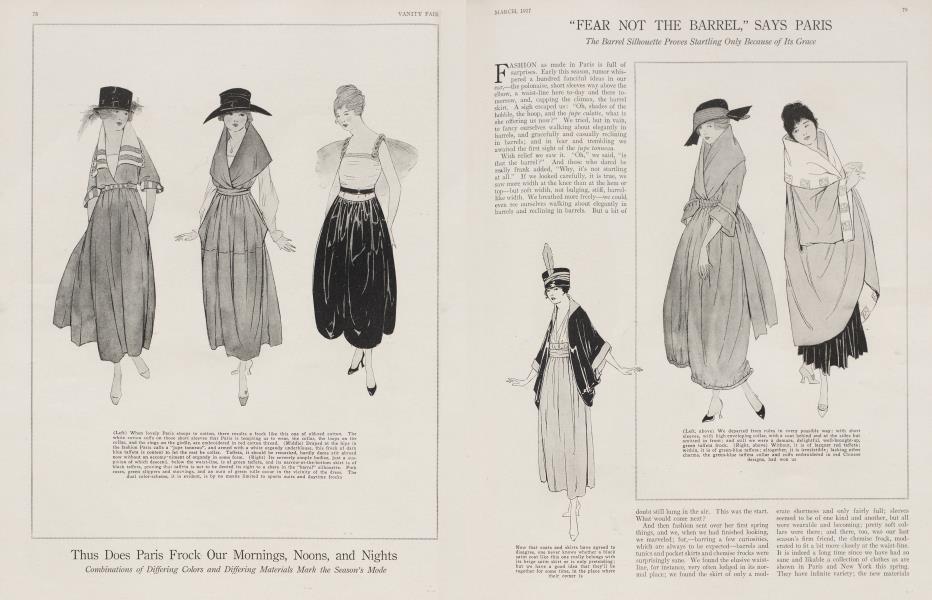
There is more interest being shown each winter in the wardrobe for the south (whether the south be Spain, the Riviera, Florida, or California), and many a later favorite among spring frocks or suits first appears as a model designed for southern wear. Delightful in the old-red cotton material in which Paris made it, is the frock at the left on page 78; it brings up visions of the clear blue waters and yellow sands of the south. Without a change in its white cotton collar and cuffs, gaily stitched in red, and its embroidered rings at belt and collar, it would be charming made up in gabardine, tussur, or any other of the new spring materials.
THE taffeta frock enters shyly, and with it a
crisp freshness of organdy; for we are to have taffeta again to some extent, in spite of its great popularity of the past two seasons. The skirt of the frock in the middle of page 78 shows a conservative barrel effect, placed rather higher than most, but a perfect complement to the distinctive collar. The organdy underblouse is exquisitely fine and plain.
Just such another collar—and think how becoming these collars will be—is shown in the dark green taffeta costume in the middle of page 79, which has also a novel coat, full on either hip, absolutely flat in back and entirely non-existent in front. And the skirt, a perfect barrel, turns up a bit at the bottom and is softly bouffant from any point of view.
ONE can no longer state that a frock or a suit is of this or that material; it is often of three or four different fabrics and at least two distinct colors, each assuming an equally important part. The two-color and two-material scheme is well illustrated in both the wool jersey suit, second from the left on page 80, and the very effective dress and coat at the top of the same page. In the first, which is from Hollander, the simple, soft-belted, blue jersey coat has a deep boyish collar and cuffs and two bands embroidered in gray silk over a soft, barrel-like gray jersey skirt. In the other model, which is from Stein and Blaine, this idea is reversed; the simple one-piece dress is of platinum gray Georgette charmeuse (a very lustrous new satin fabric with an excellent body to it), stitched in gray silk; while its collar and the deep band on the skirt are of a soft blue velours, with a rather deep pile. The velours is used again on the collar of the coat. This coat shows the flexibility of the mode. "The frock will be at its best with a short, loose, box coat," said the designer; so forthwith, the coat was short and loose.
EVENING dresses show a new use of two colors. The bodice (and there is enough to it this season to recognize it by name) is frequently of a different—often a surprisingly different—color from the skirt. A daring French color-combination, at the right on page 78, is a lettuce green taffeta bodice with a black taffeta skirt and the softest of pink roses holding a wing-like green tulle drapery over the shoulders. No less surprising and no less successful is the lacquer red taffeta wrap, at the right on page 79, with its lining and collar and cuffs of queer green-blue taffeta of the softest sort, embroidered in Chinese motifs in red.
At the left on page 79 is a costume that sponsors the very short sleeves which Paris is daring America to adopt; like the costume at the right on page 86, this one is evidence of a very strong tendency, which is one of the few real features of the season, the tendency to make the coat of a different material from the frock or skirt. In this case, it is the black satin coat which gives character to the beige satin frock, but just as often this situation is reversed, and it is the skirt which is darker than the coat.
Machine-stitching, hand-embroidery, beadwork, and anything which gives a similar effect, are seen everywhere. The patterns are conventional, and the surface embroidered is closely covered with the pattern, to give an almost solid effect. A very effective example of the use of this embroidered work is in the frock at the left on this page. It is one of those street dresses which, together with the tailored suit, are the mainstay of the spring wardrobe. The dress is made of midnight blue Georgette charmeuse, stitched in a dull gold colored thread; this close bold stitching covers the underskirt, cuffs, and belt, and decorates the deep pointed ends of the tunic; for the tunic is back once more. It is a tunic planned to give long lines, though it is hung over a barrel underskirt. Gold pussy willow taffeta lines the tunic, and is used for the high, clinging, narrow collar. This dress, braided in dark blue or black, comes in dark blue tricot or gabardine with an underskirt of the Georgette charmeuse in the same shade.
The effectiveness of braided trimming appears again in the frock at the lower right on page 80. Here the trimming is used frankly as the only decoration of a very simple frock and coat, but against the dark blue Georgette charmeuse that is a favorite with this designer, the pattern stands out in striking fashion; for it is done in cording of a topaz yellow; the cording is repeated on the chiffon of the top, back and sleeves of the bodice. This is another box coat; confined a bit at the waist-line, and a little longer than the one described above, it possesses the loose sleeve and deep cuff that is a fitting accompaniment to this type of coat; this model and the model just described, from Stein and Blaine.
In the soft, simple, dove gray, wool jersey suit, at the left on page 80, a similar effect is gained with steel beads and steel thread embroidery. The coat is a softly tailored model with the embroidery as its main feature; the skirt, simple and moderately full, has a touch of the embroidery on the belt; from Hollander.
We often hear, early in a season, the announcement that tailored suits will not be greatly used, or later we are told that tailored suits have not been worn as much as dresses and coats; but never was there a time when tailored suits did not play a most important part in the wardrobe of the fashionable American woman. It would be a strong-minded designer indeed who could refuse the American woman anything so dear to her heart as the tailored suit. This season, in response to the ever constant demand, Hollander is showing a suit of most severely tailored character and most unusual distinction; it appears at the right on this page. The material has the softness of velours and the coarseness of weave of homespun, and is called mouflonne; it is of the popular beige shade. Its tight plain sleeves finished with bone buttons, its long slender revers, its tiny slit pockets and the bone buttons that link it in front are all carefully thought out details; but the chief feature is its soft white satin waistcoat, which fastens to one side and shows both above and below the closing. There is something very smart about a well-made satin waistcoat, particularly when it accompanies a suit of a severe type.
(Continued on page 86)
(Continued from page 81)
Three models which have only just arrived at the New York branch of the Maison Marianne Buzenet, show features that are well worth a study. A frock made of pink handkerchief linen is another example of effectively used braiding; it is the second from the left on page 81. The braiding is of narrow gray soutache, and the frock is made in chemise style; the straight line here is partly held in by a suspicion of a belt. This frock has been so well received that it has been copied in blue tricot, gaily braided in scarlet. It has a youthful charm and a simplicity that lends itself to many materials; for instance, the crêpe de Chine which is bidding fair to wrest the season's laurels from taffeta.
An evening frock, second from the right on page 81, forms a complete costume with the wrap second from the right on page 80. The black tulle tunic of the frock is embroidered with sunbursts of delicate paillettes in claire-de-lune and black. The tunic is veined and weighted with heavy jet beads and tassels, and forms a train of two sharp points in the back. The black tulle underskirt has two satin bands as a finish; the surplice bodice is filled in with flesh colored tulle and finished in the back with an effective black tulle drapery.
The wrap mentioned above is one of those essentially feminine things in which most women look their best. Made of black tulle, its trimming is of claire-de-lune paillettes in wide bands which radiate from a band down the middle of the back; the collar is of black fox fur. The weight of the paillettes, the sheerness of the tulle, and the softness of the fur together spell effectiveness.
Satin, pre-eminently a favorite in Paris and America, is used for all types of clothes. A smart satin country coat, at the right on this page, is accompanied by its own particular little hat; the result is a costume suitable for nearly any occasion—the kind of a costume that always seems begging one to put it on. Another of the season's coats accompanies the beige tussur frock at the left on this page. This three-piece ensemble is another example of the costume that is appropriate to many occasions. The turban in the middle of the page is imported by Joseph.
Subscribers have complete access to the archive.
Sign In Not a Subscriber?Join Now


