Sign In to Your Account
Subscribers have complete access to the archive.
Sign In Not a Subscriber?Join NowTHE GREAT AMERICAN COMPOSER
His Grandfathers Are the Present Writers of Our Popular Ragtime Songs
CARL VAN VECHTEN
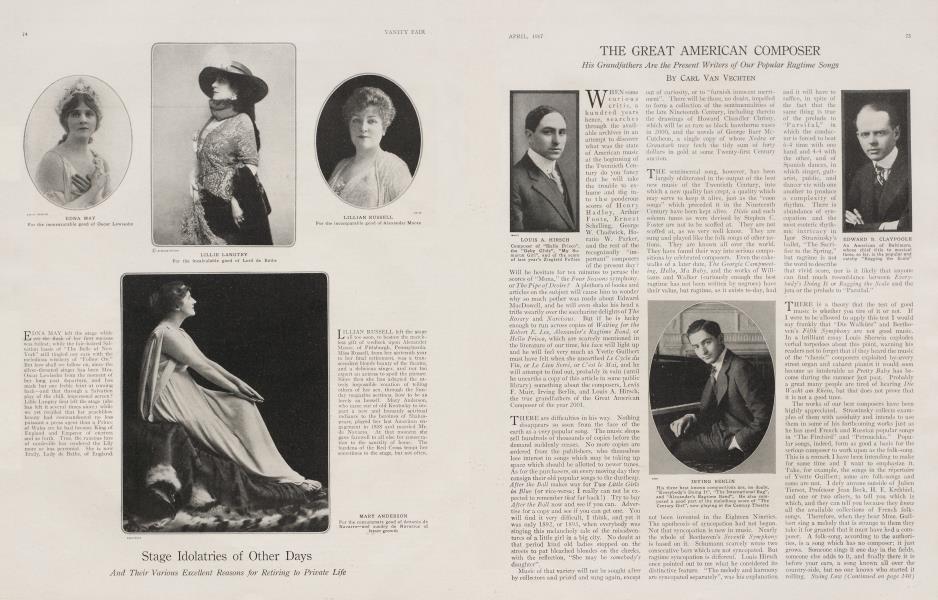
WHEN curious some critic, a hundred years hence, searches through the available archives in an attempt to discover what was the state of American music at the beginning of the Twentieth Century do you fancy that he will take the trouble to exhume and dig into the ponderous scores of Henr) Hadley, Arthur Foote, Ernest Schelling, George W. Chadwick, Horatio W. Parker, and the rest of the recognizedly "important Composers of the present day? Will he hesitate for ten minutes to peruse the scores of "Mona," the Four Seasons symphony, or The Pipe of Desire? A plethora of books and articles on the subject will cause him to wonder why so much pother was made about Edward MacDowell, and he will even shake his head a trifle wearily over the saccharine delights of The Rosary and Narcissus. But if he is lucky enough to run across copies of Waiting for the Robert E. Lee, Alexander's Ragtime Band, or Hello Frisco, which are scarcely mentioned in the literature of our time, his face will light up and he will feel very much as Yvette Guilbert must have felt when she unearthed Le Cycle du Vin, or Le Lien Serre, or C'est le Mai, and he will attempt to find out, probably in vain (until he unearths a copy of this article in some public library) something about the composers, Lewis F. Muir, Irving Berlin, and Louis A. Hirsch, the true grandfathers of the Great American Composer of the year 2001.
THERE are difficulties in his way. Nothing disappears so soon from the face of the earth as a very popular song. The music shops sell hundreds of thousands of copies before the demand suddenly ceases. No more copies are ordered from the publishers, who themselves lose interest in songs which may be taking up space which should be allotted to newer tunes. As for the purchasers, on every moving day they consign their old popular songs to the dustheap. After the Ball makes way for Two Little Girls in Blue (or vice-versa; I really can not be expected to remember that far back!) Try to buy After the Ball now and see if you can. Advertise for a copy and see if you can get one. You will find it very difficult, I think, and yet it was only 1892, or 1893, when everybody was singing this melancholy tale of the misadventures of a little girl in a big city. No doubt at that period kind old ladies stopped on the streets to pat bleached blondes on the cheeks, with the reflection, "She may be somebody's daughter".
Music of that variety will not be sought after by collectors and prized and sung again, except out of curiosity, or to "furnish innocent merriment". There will be those, no doubt, impelled to form a collection of the sentimentalities of the late Nineteenth Century', including therein the drawings of Howard Chandler Christy, which will be as rare as black hawthome vases in 2000, and the novels of George Barr McCutcheon, a single copy of whose Nedra or Graustark may fetch the tidy sum of forty dollars in gold at some Twenty-first Century' auction.
THE sentimental song, however, has been largely obliterated in the output of the best new music of the Twentieth Century, into which a new quality has crept, a quality which may serve to keep it alive, just as the "coon songs" which preceded it in the Nineteenth Century have been kept alive. Dixie and such solemn tunes as were devised by Stephen C. Foster are not to be scoffed at. They are not scoffed at, as we very well know. They are sung and played like the folk songs of other nations. They are known all over the world. They have found their way into serious compositions by celebrated composers. Even the cakewalks of a later date, The Georgia Campmeeting, Hello, Ma Baby, and the works of Williams and Walker (curiously enough the best ragtime has not been written by negroes) have their value, but ragtime, as it exists to-day, had not been invented in the Eighteen Nineties. The apotheosis of syncopation had not begun. Not that syncopation is new in music. Nearly the whole of Beethoven's Seventh Symphony is based on it. Schumann scarcely wrote two consecutive bars which are not syncopated. But ragtime syncopation is different. Louis Hirsch once pointed out to me what he considered its distinctive feature. "The melody and harmony are syncopated separately", was his explanation and it will have to suffice, in spite of the fact that the same thing is true of the prelude to "Parsifal," in which the conductor is forced to beat 6-4 time with one hand and 4-4 with the other, and of Spanish dances, in which singer, guitarist, public, and dancer vie with one another to produce a complexity of rhythm. There is abundance of syncopation and the most esoteric rhythmic intricacy in Igor Strawinsky's ballet, " I he Sacrifice to the Spring," but ragtime IS not the word to describe that vivid score, nor is it likely that anyone can find much resemblance between Everybody's Doing It or Ragging the Scale and the jota or the prelude to "Parsifal."
THERE is a theory that the test of good music is whether you tire of it or not. If I were to be allowed to apply this test I would say frankly that "Die Walkure" and Beethoven's Fifth Symphony are not good music. In a brilliant essay Louis Sherwin explodes verbal torpedoes about this point, warning his readers not to forget that if they heard the music of the "classic" composers exploited by every street organ and cabaret pianist it would soon become as intolerable as Pretty Baby has become during the summer just past. Probably a great many people are tired of hearing Die Wacht am Rhein, but that does not prove that it is not a good tune.
The works of our best composers have been highly appreciated. Strawinsky collects examples of them with assiduity and intends to use them in some of his forthcoming works just as he has used French and Russian popular songs in "The Firebird" and "Petrouchka." Popular songs, indeed, form as good a basis for the serious composer to work upon as the folk-song. This is a remark I have been intending to make for some time and I want to emphasize it. Take, for example, the songs in the repertoire of Yvette Guilbert; some are folk-songs and some are not. I defy anyone outside of Julien Tiersot, Professor Jean Beck, H. E. Krehbiel, and one or two others, to tell you which is which, and they can tell you because they know all the available collections of French folksongs. Therefore, when they hear Mme. Guilbert sing a melody that is strange to them they take it for granted that it must have had a composer. A folk-song, according to the authorities, is a song which has no composer; it just grows. Someone sings it one day in the fields, someone else adds to it, and finally there it is before your ears, a song known all over the country-side, but no one knows who started it rolling. Swing Low Sweet Chariot is such a folk-song; it is an extremely good example and it has been quoted with effect in Dvorak's symphony, "From the New World." Funiculi' Funicula' is not a folk-song. It is a popular Neapolitan song (most popular Neapolitan songs, like O Sole Mio, Santa Lucia, and Maria Mari are not folk-songs) written by Denza, a well-known composer, to celebrate the funicular railway in Naples. Nevertheless, no less a personage than Richard Strauss quoted it bodily in his symphonic fantasia, Aus ltalien, although, to be sure, he labored under the impression at the time that it was a folk-song. When Paul Dukas's lyric drama, "Ariane et BarbeBleue," was produced at the Metropolitan Opera House, the critical writers, almost to a man, referred to the song of the wives, which floats out of the cellar of the castle when Ariane opens the door in the first act, as a Brittany folk-song. So it may very well be; I believe that Dukas has said that it was. However, I am informed on good authority that he composed it himself! It has a folk-song air, to be sure. La Jambe de Bois, utilized by Strawinsky in the first scene of "Petrouchka," might be a folk-song but it is not It is a French popular song.
(Continued on page 140)
(Continued from page 75)
THUS it happens that while many composers, even such celebrated men (in their day) as Raff, Rubinstein, Gade, and Mendelssohn, fall rapidly into oblivion, the composer of a good popular song is assured of immortality as such things go. His name may be forgotten but his song will be sung down through the century as often perhaps as any folksong, probably a good deal oftener. Take The Old Folks at Home, for example, or Dixie, or My Old Kentucky Home, or Old Black Joe, and you will find that more people know them and sing them and love them to-day, nearly three-quarters of a century after they were composed, than know or sing or love Swing Low Sweet Chariot, or Nobody Knows de Trouble I've Seen.
IT is my theory that the American composers of to-day (I am still speaking of Irving Berlin, Louis Hirsch, Lewis F. Muir, and others of their kind) have brought a new quality into music, a spirit to be found in the best folk-dances of Spain, in gypsy, Hungarian, and Russian popular music, and a form entirely new. They have been working for a livelihood, to be sure, but in that respect they have only followed the precedent established by Offenbach, Richard Strauss, Jules Massenet, Verdi, and Puccini.
Bernard Shaw has probably made a great deal more money than Henry Arthur Jones, but no one thinks of calling him less of an artist than Mr. Jones for that reason. Zuloaga sells his pictures and Rodin his sculptures at very high rates. There seems to be, indeed, no particular reason why an artist should not be permitted to make money if he is able to do so. It is the nature of some artists to shy at the annoyances and complications of business. The work of others, Stephane Mallarme, Monticelli, is antipathetic to the crowd and always will be. Many of the greatest artists, however, have made the widest appeal (I might mention Beethoven, Michael Angelo, and Tolstoi) and some few men of this stamp have been able to transform their inspirations into worldly goods. In the circumstances one can scarcely blame Avery Hopwood and Irving Berlin for making money.
The most obvious point of superiority of our ragtime composers (overlooking the fact that their music is pleasanter to listen to) over Messrs. Parker, Chadwick, ana Hadley, is that they are expressing the very soul of the epoch while their more serious confreres are struggling to pour into the forms of the past, the thoughts of the past, re-arranged, to be sure, but without notable expression of inspiration. They have nothing new to say and no particular reason for saying it
REGARD the form of Waiting for the Robert E. Lee. A writer in the "London Times" calls attention to the fact that, although for convenience it is written out in a rhythm of 8, it is really a rhythm of 3 followed by a rhythm of 5, proceeding without warning occasionally into the normal rhythm of 8. It is impossible for many trained singers to read ragtime at all. They can decipher the notes, but they do not understand the conventions observed by the composers in setting these notes on paper, conventions which are as simple as their A B C to every cabaret performer.
THE complicated vigor of American life has expressed itself through the trenchant pens of these new musicians. It is the only music produced in America to-day which is worth the paper it is written on. It is the only American music which is enjoyed by the nation (lovers of Mozart and Debussy prefer ragtime to the inert classicism of our more seriousminded composers); it is the only American music which is heard abroad (and it is heard everywhere, in the trenches by way of the record-disc, in the Cafe de Paris at Monte Carlo, in Cairo, in India, and in Australia) ; and it is the only music on which the musicians of our land can build on in the future. If it can be urged against it that it is a hybrid product, depending upon negro and Spanish rhythms, at least the same objection can be urged against Spanish music itself, which has emerged from the music of the Moors and the Arabs. Havelock Ellis even finds Greek and Egyptian influences.
IF the American composers with (what they consider) more serious aims, instead of writing symphonies or other worn-out and exhausted forms which belong to another age of composition, would strive to put into their music the rhythms and tunes that dominate the hearts of the people a new form would evolve which might prove to be the child of the Great American Composer we have all been waiting for so long and so anxiously. I do not mean to suggest that Edgar Stillman Kelley should write variations on the theme of Oh You Beautiful Doll! or that Arthur Farwell should compose a symphony utilizing The Gaby Glide for the first subject of the allegro and Everybody's Doing It for the second, with the adagio movement based on Pretty Baby in the minor key. It is not my intention to start someone writing a tone-poem called New York, in which all these songs and ten or fifteen more should be thematically bundled together and finally wrapped in the profundities of a fugue.
BUT if any composer, bearing these tendencies in mind, will allow his inspiration to run riot, it will not be necessary for him to quote or to pour his thought into the mould of the symphony, the string quartet, or any other defunct form, to stir a modern audience. The idea, manifestly based though it may be on the work of Irving Berlin and Louis Hirsch, will express itself in some new way. Percy Aldridge Grainger, Igor Strawinsky, Erik Satie, are all working along these lines, to express modernity in tone, allowing the forms to create themselves, but alas, none of these men is an American!
Subscribers have complete access to the archive.
Sign In Not a Subscriber?Join Now
