Sign In to Your Account
Subscribers have complete access to the archive.
Sign In Not a Subscriber?Join NowThe West Highland White Terrier
A Chat on the Characteristics of a Popular Breed
J. McALPIN BOGERT
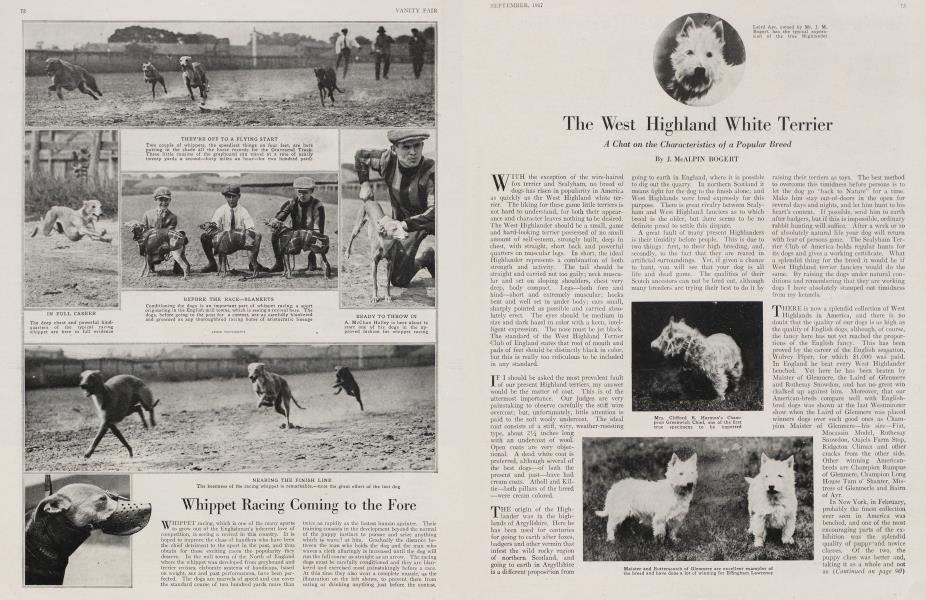
WITH the exception of the wire-haired fox terrier and Sealyham, no breed of dogs has risen in popularity in America as quickly as the West Highland white terrier. The liking for these game little terriers is not hard to understand, for both their appearance and character leaves nothing to be desired. The West Highlander should be a small, game and hard-looking terrier possessed of no small amount of self-esteem, strongly built, deep in chest, with straight, short back and powerful quarters on muscular legs. In short, the ideal Highlander represents a combination of both strength and activity. The tail should be straight and carried not too gaily; neck muscular and set on sloping shoulders, chest very deep, body compact. Legs—both fore and hind—short and extremely muscular; hocks bent and well set in under body; ears small, sharply pointed as possible and carried absolutely erect. The eyes should be medium in size and dark hazel in color with a keen, intelligent expression. The nose must be jet black. The standard of the West Highland Terrier Club of England states that roof of mouth and pads of feet should be distinctly black in color, but this is really too ridiculous to be included in any standard.
IF I should be asked the most prevalent fault of our present Highland terriers, my answer would be the matter of coat. This is of the uttermost importance. Our judges are very painstaking to observe carefully the stiff wire overcoat; but, unfortunately, little attention is paid to the soft wooly undercoat. The ideal coat consists of a stiff, wiry, weather-resisting type, about 2 1/4 inches long with an undercoat of wool.
Open coats are very objectional. A dead white coat is preferred, although several of the best dogs—of both the present and past—have had cream coats. Atholl and Kiltie—both pillars of the breed —were cream colored.
THE origin of the Highlander was in the highlands of Argyllshire. Here he has been used for centuries for going to earth after foxes, badgers and other vermin that infest the wild rocky region of northern Scotland, and going to earth in Argyllshire is a different proposition from going to earth in England, where it is possible to dig out the quarry. In northern Scotland it means fight for the dog to the finish alone; and West Highlands were bred expressly for this purpose. There is great rivalry between Sealyham and West Highland fanciers as to which breed is the older, but there seems to be no definite proof to settle this dispute.
A great fault of many present Highlanders is their timidity before people. This is due to two things: first, to their high breeding, and, secondly, to the fact that they are reared in artificial surroundings. Yet, if given a chance to hunt, you will see that your dog is all life and dead game. The qualities of their Scotch ancestors can not be bred out, although many breeders are trying their best to do it by raising their terriers as toys. The best method to overcome this timidness before persons is to let the dog go "back to Nature" for a time. Make him stay out-of-doors in the open for several days and nights, and let him hunt to his heart's content. If possible, send him to earth after badgers, but if this is impossible, ordinary rabbit hunting will suffice. After a week or so of absolutely natural life your dog will return with fear of persons gone. The Sealyham Terrier Club of America holds regular hunts for its dogs and gives a working certificate. What a splendid thing for the breed it would be if West Highland terrier fanciers would do the same. By raising the dogs under natural conditions and remembering that they are working dogs I have absolutely stamped out timidness from my kennels.
THERE is now a splendid collection of West Highlands in America, and there is no doubt that the quality of our dogs is as high as the quality of English dogs, although, of course, the fancy here has not yet reached the proportions of the English fancy. This has been proved by the career of the English sensation, Wolvey Piper, for which $1,000 was paid. In England he beat every West Highlander benched. Yet here he has been beaten by Maister of Glenmere, the Laird of Glenmere and Rothesay Snowdon, and has no great win chalked up against him. Moreover, that our American-breds compare well with Englishbred dogs was shown at the last Westminster show when the Laird of Glenmere was placed winners dogs over such good ones as Champion Maister of Glenmere—his sire—Fiat, Mocassin Model, Rothesay Snowdon, Oujels Farm Stop, Ridgeton Climax and other cracks from the other side. Other winning Americanbreds are Champion Rumpus of Glenmere, Champion Long House Tam o' Shanter, Mistress of Glenmerle and Bairn of Ayr.
In New York, in February, probably the finest collection ever seen in America was benched, and one of the most encouraging parts of the exhibition was the splendid quality of puppy and novice classes. Of the two, the puppy class was better and, taking it as a whole and not as individual specimens, was the best I have yet seen in America. Quality and class were even. The winner, Lorna Doone, however, did not have the class of last year's winner, Greentree Soldier Boy, who promised to cause quite a sensation. He was a litter brother to Bairn of Ayr, who went from puppy to winners at three shows last summer in succession and was retired to maternal duties with an unbeaten record.
(Continued on page 90)
(Continued from page 73)
THERE is no doubt that the international champion, Glenmohr Model, deserves the title of the greatest dog in America, both as a stud and show dog. He has proven his sterling qualities by siring some of the finest stocks in this country and in England, and has had a sensational show career. I do not believe he was ever at public stud, which was a great loss, for, with Atholl, Morven and Broyach, he is one of the pillars of the breed. Holland Buckley, an English authority on the breed, says: "Our American friends are lucky in their generation, for they possess in model probably the most dominant stud force in the world." Personally I consider the American-bred, the Laird of Glenmere, the finest West Highlander now being shown, for he has beaten, at one time or other, every dog he has ever met, including Champion Clarke's Hill Snooker, Crufts winner in 1916, and Wolvey Piper, Crufts winner in 1917. Laird is the only dog who has ever beaten Snooker, but, as I am his owner, I am, of course, prejudiced.
Mr. Effingham Lawrence's trio of champions, Maister and Rumpus of Glenmere and Butterscotch, have more wins to their credit than any other West Highlands now being shown. All are splendid specimens of old-fashioned type, absolutely sound. Maister seems unbeatable this spring, and must be near his third championship. Another splendid one is Champion Greenwich Cairn Fern, certainly one of our best. Mrs. Roy Rainey's brace of champions, ArdockChicf and Dunvegan Hero, are no longer to be seen on the show bench, but have become the companions of their owner.
THE quality of our bitches is not nearly so high as that of our dogs, although several stand out as perfection of correct type. The Rosstor Kennels Champion Walpole Witch— winners bitch at New York both last year and this—is perhaps the best, although she is closely pressed by her kennel mate, Cairn Rausa, for this honor. Walpole Winter and Wedgewood are two other excellent bitches housed in the Rosstor Kennels. It is greatly to be regretted that more bitches are not imported for the fancy. Certainly we must agree that without the best bitches we can not gain any foot-hold. We have the best studs that money can buy. We must have the quality of our bitches equal the quality of our studs.
Two important importations are the English champion, Wolvey Piper, and Rothesay Snowdon. Piper has seven challenge certificates to his credit, having won the last at Crufts last February. He is considered the best England has produced in years. I saw him for the first time at the Baltimore show. At that time I was disappointed in him, for he seemed very toyish—the one thing I can not endure; but he was shown painfully thin and had only arrived a few days before, so I could gain no fair opinion. At Richmond he had put on weight and looked in better condition, although he is not yet up to his English form.
ROTHESAY SNOWDON is another very beautiful terrier with rare head and out look, true front, smart, beautifully finished body and dead white coat. Every time I have seen him he was so short of coat that he should never have been shown, but in spite of this drawback he is well on his championship way. In coat and condition I look for him to beat everything in America.
From England comes the news that several others are consigned to America from the kennels of Mr. Viccar, Mrs. Pacey and other important English fanciers. The breed has not nearly reached the crest of popularity, for the fanciers actively interested in the breed are keen about it and are unwilling to see it anywhere but on the top.
A common mistake of our American judges—who do not specialize in the breed—is judging Highlanders as white Scottish terriers. In England it was a long, hard fight before fanciers persuaded the judges that the Highlander was not a "white 'un" and was absolutely a distinct breed and was not to be judged according to the standard of Scotties. We seem to be having the same problem here. To be sure, a great many of the earlier specimens, and some of the best today, closely resemble Scotties in type, but England has condemned this type and has substituted a newer type. Cairn Rausa represents this type to the extreme. He is so extreme that his rare quality has never been appreciated in this country.
The most important breeders of this type of terrier are the Rosstor Kennels at Hempstead, which house Clarke's Hill Snooker, Cairn Rausa, Moccasin Model, Walpole Witch, Winter Wedgewood and other good ones; the Greenwich Kennels at Greenwich, Conn., which include Champion Cairn Fern and Wolvey Piper; the Greentree Kennels at Manhasset, the property of that perfectly good sportswoman; Mrs. Payne Whitney; the Springmeade at Huntington; the Knoll at Florence, Mass., and the Ayr Kennels. Since April two new kennels have been started for this breed exclusively, by Robert Bacon, at Westbury, and by Mrs. J. S. Remscn at Bavside.
Subscribers have complete access to the archive.
Sign In Not a Subscriber?Join Now
