Sign In to Your Account
Subscribers have complete access to the archive.
Sign In Not a Subscriber?Join NowREVILLON FRÈRES in the ORIENT*
Trading Posts in Northern Siberia for the Collection of Sables and Ermine: Zavodes in Bokhara for Handling Broadtail and Persians. French, American and South American Furs.
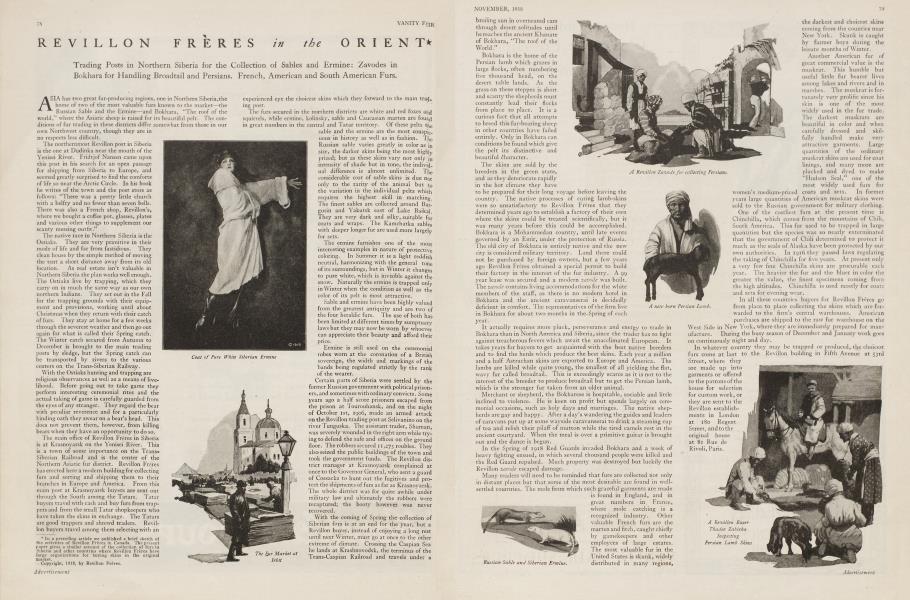
ASIA has two great fur-producing regions, one in Northern Siberia,the home of two of the most valuable furs known to the market—the Russian Sable and the Ermine—and Bokhara, "The roof of the world," where the Asiatic sheep is raised for its beautiful pelt. The conditions of fur trading in these districts differ somewhat from those in our own Northwest country, though they are in no respects less difficult.
The northernmost Revillon post in Siberia is the one at Dudinka near the mouth of the Yenisei River. Fridtjof Nansen came upon this post in his search for an open passage for shipping from Siberia to Europe, and seemed greatly surprised to find the comforts of life so near the Arctic Circle. In his book he writes of the town and the post store as follows: "There was a pretty little church, with a belfry and no fewer than seven bells.
There was also a French shop, Revillon's, where we bought a coffee pot, glasses, plates and various other things to supplement our scanty messing outfit."
The native race in Northern Siberia is the Ostiaks. They are very primitive in their mode of life and far from fastidious. They clean house by the simple method of moving the tent a short distance away from its old location. As real estate isn't valuable in Northern Siberia the plan works well enough.
The Ostiaks live by trapping, which they carry on in much the same way as our own northern Indians. They set out in the Fall for the trapping grounds with their equipment and provisions, working until about Christmas when they return with their catch of furs. They stay at home for a few weeks through the severest weather and then go out again for what is called their Spring catch.
The Winter catch secured from Autumn to December is brought to the main trading posts by sledge, but the Spring catch can be transported by rivers to the various centers on the Trans-Siberian Railway.
With the Ostiaks hunting and trapping are religious observances as well as a means of livelihood. Before going out to take game they perform interesting ceremonial rites and the actual taking of game is carefully guarded from the eyes of any stranger. They regard the bear with peculiar reverence and for a particularly binding oath they swear on a bear's head. This does not prevent them, however, from killing bears when they have an opportunity to do so.
The main office of Revillon Frères in Siberia is at Krasnoyarsk on the Yenisei River. This is a town of some importance on the TransSiberian Railroad and is the center of the Northern Asiatic fur district. Revillon Freres has erected here a modern building for collecting furs and sorting and shipping them to their branches in Europe and America. From this main post at Krasnoyarsk buyers are sent out through the South among the Tatars. Tatar buyers travel with cash and buy furs from trappers and from the small Tatar shopkeepers who have taken the skins in exchange. The Tatars are good trappers and shrewd traders. Revillon buyers travel among them selecting with an experienced eye the choicest skins which they forward to the main trading post.
The furs secured in the northern districts are white and red foxes and squirrels, while ermine, kolinsky, sable and Caucasian marten are found in great numbers in the central and Tatar territory. Of these pelts sable and the ermine are the most conspicuous in history as well as in fashion. The Russian sable varies greatly in color as in size, the darker skins being the most highly prized; but as these skins vary not only in intensity of shade but in tone, the individual difference is almost unlimited. The considerable cost of sable skins is due not only to the rarity of the animal but to the variation in the individual pelts which requires the highest skill in matching. The finest sables are collected around Bargusin and Yakutsk east of Lake Baikal. They are very dark and silky, suitable for coats and wraps. The Kamchatka sables with deeper longer fur are used more largely for sets.
The ermine furnishes one of the most interesting examples in nature of protective coloring. In Summer .it is a light reddish neutral, harmonizing with the general tone of its surroundings, but in Winter it changes to pure white, which is invisible against the snow. Naturally the ermine is trapped only in Winter when the condition as well as the color of its pelt is most attractive.
Sable and ermine have been highly valued from the greatest antiquity and are two of the four heraldic furs. The use of both has been limited at different times by sumptuary laws but they may now be worn by whoever can appreciate their beauty and afford their price.
Ermine is still used on the ceremonial robes worn at the coronation of a British sovereign, the width and markings of the bands being regulated strictly by the rank of the wearer.
Certain parts of Siberia were settled by the former Russian government with political prisoners, and sometimes with ordinary convicts. Some years ago a half score prisoners escaped from the prison at Tourouhansk, and on the night of October 1st, 1906, made an armed attack on the Revillon trading post at Selivanino on the river Tunguska. The assistant trader, Shuman, was severely wounded in the right arm while trying to defend the safe and offices on the ground floor. The robbers secured 11,275 roubles. They also seized the public buildings of the town and took the government funds. The Revillon district manager at Krasnoyarsk complained at once to the Governor General, who sent a guard of Cossacks to hunt out the fugitives and protect the shipments of furs as far as Krasnoyarsk. The whole district was for quite awhile under military law and ultimately the robbers were recaptured; the booty however was never recovered.
With the coming of Spring the collection of Siberian furs is at an end for the year, but a Revillon buyer, instead of enjoying a long rest until next Winter, must go at once to the other extreme of climate. Crossing the Caspian Sea The lands at Krashnovodsk, the terminus of the Trans-Caspian Railroad and travels under a broiling sun in overheated cars through desert solitudes until he reaches the ancient Khanate of Bokhara, "The roof of the World."
*In a preceding article we published a brief sketch of the activities of Revillon Frères in Canada. The present paper gives a similar account of the collection of furs in Siberia and other countries where Revillon Frères have large organizations for buying skins in the original market.
Copyright, 1918, by Revillon Frères.
Bokhara is the home of the Persian lamb which grazes in large flocks, often numbering five thousand head, on the desert table lands. As the grass on these steppes is short and scanty the shepherds must constantly lead their flocks from place to place. It is a curious fact that all attempts to breed this fur-bearing sheep in other countries have failed entirely. Only in Bokhara can conditions be found which give the pelt its distinctive and beautiful Character.
The skins are sold by the breeders in the green state, and as they deteriorate rapidly in the hot climate they have to be prepared for their long voyage before leaving the country. The native processes of curing lamb-skins were so unsatisfactory to Revillon Freres that they determined years ago to establish a factory of their own where the skins could be treated scientifically, but it was many years before this could be accomplished. Bokhara is a Mohammedan country, until late events governed by an Emir, under the protection of Russia. The old city of Bokhara is entirely native and the new city is considered military territory. Land there could not be purchased by foreign owners, but a few years ago Revillon Freres obtained a special permit to build their factory in the interest of the fur industry. A 99 year lease was secured and a modern zavode was built. The zavode contains living accommodations for the white members of the staff, as there is no modern hotel in Bokhara and the ancient caravanserai is decidedly deficient in comfort. The representatives of the firm live in Bokhara for about two months in the Spring of each year.
It actually requires more pluck, perseverance and energy to trade in Bokhara than in North America and Siberia, since the trader has to fight against treacherous fevers which await the unacclimated European. It takes years for buyers to get acquainted with the best native breeders and to find the herds which produce the best skins. Each year a million and a half Astrachan skins are exported to Europe and America. The lambs are killed while quite young, the smallest of all yielding the flat, wavy fur called broadtail. This is exceedingly scarce as it is not to the interest of the breeder to produce broadtail but to get the Persian lamb, which is the stronger fur taken from an older animal.
Merchant or shepherd, the Bokharese is hospitable, sociable and little inclined to violence. He is keen on profit but spends largely on ceremonial occasions, such as holy days and marriages. The native shepherds are gay and happy. After a day's wandering the guides and leaders of caravans put up at some wayside caravanserai to drink a steaming cup of tea and relish their pilaff of mutton while the tired camels rest in the ancient courtyard. When the meal is over a primitive guitar is brought out and the dance is begun.
In the Spring of 1918 Red Guards inyaded Bokhara and a week of heavy fighting ensued, in which several thousand people were killed and the Red Guard repulsed. Much property was destroyed but luckily the Revillon zavode escaped damage.
Many readers will need to be reminded that furs are collected riot only in distant places but that some of the most desirable are found in wellsettled countries. The mole from which such graceful garments are made is found in England, and in great numbers in France, where mole catching is a recognized industry. Other valuable French furs are the marten and fitch, caught chiefly by gamekeepers and other employees of large estates. The most valuable fur in the United States is skunk, widely distributed in many regions, the darkest and choicest skins coming from the counties near New York. Skunk is caught by farmer boys during the leisure months of Winter.
Another American fur of great commercial value is the muskrat. This humble but useful little fur bearer lives among lakes and rivers and in marshes. The muskrat is fortunately very prolific since his skin is one of the most widely used in the fur trade. The darkest muskrats are beautiful in color and when carefully dressed and skilfully handled make very attractive garments. Large quantities of the ordinary muskrat skins are used for coat linings, and many more are plucked and dyed to make "Hudson Seal," one of the most widely used furs for women's medium-priced coats and sets. In former years large quantities of American muskrat skins were sold to the Russian government for military clothing.
One of the costliest furs at the present time is Chinchilla, which comes from the mountains of Chili, South America. This fur used to be trapped in large quantities but the species was so nearly exterminated that the government of Chili determined to protect it much as the seals of Alaska have been protected by our own authorities. In 1916 they passed laws regulating the taking of Chinchilla for five years. At present only a very few fine Chinchilla skins are procurable each year. The heavier the fur and the bluer in color the greater the value, the finest specimens coming from the high altitudes. Chinchilla is used mostly for coats and sets for evening wear.
In all these countries buyers for Revillon Freres go from place to place collecting the skins which are forwarded to the firm's central warehouses. American purchases are shipped to the raw fur warehouse on the West Side in New York, where they are immediately prepared for manufacture. During the busy season of December and January work goes on continuously night and day.
In whatever country they may be trapped or produced, the choicest furs come at last to the Revillon building in Fifth Avenue at 53rd Street, where they are made up into garments or offered to the patrons of the house for selection for custom work, or they are sent to the Revillon establishments in London at 180 Regent Street, and to the original house at 81 Rue de Rivoli, Paris.
Subscribers have complete access to the archive.
Sign In Not a Subscriber?Join Now
