Sign In to Your Account
Subscribers have complete access to the archive.
Sign In Not a Subscriber?Join NowHope for American Racing
H. A. BUCK
With Such Staunch and Far-Sighted Supporters As R. T. Wilson, Jr.
THE recent action of the Stewards of the Jockey Club in electing Mr, R. T. Wilson to fill the vacancy in the Board caused by the sudden death of the late Schuyler L. Parsons, was more or less anticipated by the racing world.
It is the just reward of many years' devotion to the turf and its best interests, and is the highest honor that can be paid by the governing body of the American turf. In a sense, the Stewards of the Jockey Club correspond to the Supreme Court, as all cases of importance come before them for final adjudication, and their actions and decisions determine the general turf policy of the entire country. Their position is strengthened because of the fact that the Board is the licensing body for all trainers and jockeys, while the dates for the various race meetings of the East are sanctioned by them and the meetings themselves are run under their direction and very close supervision.
IN England and France, the Jockey Club (called, in France, the Societe D'Encouragement pour L'Amelioration des Races de Chevaux), is the most exclusive club of the country, and membership in it implies the highest social position. To a large extent this is true of the American Jockey. Club, its membership being confined to those prominent in the social, financial, racing and business world. The membership list of fifty includes such names as August Belmont, Perry Belmont, W. K. Vanderbilt, Harry Payne Whitney, Robert L. Gerry, Frank K. Sturgis, H. K. Knapp, John E. Cowdin, F. R. Hitchcock, Thomas Hitchcock, John Sanford, Andrew Miller, L. S. Thompson, W. P. Thompson, E. D. Morgan, Prescott Lawrence, W. C. Eustis, Clarence H. Mackay, George Peabody Wetmore, William Woodward, C. Oliver Iselin, Pierre Lorillard, H. T. Oxnard, A. K. Macomber, Major Edward B. Cassatt, Alexander Smith Cochran, Foxhall P. Keene, Edward F. Whitney, and others equally prominent in American life.
Mr. Wilson is socially well known in New York. One of his sisters is Mrs. Cornelius Vanderbilt, another is Mrs. Ogden Goelet. His brother, Mr. Orme Wilson, married Miss Caroline Astor.
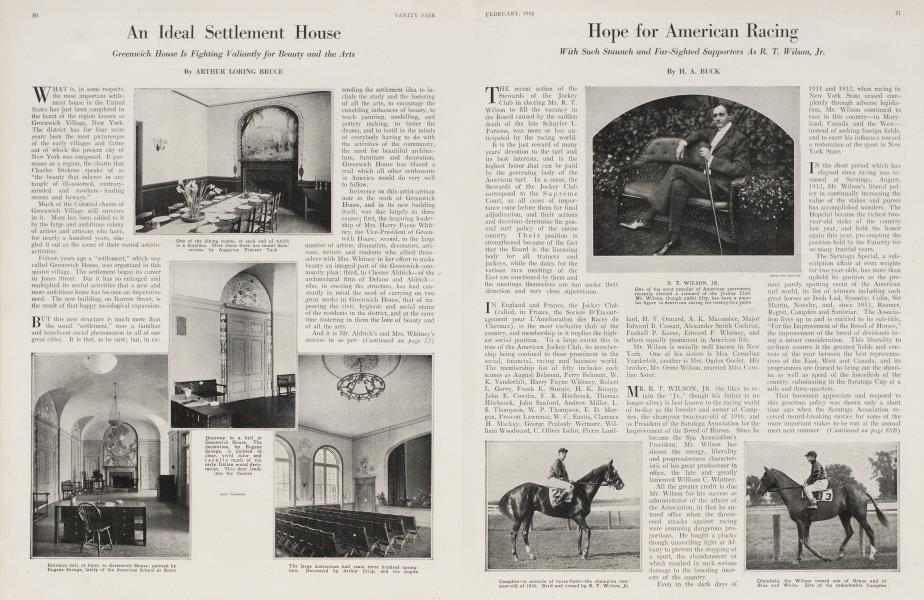
R. R. T. WILSON, JR. (he likes to retain the "Jr.," though his father is no longer alive) is best known to the racing world of to-day as the breeder and owner of Campfire, the champion two-year-old of 1916, and as President of the Saratoga Association for the Improvement of the Breed of Horses. Since he became the Spa Association's President, Mr. Wilson has shown the energy, liberality and progressiveness characteristic of his great predecessor in office, the late and greatly lamented William C. Whitney.
All the greater credit is due Mr. Wilson for his success as administrator of the affairs of the Association, in that he entered office when the threatened attacks against racing were assuming dangerous proportions. He fought a plucky though unavailing fight at Albany to prevent the stopping of a sport, the abandonment of which resulted in such serious damage to the breeding interests of the country.
Even in the dark days of 1911 and 1912, when racing in New York State ceased completely through adverse legislation, Mr. Wilson continued to race in this country—in Maryland, Canada and the West— instead of seeking foreign fields, and to exert his influence toward a restoration of the sport in New York State.
N the short period which has elapsed since racing was resumed at Saratoga, August, 1913, Mr. Wilson's liberal policy in continually increasing the value of the stakes and purses has accomplished wonders. The Hopeful became the richest twoyear-old stake of the country last year, and held the honor again this year, pre-empting the position held by the Futurity for so many fruitful years.
The Saratoga Special, a subscription affair at even weights for two-year-olds, has more than upheld its position as the premier purely sporting event of the American turf world, its list of winners including such great horses as Irish Lad, Sysonby, Colin, Sir Martin, Novelty, and, since 1913, Roamer, Regret, Campfire and Sunbriar. The Association lives up to and is entitled to its sub-title, "For the Improvement of the Breed of Horses," the improvement of the breed of dividends being a minor consideration. This liberality to turfmen assures it the greatest Yields and contests of the year between the best representatives of the East, West and Canada, and its programmes are framed to bring out the stamina as well as speed of the horseflesh of the country, culminating in the Saratoga Cup at a mile and three-quarters.
That horsemen appreciate and respond to this generous policy was shown only a short time ago when the Saratoga Association received record-breaking entries for some of the more important stakes to be run at the annual meet next summer. The rich Hopeful Stakes received 233 entries, as against 209 in 1916; the Spinaway, United States and Grand Union Hotel Slakes also showing similar encouraging increases. This increase also illustrates the confidence of owners and breeders in the future of the turf in this country, despite the Great War. In addition to increasing the value of their 1918 stakes the Association will spend $100,000 in improving the track itself and the condition of the stables.
(Continued on page 88B)
(Continued from page 51)
Encouragement of cross-country sport, so popular with the general public, has been a feature of the Saratoga Meeting for some years. Steeplechases for all classes of jumpers are given three times a week and the fields are usually large, the contests close, exciting, and high class.
THOMAS HITCHCOCK, now connected with the Aviation Corps, a Director of the Association and probably the cleverest all-round cross-country sportsman of the day, has been an important factor in the development and success of "sport between the flags'' at Saratoga, Mr. Wilson encouraging him in every possible way.
Though a comparatively young man (he is still comfortably under fifty), R. T. Wilson may now be called a "veteran of the turf," as he has been actively interested in it since 1893. An inherent love of the sport and the knowledge that his health would be greatly benefited through the outdoor life connected with it, were responsible for his advent in racing, and his interest has grown as time passed.
Starting with a small stable of four yearlings, three of which proved winners as two-year-olds, the successes of Knight of the Garter in particular were important factors in strengthening his natural fondness for the sport, as Irish Lad did in the case of Harry Payne Whitney and Herman Duryea.
"Tom" Healey, well known to all race-goers, had the largest public stable of that day, having under his charge horses owned by S. S. Howland, Ralph Ellis, Nathan Straus, Edward Kelly, E. A. Buck and B. F. Clyde, and to him Mr. Wilson entrusted his yearlings. Ever since that date, Healey has handled the Wilson stable exclusively, as its growth from four yearlings to an average of thirty horses each year, compelled him to forego all other public training. The only exception for many years was a small lot of cross-country horses (running in the name of the Milltown Stable), the property of a popular Irish Catholic priest which Healey continued to train for sentimental reasons.
Healey's integrity has always been beyond question, and for years he has ranked among the leading trainers. Mr. Wilson's confidence in him is absolute, and the tie that binds owner and trainer in this case is one of genuine and solid friendship and esteem.
Considering everything, Mr. Wilson's career on the turf has been a highly successful one. Notwithstanding off years, the Suburban, Brooklyn, Metropolitan, Brighton and Saratoga Handicaps, the Latonia Derby, Withers, Realization and other important three-year-old stakes, the Futurity, Jiopeful and Saratoga Special have all been won at various dates by horses carrying the Wilson colors. These comprise the star events of the American turf and few owners of to-day—probably only Mr. Belmont and Mr. Whitney—can lay claim to a larger or more impressive list of victories.
' The Paradcr was the earliest horse of class owned by Mr. Wilson, his three-year-old victories including the Withers and Realization of 1901.
OLAMBALA, sire of Campfire, was Mr. Wilson's next star, and few, if any, better "stayers" than the son of Ornus and Blue and White have been seen in this country in recent years. This was conclusively proved by his three-year-old victories in 1909,— the Latonia Derby at a mile and a half, and the Saratoga Cup and Municipal Handicap.
This great trio was followed the next year by his winning of the last Suburban, run at Sheepshead Bay, in which he handily defeated Ballot, the winner of many of the turf classics of the East. Then followed impressive wins in the Brighton and Saratoga Handicaps, in which latter he again defeated Ballot. Another sterling performance was his capture of the Commonwealth Handicap in 2:02 4/S, a record for many years, in which event as well as in several others, he easily took the measure of King James, considered by many one of the best horses of the country, possessing marvellous speed and stamina.
Another winner of a classic, was Mr. Wilson's Tartar, who captured the Brooklyn Handicap in 1915, having behind him such crack-a-jacks as Roamer and Borrow. Ormesdale, whose career may yet add more glory to the Wilson colors, proved the winner of the Metropolitan Handicap this Spring, as all racegoers will recall, from a high class field, Spur, Borrow, Stromboli and other highly considered horses.
RECORD-BREAKING performances are not so highly considered nowadays as formerly. Many records at a mile, have recently been made by mediocre animals such as Centre Shot, Manasseh, Vested Rights, Bonne Chance and Christophine (how many racing men recall these names to-day?), over phenomenally fast tracks such as Santa Anita, California, and Juarez, Mexico. However, whatever may be the glory of owning the mile race record holder of to-day is Mr. Wilson's, as his six-year-old gelding Amalfi secured that distinction by winning a mile race over the Syracuse, N. Y., track at the New York State Fair in 1914 in 1 :36 ¼.
R. T. Wilson's Campfire as a three-year-old proved a great disappointment, but his glory as the champion two-year-old, as in Domino's case, can never be removed from turf annals. His great victories, carrying heavy weights, in the Saratoga Special, The Hopeful, and the Futurity not only made him the greatest money winner of the year, but gave him the position of the champion two-year-old of 1916.
Owing to Campfire's victories in 1916, Mr. Wilson led the so-called legitimate list of winning owners with a total of $71,035. Campfire may yet return to his 1916 form and prove himself among the great sprinters, if not stayers, of the country.
AS a breeder, Mr. Wilson first entered the lists in 1916 when his first crop of yearlings, by Olambala, scored a remarkable success. Only five started— Campfire, Kildee, Hanobala, Fantam Bala and Mannchen. All proved winners during the season, the total winnings of the progeny of this remarkable sire being $56,280, which placed Olambala at the head of the list of sires of winning two-year-olds.
This was a sensational showing for the progeny of any sire in his first year. For several years Mr. Wilson has been collecting, at the Kirklevington Stud, Kentucky, a choice band of brood mares of the best blood lines, and that he will soon be ranked among the most successful breeders of the country there is every reason to believe.
Subscribers have complete access to the archive.
Sign In Not a Subscriber?Join Now
