Sign In to Your Account
Subscribers have complete access to the archive.
Sign In Not a Subscriber?Join NowBroadway By Candlelight
Simple Games for Young and Old to While Away the Long Dark Nights
ROBERT C. BENCHLEY
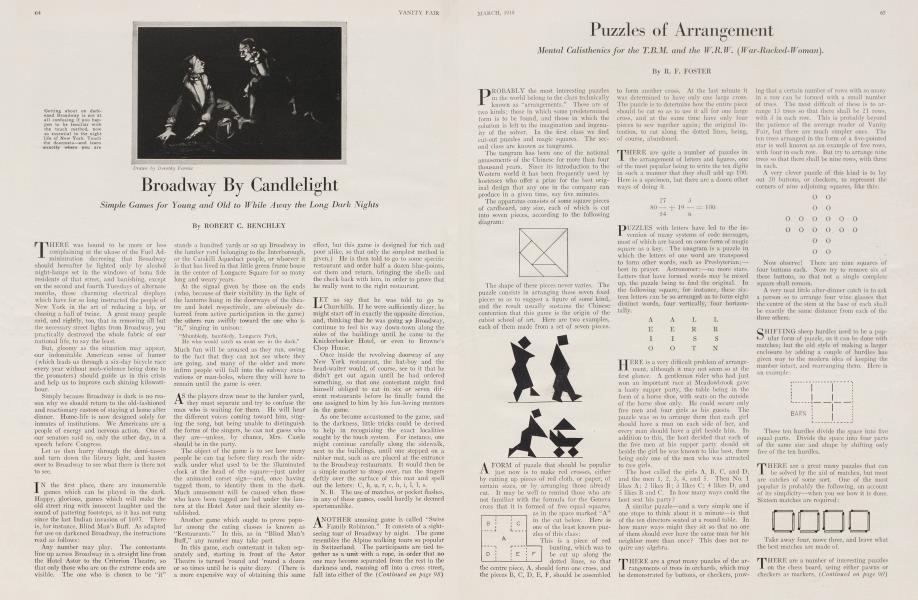
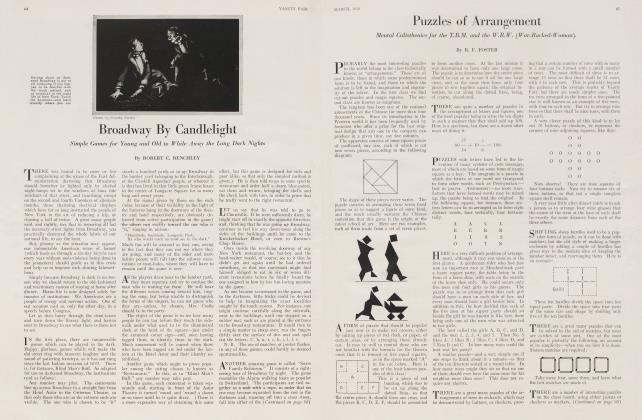
THERE was bound to be more or less complaining at the ukase of the Fuel Administration decreeing that Broadway should hereafter be lighted only by alcohol night-lamps set in the windows of bona fide residents of that street, and banishing, except on the second and fourth Tuesdays of alternate months, those charming electrical displays which have for so long instructed the people of New York in the art of reducing a hip, or chasing a ball of twine. A great many people said, and rightly, too, that in removing all but the necessary street lights from Broadway, you practically destroyed the whole fabric of our national life, to say the least.
But, gloomy as the situation may appear, our indomitable American sense of humor (which leads us through a six-day bicycle race every year without mob-violence being done to the promoters) should guide us in this crisis and help us to improve each shining kilowatthour.
Simply because Broadway is dark is no reason why we should return to the old-fashioned and reactionary custom of staying at home after dinner. Home-life is now designed solely for inmates of institutions. We Americans are a people of energy and nervous action. One of our senators said so, only the other day, in a speech before Congress.
Let us then hurry through the demi-tasses and turn down the library light, and hasten over to Broadway to see what there is there not to see.
IN the first place, there are innumerable games which can be played in the dark. Happy, glorious, games which will make the old street ring with innocent laughter and the sound of pattering footsteps, as it has not rung since the last Indian invasion of 1697. There is, for instance, Blind Man's Buff. As adapted for use on darkened Broadway, the instructions read as follows:
Any number may play. The contestants line up across Broadway in a straight line from the Hotel Astor to the Criterion Theatre, so that only those who are on the extreme ends are visible. The one who is chosen to be "it" stands a hundred yards or so up Broadway in the lumber yard belonging to the Interborough, or the Catskill Aqueduct people, or whoever it is that has lived in that little green frame house in the center of Longacre Square for so many long and weary years.
At the signal given by those on the ends (who, because of their visibility in the light of the lanterns hung in the doorways of the theatre and hotel respectively, are obviously debarred from active participation in the game.) the others run swiftly toward the one who is "it," singing in unison:
"Mumbledy, bumbledy, Longacre Park,
He who would catch us must see in the dark."
Much fun will be aroused as they run, owing to the fact that they can not see where they are going, and many of the older and more infirm people will fall into the subway excavations or man-holes, where they will have to remain until the game is over.
AS the players draw near to the lumber yard, they must separate and try to confuse the man who is waiting for them. He will hear the different voices coming toward him, singing the song, but being unable to distinguish the forms of the singers, he can not guess who they are—unless, by chance, Mrs. Castle should be in the party.
The object of the game is to see how many people he can tag before they reach the sidewalk under what used to be the illuminated clock at the head of the square—just under the animated corset sign—and, once having tagged them, to identify them in the dark. Much amusement will be caused when those who have been tagged are led under the lantern at the Hotel Astor and their identity established.
Another game which ought to prove popular among the eating classes is known as "Restaurants." In this, as in "Blind Man's Buff," any number may take part.
In this game, each contestant is taken separately and, starting in front of the Astor Theatre is turned 'round and 'round a dozen or so times until he is quite dizzy. (There is a more expensive way of obtaining this same effect, but this game is designed for rich and poor alike, so that only the simplest method is given.) He is then told to go to some specific restaurant and order half a dozen blue-points, eat them and return, bringing the shells and the check back with him, in order to prove that he really went to the right restaurant.
LET us say that he was told to go to Churchills. If he were sufficiently dizzy, he might start off in exactly the opposite direction, and, thinking that he was going up Broadway, continue to feel his way down-town along the sides of the buildings until he came to the Knickerbocker Hotel, or even to Browne's Chop House.
Once inside the revolving doorway of any New York restaurant, the hat-boy and the head-waiter would, of course, see to it that he didn't get out again until he had ordered something, so that one contestant might find himself obliged to eat in six or seven diferent restaurants before he finally found the one assigned to him by his fun-loving mentors in the game.
As one became accustomed to the game, and to the darkness, little tricks could be devised to help in recognizing the exact localities sought by the touch system. For instance, one might continue carefully along the sidewalk, next to the buildings, until one stepped on a rubber mat, such as are placed at the entrance to the Broadway restaurants. It would then be a simple matter to stoop over, run the fingers deftly over the surface of this mat and spell out the letters: C, h, u, r, c, h, i, l, l, s.
N. B. The use of matches, or pocket flashes, in any of these games, could hardly be deemed sportsmanlike.
ANOTHER amusing game is called "Swiss Family Robinson." It consists of a sightseeing tour of Broadway by night. The game resembles the Alpine walking tours so popular in Switzerland. The participants are tied together as a unit with a rope, in order that no one may become separated from the rest in the darkness and, roaming off into a cross street, fall into either of the rivers that bound New York on the East and West.
Continued on page 98
(Continued from page 64)
Starting at Forty-second Street, the party (with miners' lamps in their hats, and Alpine stocks to help them in feeling their way along the pavements and in scaling the permanent temporary structures which have been erected by the city all along the route) will proceed up Broadway through Times Square. This intersection of streets can easily be distinguished by the sensation of walking on planks, a sensation easily explained by the fact that you are walking on planks. Bearing right to car tracks, locate the cable-slot with the toe of the boot and continue straight along this through the square. Care should be taken that the cable-slot is that of the Broadway cars and not of the Seventh Avenue line, otherwise you will find yourself ending up wherever it is that Seventh Avenue ends up—and probably at a very late hour.
ONCE you are out of the square and safely on Broadway, the rest should be easy, so long as you keep feeling along the car track with the toe of your boot. There will, of course, be times when this is impracticable, as, for instance, when an oncoming street car exercises its unquestioned prerogative and uses the track for its own purposes.
Continuing on good macadam through six comers (Columbus Circle); avoiding Central Park pond, at right (this can easily be distinguished by a wet feeling the moment the foot is immersed in the fluid), turn left at Century Theatre, where, in accordance with an old, old custom in New York, all parties devoted to pleasure, must end.
THESE are, of course, only a few of the ways in which we may all overcome the handicap of lightless nights on Broadway by bringing our native inventiveness to play. Incidentally we can, in this way, assist Dr. Garfield in carrying coals to Newcastle, where, no doubt, they will be used by him in some worthy and essential industry.
We regret, in finishing this article, that lack of space has forced us to omit the one best method of finding one's way on Broadway after dark, namely, to get a lady to lead you.
Subscribers have complete access to the archive.
Sign In Not a Subscriber?Join Now
