Sign In to Your Account
Subscribers have complete access to the archive.
Sign In Not a Subscriber?Join NowThe People Who Sit in Back of Me
Fiends That Take the Joy Out of the Life of a Theatre-goer
HENRIETTE ROUSSEAU
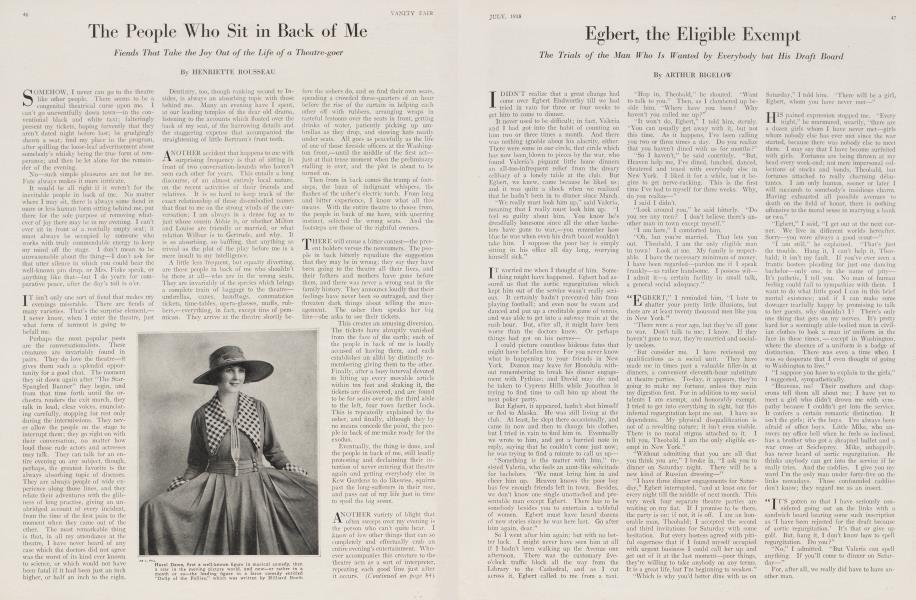
SOMEHOW, I never can go to the theatre like other people. There seems to be a congenital theatrical curse upon me. I can't go uneventfully down town—in the conventional black and white taxi; falteringly present my tickets, hoping fervently that they aren't dated night before last; be grudgingly shown a seat; find my place in the program, after spilling the loose-leaf advertisement about somebody's whisky being the true form of temperance; and then be let alone for the remainder of the evening.
No—such simple pleasures are not for me. Fate always makes it more intricate.
It would be all right if it weren't for the inevitable people in back of me. No matter where I may sit, there is always some fiend in more or less human form sitting behind me, put there for the sole purpose of removing whatever of joy there may be in my evening. I can't ever sit in front of a restfully empty seat; it must always be occupied by someone who works with truly commendable energy to keep my mind off the stage. I don't mean to be unreasonable about the thing—I don't ask for that utter silence in which you could hear the well-known pin drop, or Mrs. Fiske speak, or anything like that—but I do yearn for comparative peace, after the day's toil is o'er.
IT isn't only one sort of fiend that makes my evenings miserable. There are fiends of many varieties. That's the surprise element,— I never know, when I enter the theatre, just what form of torment is going to befall me.
Perhaps the most popular pests are the conversationalists. These creatures are invariably found in pairs. They do love the theatre—it gives them such a splendid opportunity for a good chat. The moment they sit down again after "The StarSpangled Banner" they begin, and from that time forth until the orchestra renders the exit march, they talk in loud, clear voices, enunciating carefully, stopping for rest only during the intermissions. They never allow the people on the stage to interrupt them; they go right on with their conversation, no matter how loud those rude actors and actresses may talk. They can talk for an entire evening on any subject, though, perhaps, the greatest favorite is the always absorbing topic of diseases.
They are always people of wide experience along those lines, and they relate their adventures with the glibness of long practise, giving an unabridged account of every incident, from the time of the first pain to the moment when they came out of the ether. The most remarkable thing is that, in all my attendance at the theatre, I have never heard of any case which the doctors did not agree was the worst of its kind ever known to science, or which would not have been fatal if it had been just an inch higher, or half an inch to the right.
Dentistry, too, though ranking second to Insides, is always an absorbing topic with those behind me. Many an evening have I spent, at our leading temples of the dear old drama, listening to the accounts which floated over the back of my seat, of the harrowing details and the staggering expense that accompanied the straightening of little Bertram's front teeth.
ANOTHER accident that happens to me with surprising frequency is that of sitting in front of two conversation-hounds who haven't seen each other for years. This entails a long discourse, of an almost entirely local nature, on the recent activities of their friends and relatives. It is so hard to keep track of the exact relationship of those disembodied names that float to me on the strong winds of the conversation; I am always in a dense fog as to just whose cousin Abbie is, or whether Milton and Louise are friendly or married, or what relation Wilbur is to Gertrude, and why. It is so absorbing, so baffling, that anything as trivial as the plot of the play before me is a mere insult to my intelligence.
A little less frequent, but equally diverting, are those people in back of me who shouldn't be there at all—who are in the wrong seats. They are invariably of the species which brings a complete train of baggage to the theatre— umbrellas, canes, handbags, commutation tickets, time-tables, opera-glasses, muffs, rubbers,—everything, in fact, except tins of pemmican. They arrive at the theatre shortly before the ushers do, and so find their own seats, spending a crowded three-quarters of an hour before the rise of the curtain in helping each other off with rubbers, arranging wraps in tasteful festoons over the seats in front, getting drinks of water, patiently picking up umbrellas as they drop, and stowing hats neatly under seats. All goes as peacefully as the life of one of those fireside officers at the Washington front,—until the middle of the first act— just at that tense moment when the preliminary stalling is over, and the plot is about to be turned on.
Then from in back comes the tramp of footsteps, the buzz of indignant whispers, the flashes of the usher's electric torch. From long and bitter experience, I know what all this means. With the entire theatre to choose from, the people in back of me have, with unerring instinct, selected the wrong seats. And the footsteps are those of the rightful owners.
THERE will ensue a bitter contest—the present holders versus the newcomers. The people in back bitterly repudiate the suggestion that they may be in wrong; they say they have been going to the theatre all their lives, and their fathers and mothers have gone before them, and there was never a wrong seat in the family history. They announce loudly that their feelings have never been so outraged, and they threaten dark things about telling the management. The usher then speaks her big line—she asks to see their tickets.
This creates an amusing diversion. The tickets have abruptly vanished from the face of the earth; each of the people in back of me is loudly accused of having them, and each establishes an alibi by distinctly remembering giving them to the other. Finally, after a busy interval devoted to lifting up every movable article within ten feet and shaking it, the tickets are discovered, and are found to be for seats over on the third aisle to the left, four rows farther back. This is repeatedly explained by the usher, and finally, although they by no means concede the point, the people in back of me make ready for the exodus.
Eventually, the thing is done, and the people in back of me, still loudly protesting and declaiming their intention of never entering that theatre again and getting everybody else in Kew Gardens to do likewise, squirm past the long-sufferers in their row, and pass out of my life just in time to spoil the big scene.
ANOTHER variety of blight that often sweeps over my evening is the person who can't quite hear. I know of few other things that can so completely and effectually crab an entire evening's entertainment. Whoever accompanies this creature to the theatre acts as a sort of interpreter, repeating each good line just after it occurs. This makes everything harder. If there are many good lines, the interpreter is always two or three jumps behind the dialogue on the stage, and it becomes hopelessly impossible ever to bring it up to date. I will say, however, that this hasn't occurred many times at this season's plays. Usually there has been ample time for the blight behind me to repeat the good line, slowly and carefully, and then settle down for a good, long rest for the remainder of the night.
(Continued on page 84)
(Continued from page 46)
THERE is another form of line repeaters; these do it for their own amusement, not from any high motive about helping out a fellow creature. They think it encumbent upon them, whenever a joke is uttered on the stage, to repeat it, in a shriek of amusement, before they feel free to laugh at it. They also sit behind me in the movies, where they dutifully read every caption aloud.
Other vivacious pests are the chronic applauders. These creatures applaud almost incessantly, throughout the play. They are the kind who raise their hands on high, so that their applause may be visible, as well as audible. They usually have some acquaintance on the stage, whose every utterance must be deafeningly appreciated, just to show that friends are near. They feel, too, that they can do their bit in the theatre; at every mention of the president, the flag, the army, or the navy, they applaud so strenuously that the next ten minutes of the drama are completely lost. When the finale of all nations is put on, with Russia in the conventional boots and America in white tights with a flag hanging from the shoulders, they nearly wear out their hands in their frenzy.
AND then there are the lovers. They are always met with at musical comedies, or at those awfully sweet, clean little romantic plays. They always behave in the theatre as if they were the only ones in the house. I do wish they could be segregated until after marriage. Everything on the stage reminds them of something in their own lives; all the songs about love, all the stage proposals are just like their own experiences, and necessitate much squeezing of hands and interchanging of meaning glances. The comedian's witticisms on the always fruitful subjects of love and marriage they think are simply killing; they explode with laughter and nudge each other at every line.
PERHAPS the most entertaining of all those who sit behind me are the people who know all the inside information about the actors and actresses. There are few things in this dreary world more diverting than listening to someone loudly informing his or her—usually her— companion that Ethel Barrymore is John Drew's daughter, or that Elsie Ferguson is married to Senator Clark, or that Roszika and Yansci Dolly are really not related. On absolutely reliable, firsthand information, they know all the most intimate details about the private lives of stage people. They know these things for facts—the leading lady's best friends sits next them in the Red Cross workroom, or they have the same hairdresser as the wife of the leading man, or something equally indisputable. They discourse on temperaments, eccentricities, relationships, and previous conditions of matrimony all evening, and have enough left over to last them all the way home in the Broadway car. It is rather like being read aloud to from "Snappy Stories" to hear them talk. Judging from the tales I have heard them relate about the private lives of actors and actresses, free love, as we non-stage people know of it, is still in its infancy.
Only a trifle less insistent in their display of knowledge are those who always see the play in a blur of wrong impressions. They lose their programs early in the evening, and they go on, playing a nice, clean parlor game, the object of which is to guess who is playing each part. In more virulent cases, these fiends are even in a haze as to the play itself. A memorable evening was recently had by all at "The Wild Duck," to which the large, blonde, over-manicured lady in back of me had come under the delusion that she was going to see "The Squab Farm," and waited patiently all evening long for those vulgar lines that all the critics wrote about.
But after all, if you must have a happy ending, those fiends who infest my evenings do have their bright side. In fact, when I look back over the season, I feel that I really owe them a great debt*. For there was always this about them—they took my mind off the play.
Subscribers have complete access to the archive.
Sign In Not a Subscriber?Join Now
