Sign In to Your Account
Subscribers have complete access to the archive.
Sign In Not a Subscriber?Join NowArtemus Ward and "Vanity Fair"
A Retrospect of the Early Days of the Magazine Under Its Third Editor
HERBERT TURNER
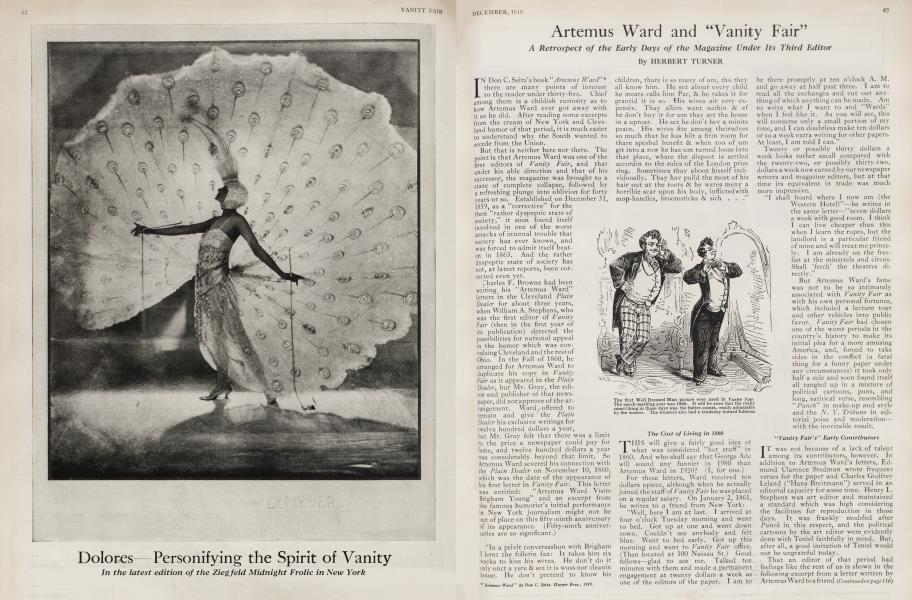
IN Don C. Seitz's book "Artemus Ward"* there are many points of interest to the reader under thirty-five. Chief among them is a childish curiosity as to how Artemus Ward ever got away with it as he did. After reading some excerpts from the cream of New York and Cleveland humor of that period, it is much easier to understand why the South wanted to secede from the Union.
But that is neither here nor there. The point is that Artemus Ward was one of the first editors of Vanity Fair, and that under his able direction and that of his successor, the magazine was brought to a state of complete collapse,followed by a refreshing plunge into oblivion for forty years or so. Established on December 31, 1859, as a "corrective" for the then "rather dyspeptic state of society," it soon found itself involved in one of the worst attacks of internal trouble that society has ever known, and was forced to admit itself beaten in 1863. And the rather dyspeptic state of society has not, at latest reports, been corrected even yet.
Charles F. Browne had been writing his "Artemus Ward" letters in the Cleveland Plain dealer for about three years, when William A. Stephens, who was the first editor of Vanity Fair (then in the first year of its publication) detected the possibilities for national appeal in the humor which was convulsing Cleveland and the rest of Ohio. In the Fall of 1860, he arranged for Artemus Ward to duplicate his copy in Vanity Fair as it appeared in the Plain Dealer, but Mr. Gray, the editor and publisher of that newspaper, did not approve of the arrangement. Wardy offered to remain and give the Plain Dealer his exclusive writings for twelve hundred dollars a year, but Mr. Gray felt that there was a limit to the price a newspaper could pay for fame, and twelve hundred dollars a year was considerably beyond that limit. So Artemus Ward severed his connection with the Plain Dealer on November 10, 1860, which was the date of the appearance of his first letter in Vanity Fair. This letter was entitled: "Artemus Ward Visits
Brigham Young" and an excerpt from the famous humorist's initial performance in New York journalism might not be out of place on this fifty-ninth anniversary of its appearance. (Fifty-ninth anniversaries are so significant.)
"In a privit conversashun with Brigham I lernt the follerin fax: It takes him six weeks to kiss his wives. He don't do it only onct a yere & sez it is wuss nor cleanin house. He don't pretend to know his children, thare is so many of um, tho they all know him. He sez about every child he meats calls him Par, & he takes it for grantid it is so. His wives air very expensiv. Thay allers want suthin & ef he don't buy it for um thay set the house in a uproar. He sez he don't hev a minits peace. His wives fite amung theirselves so much that he has bilt a fitin room for thare speshul benefit & when too of um git into a row he has um turned loose into that place, whare the dispoot is settled accordin to the rules of the London prize ring. Sometimes thay abooz hisself lndividooally. Thay hav pulld the most of his hair out at the roots & he wares meny a horrible scar upon his body, inflictedwith mop-handles, broomsticks & sich . . ."
*" Artemus Ward" b Don C. Seitz. Harter Bros., 1919.
The Cost of Living in 1860
THIS will give a fairly good idea ot what was considered "hot stuff" in 1860. And who shall say that George Ade will sound any funnier in 1980 than Artemus Ward in 1920? (I, for one.)
For these letters, Ward received ten dollars apiece, although when he actually joined the staff of Vanity Fair he was placed on a regular salary. On January 2, 1861, he writes to a friend from New York:
"Well, here I am at last. I arrived at four o'clock Tuesday morning and went to bed. Got up at one and went down town. Couldn't see anybody and felt blue. Went to bed early. Got up this morning and went to Vanity Fair office. (Then located at 100 Nassau St.) Good fellows—glad to see me. Talked. ten. minutes with them and made a permanent engagement at twenty dollars a week as one of the editors of the paper. I am to be there promptly at ten o'clock A. M. and go away at half past three. I am to read all the exchanges and cut out anything of which anything can be made. Am to write what I want to and "Wards" when I feel like it. As you will see, this will consume only a small portion of my time, and I can doubtless make ten dollars or so a week extra writing for other papers. At least, I am told I can."
Twenty or possibly thirty dollars a week looks rather small compared with the twenty-two, or possibly thirty-two, dollars a week now earned by our newspaper writers and magazine editors, but at that time its equivalent in trade was much more impressive.
"I shall board where I now am (the Western Hotel)"—he writes in the same letter—"seven dollars a week with good room. I think I can live cheaper than this when I learn the ropes, but the landlord is a particular friend of mine and will treat me princely. I am already on the freelist at the minstrels and circus. Shall 'fetch' the theatres directly."
But Artemus Ward's fame was not to be so intimately associated with Vanity Fair as with his own personal fortunes, which included a lecture tour and other vehicles into public favor. Vanity Fair had chosen one of the worst periods in the country's history to make its initial plea for a more amusing America, and, forced to take sides in the conflict (a fatal thing for a funny paper under any circumstances) it took only half a side and soon found itself all tangled up in a mixture of political cartoons, puns, and long, satirical verse, resembling "Punch" in make-up and style and the N. Y. Tribune in editorial poise and moderation— with the inevitable result.
"Vanity Fair's" Early Contributors
IT was not because of a lack of talent among its contributors, however. In addition to Artemus Ward's letters, Edmund Clarence Stedman wrote frequent verses for the paper and Charles Godfrey Leland ("Hans Breitmann") served in an editorial capacity for some time. Henry L. Stephens was art editor and maintained a standard which was high considering the facilities for reproduction in those days. It was frankly modeled after Punch in this respect, and the political cartoons by the art editor were evidently done with Teniel faithfully in mind. But, after all, a good imitation of Teniel would not be ungrateful today.
That an editor of that period had feelings like the rest of us is shown in the following excerpt from a letter written by Artemus Ward to a friend "By the way, Vanity Fair is set up by girls, and the printing-office is next door to the editorial office. They are devilish i ne girls, and I took two of them to Bryant's last night, but I am a man of strict honor."
(Continued on page 116)
(Continuedfrom page 63)
So long as he continued to take them out two at a time, the humorist was safe, and we have no record that he ever narrowed his attentions down to anything more intimate.
There had been a change, however, in Ward's living arrangements, which may have given him greater lee-way in his social expenditures. On January 22 he writes:
"I am now rooming with the publisher of Vanity Fair at No. 28 East 28th St. We have a parlor, bathroom, closets, fire, gas, and breakfast sent to the room for four dollars a week each. Our dinners we get down-town, a shilling getting a beefsteak pie or a piece of baked beef . . . . I mention these things so that if you come here by and by you will come to the office and go home with me. I can keep you like a fighting cock for a few shillings a day. Such beef as we get at Crook & Duff's you never saw since God made you . ... I am glad Alphonsus is exerting himself. A man ought to for six dollars a week."
The Beginning of the End
BUT things were not going so well on Vanity Fair. Mr. Leland was a strong abolitionist and wanted to make the magazine radical in its stand. Thompson and Stephens, the owner and publisher respectively, were both Democrats, and although loyal to the Union, felt that there might still be some way out of the trouble. When Fort Sumpter was fired on, Leland decided that it was time for him to leave Vanity Fair and express himself as he felt, which he succeeded in doing to his heart's content in Boston through the Continental Magazine. Artemus Ward was given Leland's place as managing Editor of Vanity Fair.
But as the summer wore on, things went from bad to worse. The war made it impossible to appeal to the comic spirit of the nation, because the national comic spirit was practically non-existent, and as a satirical sheet, Vanity Fair was a bit george-harvey. Artemus liked being editor, with the exception of the work which was involved. Especially distasteful was that part of the work which dealt with finances. There was a sort of freeand-easy method of payment of contributors, whereby the articles were written and printed, and then, whenever some extra money, over and above the running expense, came into the office, some of it was sent out to the waiting authors. William Dean Howells, who had sold some verses to the magazine in 1861, writes: "I sailed without the money, but I hardly expected that, for the editor, who was then Artemus Ward, had frankly told me in taking my address that ducats were few at that moment with Vanity Fair."
Artemus Ward then became a national figure on the platform, and his fame eclipsed the short-lived memory of the magazine which had brought him to New York and the world. But could he sell one of his letters to the present editor of Vanity Fair, even for ten dollars? It is doubtful.
And neither, by the same token, could the present editors sell any of their articles to the editors who will be presiding over Vanity Fair in 1990. Thus do we progress toward the Perfect Satire.
Subscribers have complete access to the archive.
Sign In Not a Subscriber?Join Now
