Sign In to Your Account
Subscribers have complete access to the archive.
Sign In Not a Subscriber?Join NowDon Juan's Lament
Melancholy Reflections of the Romantic Hero Who Couldn't Fall in Love
GIOVANNI PAPINI
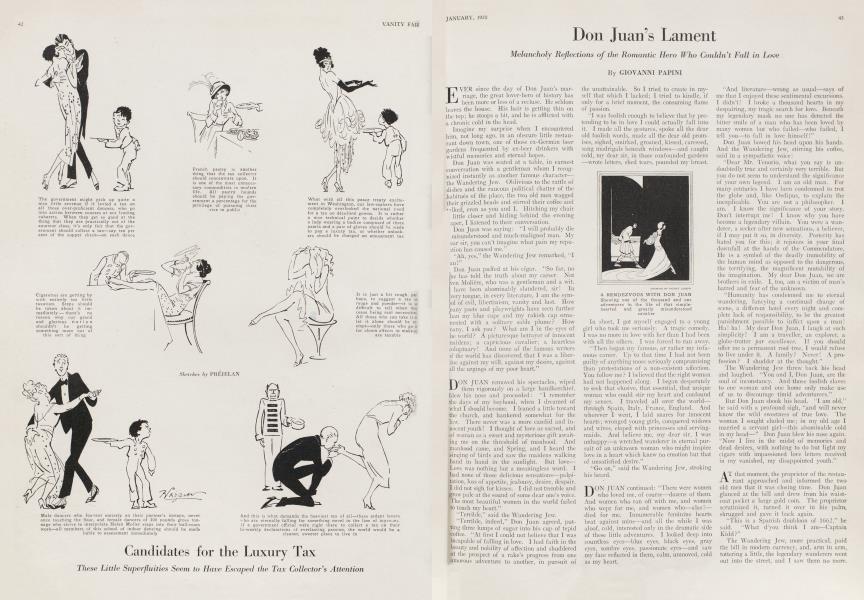
EVER since the day of Don Juan's marriage, the great lover-hero of history has been more or less of a recluse. He seldom leaves the house. His hair is getting thin on the top; he stoops a bit, and he is afflicted with a chronic cold in the head.
Imagine my surprise when I encountered him, not long ago, in an obscure little restaurant down town, one of those ex-German beer gardens frequented by ex-beer drinkers with wistful memories and eternal hopes.
Don Juan was seated at a table, in earnest conversation with a gentleman whom I recognized instantly as another famous character— the Wandering Jew. Oblivious to the rattle of dishes and the raucous political chatter of the habitues of the place, the two old men wagged their grizzled heads and stirred their coffee and talked, even as you and I. Hitching my chair little closer and hiding behind the evening aper, I listened to their conversation.
Don Juan was saying: "I will probably die misunderstood and much-maligned man. My ear sir, you can't imagine what pain my repuition has caused me."
"Ah, yes," the Wandering Jew remarked, "I an!"
Don Juan puffed at his cigar. "So far, no ne has told the truth about my career. Not ven Moliere, who was a gentleman and a wit. have been abominably slandered, sir! In very tongue, in ever}' literature, I am the symbol of evil, libertinism, vanity and lust. How nany poets and playwrights have seen further ban my blue cape and my rakish cap ornanented with a solitary sable plume? How nany, I ask you ? What am I in the eyes of he world ? A picturesque betrayer of innocent maidens; a capricious cavalier; a heartless woluptuary! And none of the famous writers of the world has discovered that I was a liberine against my will, against my desire, against all the urgings of my poor heart."
DON JUAN removed his spectacles, wiped them vigorously on a large handkerchief, blew his nose and proceeded: "I remember the days of my boyhood, when I dreamed of what I should become. I leaned a little toward the church, and hankered somewhat for the law. There never was a more candid and inmocent youth! I thought of love as sacred, and of woman as a sweet and mysterious gift awaiting me on the threshold of manhood. And manhood came, and Spring, and I heard the singing of birds and saw the maidens walking hand in hand in the sunlight. But love— Love was nothing but a meaningless word. I had none of those delicious sensations—palpiation, loss of appetite, jealousy, desire, despair. I did not sigh for kisses. I did not tremble and grow pale at the sound of some dear one's voice. The most beautiful women in the world failed to touch my heart."
"Terrible," said the Wandering Jew.
"Terrible, indeed," Don Juan agreed, putting three lumps of sugar into his cup of tepid coffee. "At first I could not believe that I was ncapable of falling in love. I had faith in the beauty and nobility of affection and shuddered at the prospect of a rake's progress from one amorous adventure to another, in pursuit of the unattainable. So I tried to create in myself that which I lacked; I tried to kindle, if only for a brief moment, the consuming flame of passion.
"I was foolish enough to believe that by pretending to be in love I could actually fall into it. I made all the gestures, spoke all the dear old foolish words, made all the dear old promises, sighed, smirked, groaned, kissed, caressed, sang madrigals beneath windows—and caught cold, my dear sir, in those confounded gardens —wrote letters, shed tears, pounded my breast. In short, I got myself engaged to a young girl who took me seriously. A tragic comedy. I was no more in love with her than I had been with all the others. I was forced to run away.
"Then began my famous, or rather my infamous career. Up to that time I had not been guilty of anything more seriously compromising than protestations of a non-existent affection. You follow me ? I believed that the right woman had not happened along. I began desperately to seek that elusive, that essential, that unique woman who could stir my heart and confound my senses. I traveled all over the world— through Spain, Italy, France, England. And wherever I went, I laid snares for innocent hearts; wronged young girls, conquered widows and wives, eloped with princesses and servingmaids. And believe me, my dear sir, I was unhappy—a wretched wanderer in eternal pursuit of an unknown woman who might inspire love in a heart which knew no emotion but that of unsatisfied desire."
"Go on," said the Wandering Jew, stroking his beard.
DON JUAN continued: "There were women who loved me, of course—dozens of them. And women who ran off with me, and women who wept for me, and women who—alas!— died for me. Innumerable feminine hearts beat against mine—and all the while I was aloof, cold, interested only in the dramatic side of these little adventures. I looked deep into countless eyes—blue eyes, black eyes, gray eyes, sombre eyes, passionate eyes—and saw my face reflected in them, calm, unmoved, cold as my heart. "And literature—wrong as usual—says of me that I enjoyed these sentimental excursions.
I didn't! I broke a thousand hearts in my despairing, my tragic search for love. Beneath my legendary mask no one has detected the bitter smile of a man who has been loved by many women but who failed—who failed, I tell you—to fall in love himself!"
Don Juan bowed his head upon his hands. And the Wandering Jew, stirring his coffee, said in a sympathetic voice:
"Dear Mr. Tenorio, what you say is undoubtedly true and certainly very terrible. But you do not seem to understand the significance of your own legend. I am an old man. For many centuries I have been condemned to trot the globe and, like Oedipus, to explain the inexplicable. You are not a philosopher. I am. I know the significance of your story. Don't interrupt me! I know why you have become a legendary villain. You were a wanderer, a seeker after new sensations, a believer, if I may put it so, in diversity. Posterity has hated you for this; it rejoices in your final downfall at the hands of the Commendatore. He is a symbol of the deadly immobility of the human mind as opposed to the dangerous, the terrifying, the magnificent mutability of the imagination. My dear Don Juan, we are brothers in exile. I, too, am a victim of man's hatred and fear of the unknown.
"Humanity has condemned me to eternal wandering, fancying a continual change of scene, a different hotel every night and complete lack of responsibility, to be the greatest punishment possible to inflict upon a man! Ha! ha! My dear Don Juan, I laugh at such simplicity! I am a traveller, an explorer, a globe-trotter par excellence. If you should offer me a permanent roof-tree, I would refuse to live under it. A family? Never! A profession? I shudder at the thought."
The Wandering Jew threw back his head and laughed. "You and I, Don Juan, are the soul of inconstancy. And those foolish slaves to one woman and one home only make use of us to discourage timid adventurers."
But Don Juan shook his head. "I am old," he said with a profound sigh, "and will never know the wild sweetness of true love. The woman I sought eluded me; in my old age I married a servant girl—this abominable cold in my head—" Don Juan blew his nose again. "Now I live in the midst of memories and dead desires, with nothing to do but light my cigars with impassioned love letters received in my vanished, my disappointed youth."
AT that moment, the proprietor of the restaurant approached and informed the two old men that it was closing time. Don Juan glanced at the bill and drew from his waistcoat pocket a large gold coin. The proprietor scrutinized it, turned it over in his palm, shrugged and gave it back again.
"This is a Spanish doubloon of 1662," he said. "What d'you think I am—Captain Kidd?"
The Wandering Jew, more practical, paid the bill in modem currency, and, arm in arm, tottering a little, the legendary wanderers went out into the street, and I saw them no more.
Subscribers have complete access to the archive.
Sign In Not a Subscriber?Join Now