Sign In to Your Account
Subscribers have complete access to the archive.
Sign In Not a Subscriber?Join NowLooking Back at 1919
Some of the High Spots of a Year of Motor Boating
GEORGE W. SUTTON, Jr.
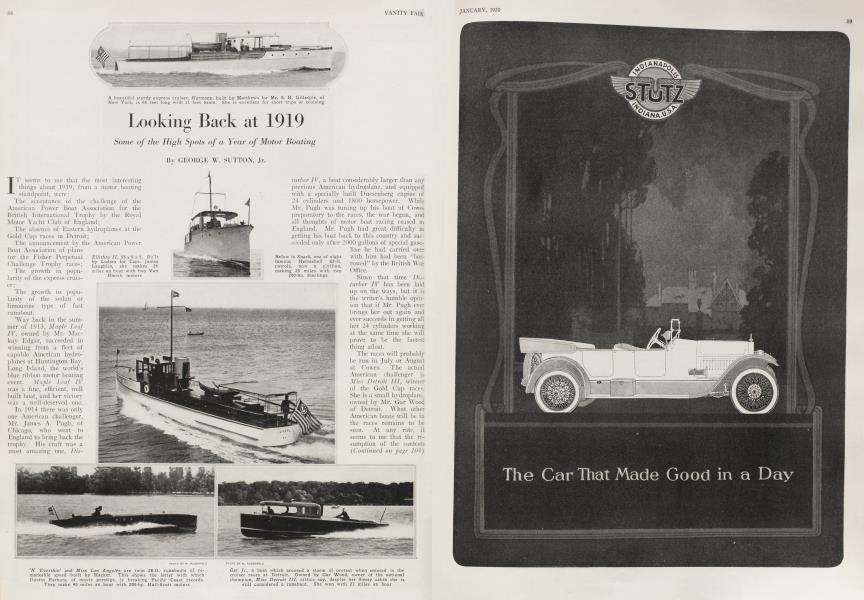
IT seems to me that the most interesting things about 1919, from a motor boating standpoint, were:
The acceptance of the challenge of the American Power Boat Association for the British International Trophy by the Royal Motor Yacht Club of England;
The absence of Eastern hydroplanes at the Gold Cup races in Detroit;
The announcement by the American Power Boat Association of plans for the Fisher Perpetual Challenge Trophy races;
The growth in popularity of the express cruiser;
The growth in popularity of the sedan or limousine type of fast runabout.
'Way back in the summer of 1913, Maple Leaf IV, owned by Mr. Mackay Edgar, succeeded in winning from a fleet of capable American hydroplanes at Huntington Bay, Long Island, the world's blue ribbon motor boating event. Maple Leaf IV was a fine, efficient, well built bpat, and her victory was a well-deserved one.
In 1914 there was only one American challenger, Mr. James A. Pugh, of Chicago, who went to England to bring back the trophy. His craft was a most amazing one, Dis- turber IV, a boat considerably larger than any previous American hydroplane, and equipped with a specially built Duesenberg eng-ine of 24 cylinders and 1800 horsepower. While Mr. Pugh was tuning up his boat at Cowes preparatory to the races, the war began, and all thoughts of motor boat racing ceased in England. Mr. Pugh had great difficulty in getting his boat back to this country and succeeded only after 2000 gallons of special gasoline he had carried over with him had been "borrowed" by the British War Office.
Since that time Disturber IV has been laid up on the ways, but it is the writer's humble opinion that if Mr. Pugh ever brings her out again and ever succeeds in getting all her 24 cylinders working at the same time she will prove to be the fastest thing afloat.
The races will probably be run in July or August at Cowes. The actual American challenger is Miss Detroit III, winner of the Gold Cup races. She is a small hydroplane, owned by Mr. Gar Wood of Detroit. What other American boats will be in the races remains to be seen. At any rate, it seems to me that the resumption of the contests for this international trophy offered by Lord Northcliffe was one of the most interesting developments of the past year in motor boating.
Continued on page 104
Continued, from page 88
From the first Gold Cup race on the Hudson in June, 1904, up to 1912, the building and racing of hydroplanes had been considered a privilege to be monopolized by Eastern yachtsmen. This may have been caused by the great number of protected harbors along the Eastern coast. Now, however, the sport seems to have moved westward, and settled more or less permanently in the Middle West. It appears to be the attitude of Eastern yachtsmen that the great amount of money needed to build and experiment with a modern hydroplane is productive of too uncertain results to be worth while. They seem to feel that the expenditure of even less money on a high-class express cruiser is a decidedly better investment for sport, and while motor boat racfes have lost none of their popularity with the public, in spite of the inevitable delays and breakdowns caused by lack of efficient preparation, it must be said that a great many others in a position to indulge in motor boat racing feel the same way about it. A hydroplane is useless for any other purpose than racing. It is a mere cockleshell with a bottom construction which enables it to ride almost entirely on a cushion of air. It is worse than useless in rough water, and the expense attached to building and racing one 20foot hydroplane in one race is in the neighborhood of $50,000, although many men have done it for less. An express cruiser has a multitude of uses, yet it is speedy enough to afford excellent racing.
However, I do not believe the hydroplane is going to die. As long as there is sporting blood in the country there will be a demand for fast motor boat racing, and, except for Prof. Bell's airplane boat, no craft is faster than the hydroplane. The Pacific Coast, which has specialized in commercial motor boats, is now going in for fast pleasure craft, including sea sleds and speedy runabouts, and it may be that within the next few years we shall see the interest in hydroplane racing wane in the Middle West and move again, this time out to the Golden Gate.
In view of the decreasing interest in hydroplane racing the announcement of the Fisher trophy race conditions is important. These rules, as announced by the American Power Boat Association, call for contests between displacement boats of stock design, sturdy enough to race in any kind of weather, and demonstrated to be able to make at least 35 miles an hour. The trophy has been donated by Mr. Carl Fisher of Indianapolis, and since the conditions call for boats of strong construction to race without handicap or time allowance, at least 32 feet long, with a maximum total piston displacement of 3000 cubic inches, it is sure to result in the construction of very fast, powerful boats, which can be used for many other purposes. The most important part of these races is the fact that no postponements will be allowed. This has been the bane of motor boat racing in the past, and its elimination will cause an increased interest on the part of the public.
The popularity of the express cruiser is one of the healthiest signs on the whole motor boating horizon. This type of boat is simply a combination of speed and comfort. It is capable of doing up to 40 miles an hour, although the majority of owners are content with boats which can cruise for long distances at between 20 and 30 miles. Several hundreds of these boats have been built by various companies during the past year, and they have reached the state now where they contain almost every comfort and luxury of the modem home.
One of the most elaborate express cruisers of the 1919 season is Georgena II, designed and built by the Consolidated Ship Building Corporation for Mr. F. F. Proctor, equally well known as a sportsman and a theatrical producer. Georgena, II is 73 feet 6 inches long, with a beam of 13 feet 6 inches and a draft of 3 feet 6 inches. She is equipped with two 200 H.P. 8-cylinder Speedway motors, which are controlled from the steering wheel. She is the ultimate in luxurious boat building, with a dining salon finished in gold with mahogany trimmings, with silk hangings and upholstery. The cabins are fitted up like the rooms in a palace, while the main reception room contains many features conducive to the enjoyment of guests. Among other things, there is an electric player piano concealed within which is a Victrola. The two are operated in conjunction and render very effective music.
There has been a great increase in the use of the limousine type of boat. This craft under various names has been found very useful for commuting to business, and for short trips in such ideal motor boat locations as the Thousand Islands. Two of the most important boats of this class have been built by the George Lawley & Son Corporation, and they will be shown at the forthcoming motor boat show in February. One is a 36-footer, equipped with a six-cylinder Van Blerck engine, which gives her a speed of about 26 miles an hour. She has the long, clean lines for which the Lawley firm has long been famous, and a small but comfortable cabin which seems to be the exact duplicate of the automobile sedan type of body, including a slanting windshield, a spotlight, and an automobile wheel carrying all engine controls. The other Lawley creation is a 41-foot boat equipped with an eight-cylinder Sterling motor, giving her a speed of about 30 miles an hour. While her cabin arrangement provides for a wheel, windshield and spotlight of the automobile type, the shape of the cabin itself is suggestive of a high-class limousine, and gives more or less of a gondola effect. Both of these boats are perfect examples of beauty, grace and mechanical efficiency.
Some very important work has been done during the past year in the production of small, very fast runabouts of exceptional quality. Two sister ships of this type, turned out by the John L. Hacker Boat Company, are particularly worthy of notice. Their names are TV 'Everthin' and Miss Los Angeles. They are both displacement boats, meaning that they have a regular boat bottom instead of the hydroplane construction, and both are very fast, making over 36 miles an hour officially. The latter is owned by Mr. Dustin Farnum, the actor, and is cleaning up all the races on the Pacific Coast. 'N 'Everthin' is owned by Mr. W. JR. Kemp of Detroit, and both boats are equipped with 200 H.P. six-cylinder Hall-Scott motors. These boats are of the type which will make the Fisher trophy races successful. The first race will be held in Detroit, the second at Miami, Fla., and the third at Lake George. The courses will be short so that the spectators will have an opportunity to view the boats during the entire race. This donation of a $5,000 trophy by Mr. Fisher through the American Power Boat Association is the best and biggest thing that has happened in the marine industry in a long time, as it is sure to result in a big advance in the construction of standardized boats and motors of a big, husky runabout type.
Subscribers have complete access to the archive.
Sign In Not a Subscriber?Join Now
