Sign In to Your Account
Subscribers have complete access to the archive.
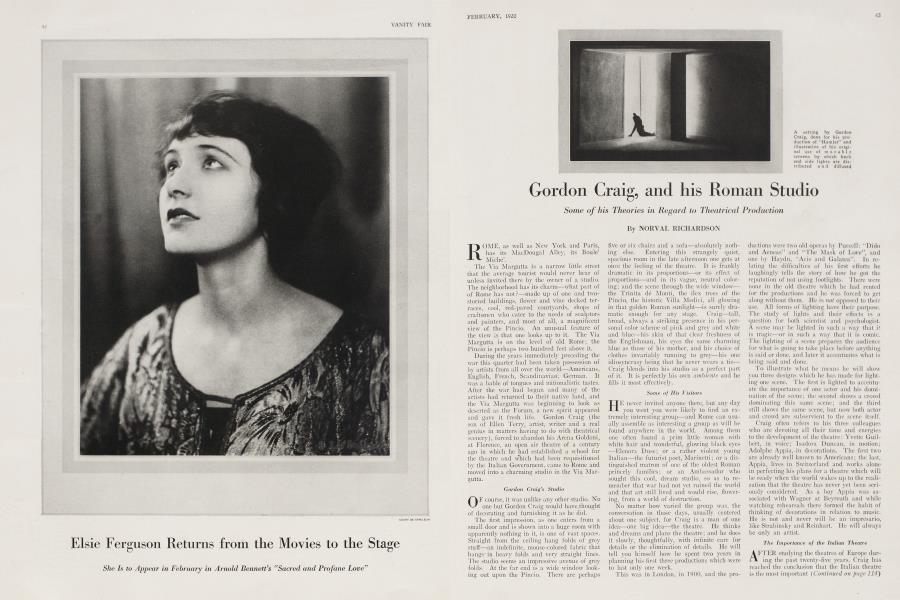
Sign In Not a Subscriber?Join NowGordon Craig, and his Roman Studio
Some of his Theories in Regard to Theatrical Production
NORVAL RICHARDSON
ROME, as well as New York and Paris, has its MacDougal Alley, its Boule Miche'.
The Via Margutta is a narrow little street that the average tourist would never hear of unless invited there by the owner of a studio. The neighborhood has its charm—what part of of Rome has not?—made up of one and twostoried buildings, flower and vine decked terraces, cool, red-paved courtyards, shops of craftsmen who cater to the needs of sculptors and painters, and most of all, a magnificent view of the Pincio. An unusual feature of the view is that one looks up to it. The Via Margutta is on the level of old Rome; the Pincio is perhaps two hundred feet above it.
During the years immediately preceding the war this quarter had been taken possession of by artists from all over the world—Americans, English, French, Scandinavian, German. It was a bable of tongues and nationalistic tastes. After the war had begun and many of the artists had returned to their native land, and the Via Margutta was beginning to look as deserted as the Forum, a new spirit appeared and gave it fresh life. Gordon Craig (the son of Ellen Terry, artist, writer and a real genius in matters having to do with theatrical scenery), forced to abandon his Arena Goldoni, at Florence, an open air theatre of a century ago in which he had established a school for the theatre and which had been requisitioned by the Italian Government, came to Rome and moved into a charming studio in the Via Margutta.
Gordon Craig's Studio
OF course, it was unlike any other studio. No one but Gordon Craig would have thought of decorating and furnishing it as he did.
The first impression, as one enters from a small door and is shown into a huge room with apparently nothing in it, is one of vast spaces. Straight from the ceiling hang folds of grey stuff—an indefinite, mouse-colored fabric that hangs in heavy folds and very straight lines. The studio seems an impressive avenue of grey folds. At the far end is a wide window looking out upon the Pincio. There are perhaps five or six chairs and a sofa—absolutely nothing else. Entering this strangely quiet, spacious room in the late afternoon one gets at once the feeling of the theatre. It is frankly dramatic in its proportions—or its effect of proportions—and in its vague, neutral coloring; and the scene through the wide window— the Trinita de Monti, the ilex trees of the Pincio, the historic Villa Medici, all glowing in that golden Roman sunlight—is surely dramatic enough for any stage. Craig—tall, broad, always a striking presence in his personal color scheme of pink and grey and white and blue—his skin of that clear freshness of the Englishman, his eyes the same charming blue as those of his mother, and his choice of clothes invariably running to grey—his one idiosyncrasy being that he never wears a tie— Craig blends into his studio as a perfect part of it. It is perfectly his own ambiente and he fills it most effectively.
Some of His Visitors
HE never invited anyone there, but any day you went you were likely to find an extremely interesting group—and Rome can usually assemble as interesting a group as will be found anywhere in the world. Among them one often found a prim little woman with white hair and wonderful, glowing black eyes —Elenora Duse; or a rather violent young Italian—the futurist poet, Marinetti; or a distinguished matron of one of the oldest Roman princely families; or an Ambassador who sought this cool, dream studio, so as to remember that war had not yet ruined the world and that art still lived and would rise, flowering, from a world of destruction.
No matter how varied the group was, the conversation in those days, usually centered about one subject, for Craig is a man of one idea—one big idea—the theatre. He thinks and dreams and plans the theatre; and he does it slowly, thoughtfully, with infinite care for details or the elimination of details. He will tell you himself how he spent two years in planning his first three productions which were to last only one week.
This was in London, in 1900, and the productions were two old operas by Purcell: "Dido and Aeneas" and "The Mask of Love", and one by Haydn, "Acis and Galatea". In relating the difficulties of his first efforts he laughingly tells the story of how he got the reputation of not using footlights. There were none in the old theatre which he had rented for the productions and he was forced to get along without them. He is not opposed to their use. All forms of lighting have their purpose. The study of lights and their effects is a question for both scientist and psychologist. A scene may be lighted in such a way that it is tragic—or in such a way that it is comic. The lighting of a scene prepares the audience for what is going to take place before anything is said or done, and later it accentuates what is being said and done.
To illustrate what he means he will show you three designs which he has made for lighting one scene. The first is lighted to accentuate the importance of one actor and his domination of the scene; the second shows a crowd dominating this same scene; and the third still shows the same scene, but now both actor and crowd are subservient to the scene itself.
Craig often refers to his three colleagues who are devoting all their time and energies to the development of the theatre: Yvette Guilbert, in voice; Isadora Duncan, in motion; Adolphe Appia, in decorations. The first two are already well known to Americans; the last, Appia, lives in Switzerland and works alone in perfecting his plans for a theatre which will be ready when the world wakes up to the realization that the theatre has never yet been seriously considered. As a boy Appia was associated with Wagner at Beyreuth and while watching rehearsals there formed the habit of thinking of decorations in relation to music. He is not and never will be an impresario, like Strabinsky and Reinhart. He will always be only an artist.
The Importance of the Italian Theatre
AFTER studying the theatres of Europe during the past twenty-five years, Craig has reached the conclusion that the Italian theatre is the most important of them all. Italians are born actors; they are acting every moment of their lives; their country and their traditions are dramatic. They are much more human than the French, who are too cold and finished and perfect—and never emotional. Italians have traditions which they clir.g to and which are good traditions; they lead up slowly and save themselves for telling effects in big moments; they do not show everything they are capable of in the first act. But, alas, the Italian theatre and its acting cannot be imported into other countries for the reason that the audience is such an important part of it. The attention of an Italian audience is real, there is neither gushing nor indifference, there is sincere, quiet, interested attention; there is nothing of a social nature in the audience; they do not dress to go to the theatre; they go for one purpose alone—to see the way the play is acted; and they are very quick to resent poor work and voice loudly their disapproval and derision. Even Duse, in an unsuccessful production of one of D'Annunzio's plays, was hissed and left to finish the piece to empty benches.
Continued on page 114
Continued from page 43
Craig, in comparing the Italian theatre to that of England, quotes Salvini's impressions of Irving in Hamlet. After the first act, Salvini said it was a magnificent piece of work; he found Irving's voice, gestures, appearance perfect. After the second act he was still enthusiastic. But after the third, he said that Irving had wholly disappeared.
Why? Because, in that act, Hamlet meets Ophelia. The great moment has come. It is the situation now between a man and a woman—always the most important moment to Italians, indeed, the big moment of life, life itself in that the life forces which create life, continue it and keep it alive. At this moment Irving failed—just as all AngloSaxon actors fail; they never appreciate the immensity of the life forces coming into contact, the biggest dramatic question of all—the meeting of a man with a woman.
But to come back to Craig.
Adjoining the studio with its avenue of grey curtains is another, much smaller, much more intimate, and you are very lucky if you have an opportunity to look into it, for here is an interesting, inconglomerate mass of theatrical paraphernalia;—designs for scenes from "Hamlet," scenes themselves, masks from all parts of the world, marionettes, strange sandals and boots, a fragment of a medieval saddle, bits of costume, quantities of strange stuffs, everything showing the rare taste of an artist, nothing banal, nothing that you have grown accustomed to and tired of; and, most interesting of all, a miniature theatre, in a tent.
Seated in this tent, with the lights properly adjusted, Craig will show you, objectively, his working designs for stage settings. For, in spite of his sometimes giving you the impression that he is talking vaguely, he can invariably give you a definite example which proves him a correct worker as well as a visionary or dreamer. With a few plain white screens and a more than clever manipulation of lights he shows you a scene for a tragedy, a comedy, a dark autumnal forest, a sunlit gay spring day; a setting which instantly calls to the. mind thoughts of death; one that suggests languor and sensuousness; one that is at once virile and filled with battling forces;—all this done by shifting a few screens and concentrating or diffusing his lights, without actors, without words, without music.
Gordon Craig's Marionettes
AFTER this, he will turn with caressing hands to his marionettes. They are from all parts of the world—Burmah, Italy, Java, China. His favorite is one from Burmah, made of wood, about four feet high, dressed in an ancient jeweled robe and wearing a pagoda-like hat. Its face is painted white, with half-open, sleepy-looking eyes. Holding it upright, he leads it onto the stage, its movements always very slow and mysterious; its arms rise in careful, solemn gestures, it advances toward you, it retreats, it kneels down and reclines in an easy, languid position and finally falls asleep. All its motions are as though it were feeling its way about, groping, in some . vague, unknown sphere. One receives the impression that this is a real being, but from another world, with thoughts and a life of its own.
And you should hear Craig talk of marionettes—one of his favorite subjects. The modern world has an entirely erroneous idea of what they are. Producers make the mistake of believing that their gestures should imitate the gestures of living people. Not at all. They have their own gestures—• quite apart, and different, and vastly suggestive. They are a theatre quiteto themselves; they form a separate part of the three theatres of the world—the other two are the Greek plays and those of Shakespeare. Marionettes are hardly appreciated by the Western world; yet they are the root of the art of the Oriental theatre. Some of the greatest dramas of the world have been written for marionettes. Japan, China, India and Java have each furnished them with really great plays.
Craig admits that he knows very little of the American theatre. He visited it only once, many years ago, when his mother was making a tour of America. In London he once saw an American actor whom he found really magnificent—Bert Williams. It would interest him very much to go to America, but when the question arises it is always a matter of making only one production. What is one production? It amounts to nothing; it creates no lasting impression. A series of productions is what is needed, and when the time comes for them, he will cross the Atlantic and show us what we should have had many years ago.
Subscribers have complete access to the archive.
Sign In Not a Subscriber?Join Now
