Sign In to Your Account
Subscribers have complete access to the archive.
Sign In Not a Subscriber?Join NowThe Cocoon
In Which it is Shown That the Study of Nature May Suggest Strange Fantasies
FRANZ MOLNAR
Benjamin F. Glazer
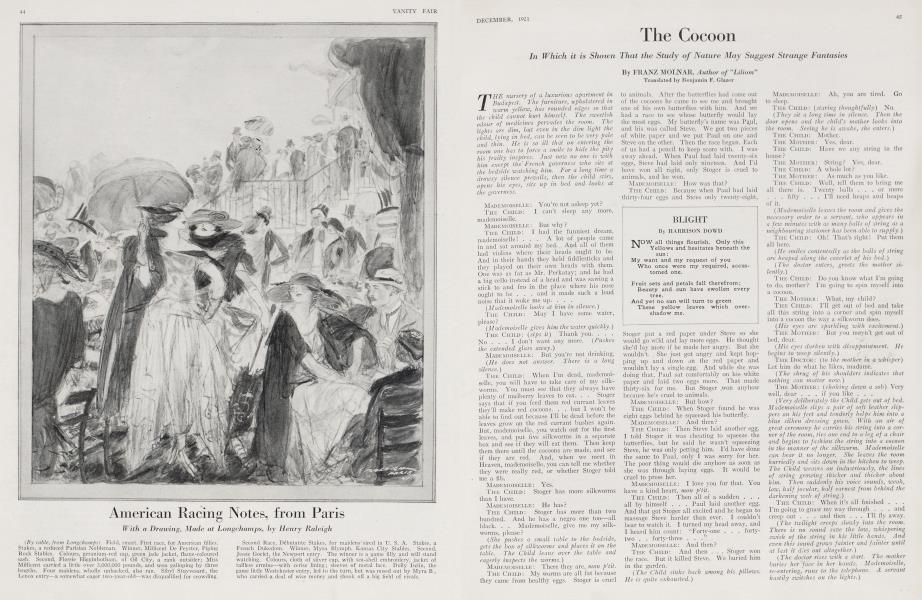
THE nursery of a luxurious apartment in Budapest. The furniture, upholstered in warm yellow, has rounded edges so that the child cannot hurt himself. The sweetish odour of medicines pervades the room. The lights are dim, but even in the dim light the child, lying in bed, can be seen to be very pale and thin. He is so ill that on entering the room one has to force a smile to hide the pity his frailty inspires. Just now no one is with him except the French governess who sits at the bedside watching him. For a long time a drowsy silence prevails, then the child stirs, opens his eyes, sits up in bed and looks at the governess.
MADEMOISELLE: You're not asleep yet?
THE CHILD: I can't sleep any more, mademoiselle.
MADEMOISELLE: But why?
THE CHILD: I had the funniest dream, mademoiselle! ... A lot of people came in and sat around my bed... A$d all of them had violins where their heads ought to be. And in their hands they held fiddlesticks and they played on their own heads with them. One was as fat as Mr. Perkatay; and he had a big cello instead of a head and was sawing a stick to and fro in the place where his nose ought to be . . . and it made such a loud noise that it woke me up. ...
(Mademoiselle looks at him in silence.)
THE CHILD: May I have some water, please?
(Mademoiselle gives him the water quickly.) THE CHILD: (sips it) Thank you. . . . No ... I don't want any more. {Pushes the extended glass away.)
MADEMOISELLE: But you're not drinking. (He does not answer. There is a long silence.)
THE CHILD: When I'm dead, mademoiselle, you will have to take care of my silkworms. You must see that they always have plenty of mulberry leaves to eat. . . Stoger says that if you feed them red currant leaves they'll make red cocoons. . . but I won't be able to find out because I'll be dead before the leaves grow on the red currant bushes again. But, mademoiselle, you tvatch out for the first leaves, and put five silkworms in a separate box and see if they will eat them. Then keep them there until the cocoons are made, and see if they are red. And, when we meet in Heaven, mademoiselle, you can tell me whether they were really red, or whether Stoger told me a fib.
MADEMOISELLE: Yes.
THE CHILD: Stoger has more silkworms than I have.
MADEMOISELLE: He has?
THE CHILD: Stoger has more than two hundred. And he has a negro one too—all black. . . Mademoiselle, give me my silkworms, please?
(She pushes a small table to the bedside, gets the box of silkworms and places it on the table. The Child leans over the table and eagerly inspects the worms.)
MADEMOISELLE: There they are, mon p'tit. THE CHILD: My worms are all fat because they came from healthy eggs. Stoger is cruel to animals. After the butterflies had come out of the cocoons he came to see me and brought one of his own butterflies with him. And we had a race to see whose butterfly would lay the most eggs. My butterfly's name was Paul, and his was called Steve. We got two pieces of white paper and we put Paul on one and Steve on the other. Then the race began. Each of us had a pencil to keep score with. I was away ahead. When Paul had laid twenty-six eggs, Steve had laid only nineteen. And I'd have won all right, only Stoger is cruel to animals, and he won.
MADEMOISELLE: HOW was that?
THE CHILD: Because when Paul had laid • thirty-four eggs and Steve only twenty-eight, Stoger put a red paper under Steve so she would go wild and lay more eggs. He thought she'd lay more if he made her angry. But she wouldn't. . She just got angry and kept hopping up and down on the red paper and wouldn't lay a single egg. And while she was doing that, Paul sat comfortably on his white paper and laid two eggs more. That made thirty-six for me. But Stoger .won anyhow because he's cruel to animals.
MADEMOISELLE: But how?
THE CHILD: When Stoger found he was eight eggs behind he squeezed his butterfly.
MADEMOISELLE: And then?
THE CHILD: Then Steve laid another egg. I told Stoger it was cheating to squeeze the butterflies, but he said he wasn't squeezing Steve, he was only petting him. I'd have done the same to Paul, only I was sorry for her. The poor thing would die anyhow as soon as she was through laying eggs. It would be cruel to press her.
MADEMOISELLE: I love you for that. You have a kind heart, mon p'tit.
THE CHILD: Then all of a sudden . . . all by himself . . . Paul laid another egg. And that got Stoger all excited and he began to massage Steve harder than ever. I couldn't bear to watch it. I turned my head away, and I heard him count: "Forty-one . . . fortytwo . . forty-three ..."
MADEMOISELLE: And then?
THE CHILD: And then . . . Stoger won the race. But it killed' Steve. We buried him in the garden.
(The Child sinks back among his pillows. He is quite exhausted.)
MADEMOISELLE: Ah, you are tired. Go to sleep.
THE CHILD: {staring thoughtfully) No.
{They sit a long time in silence. Then the door opens and the child's mother looks into the room. Seeing he is awake, she enters.)
THE CHILD : Mother.
THE MOTHER: Yes, dear.
THE CHILD: Have we any string in the house?
THE MOTHER: String? Yes, dear.
THE CHILD: A whole lot?
THE MOTHER : As much as you like.
THE CHILD: Well, tell them to bring me all there is. Twenty balls ... or more . . .fifty . . . I'll need heaps and heaps of it.
{Mademoiselle leaves the room and gives the necessary order to a servant, who appears in a few minutes with as many balls of string as a neighbouring stationer has been able to supply.)
THE CHILD: Oh! That's right! Put them all here.
{He smiles contentedly as the balls of string are heaped along the coverlet of his bed.)
(The doctor enters, greets the mother silently.)
THE CHILD : Do you know what I'm going to do, mother? I'm going to spin myself into a cocoon.
THE MOTHER: What, my child?
THE CHILD: I'll get out of bed and take all this string into a corner and spin myself into a cocoon the way a silkworm does.
(His eyes are sparkling with excitement.)
THE MOTHER: But you mayn't get out of bed, dear.
(His eyes darken with disappointment. He begins to weep silently.) r
THE DOCTOR: (to the mother in a whisper) Let him do what he likes, madame.
(The shrug of his shoulders indicates that nothing can matter now.)
THE MOTHER: (choking down a sob) Very well, dear ... if you like . . .
(Very deliberately the Child gets out of bed. Mademoiselle slips a pair of soft leather slippers on his feet and tenderly helps him into a blue silken dressing gown. With an air of great ceremony he carries his string into a corner of the room, ties one end to aleg of a chair and begins to fashion the string into a cocoon in the manner of the silkworm. Mademoiselle can bear it no longer. She leaves the room hurriedly and sits down in the kitchen to weep. The Child weaves on industriously, the lines of siring growing thicker and thicker about him. Then suddenly his voice sounds, weak, low, half jocular, half earnest from behind the darkening web of string.)
THE CHILD: When it's all finished . . . I'm going to gnaw my way through . . . and creep out... and then... I'll fly away.
(The twilight creeps slowly into the room. There is no sound save the low, whispering swish of the string in his little hands. And even this sound grows fainter and fainter until at last it dies out altogether.)
(The doctor rises with a start. The mother buries her face in her hands. Mademoiselle, re-entering, runs to the telephone. A servant hastily switches on the lights.)
Subscribers have complete access to the archive.
Sign In Not a Subscriber?Join Now