
Sign In to Your Account
Subscribers have complete access to the archive.
Sign In Not a Subscriber?Join NowThe Theatrical Callboard
Critical Notes Before the Curtain Rises
KENNETH MACGOWAN
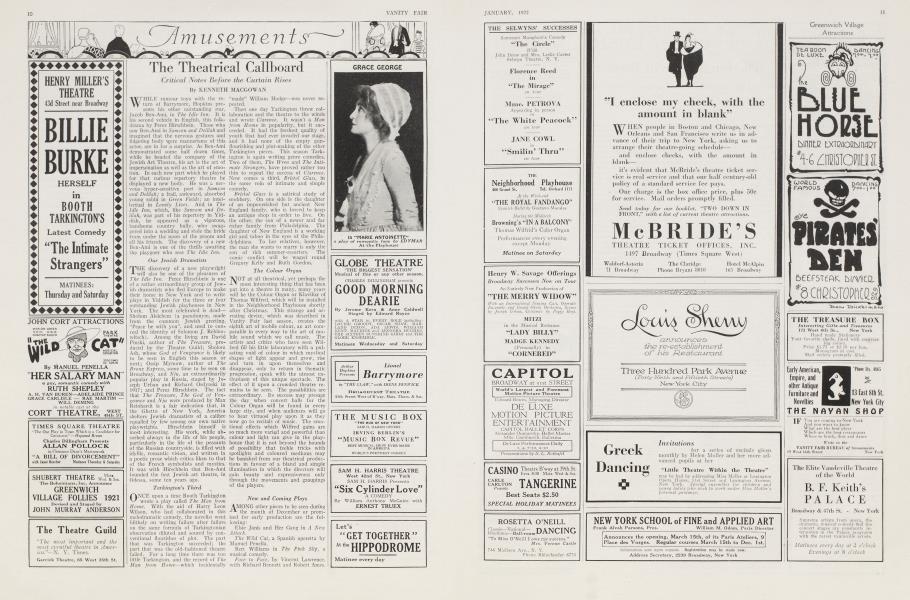
WHILE of rumour Barrymore, toys Hopkins with the preresents his other outstanding star, Jacob Ben-Ami, in The Idle Inn. It is his second vehicle in English, this folkdrama by Perez Hirschbein. Those who saw Ben-Ami in Samson and Delilah and imagined that the nervous gestures and fidgeting body were mannerisms of this actor, are in for a surprise. As Ben-Ami demonstrated some half dozen times, while he headed the company of the Jewish Art Theatre, his art is the art of impersonation as well as the art of emotion. In each new part which he played for that curious repertory theatre he displayed a new body. He was a nervous hyper-sensitive poet in Samson and Delilah; a frail, awkward, absorbed young rabbi in Green Fields; an intellectual in Lonely Lives. And in The Idle Inn, which, like Samson and Delilah, was part of his repertory in Yiddish, he appeared as a vigorous, handsome country bully, who swaggered into a wedding and stole the bride from under the noses of the groom and all his friends. The discovery of a new Ben-Ami is one of the thrills awaiting the playgoer who sees The Idle Inn.
Our Jewish Dramatists
THE discovery of a new playwright will also be one of the pleasures of The Idle Inn. Perez Hirschbein is one of a rather extraordinary group of Jewish dramatists who fled Europe to make their home in New York and to write plays in Yiddish for the three or four outstanding Jewish playhouses in New York. The most celebrated is dead— Sholom Aleichem (a pseudonym, made from the common Jewish greeting, "Peace be with you", and used to conceal the identity of Solomon J. Rebinowitsch). Among the living are David Pinski, author of The Treasure, produced by the Theatre Guild; Sholom Ash, whose God of Vengeance is likely to be seen in English this season or next; Ossip Mymow, author of The Bronx Express, some time to be seen on Broadway, and Nju, an extraordinarily popular play in Russia, staged by Joseph Urban and Richard Ordynski in 1917; and Perez Hirschbein. The fact that The Treasure, The God of Vengeance and Nju were produced by Max Reinhardt is a fair indication that, in the Ghetto of New York, America shelters Jewish dramatists of a calibre equalled by few among our own native playwrights. Hirschbein himself is most interesting. His work, while absorbed always in the life of his people, particularly in the life of the peasants of the Russian countryside, is filled with idyllic, romantic vision, and written in a poetic prose which critics liken to that of the French symbolists and mystics, It was with Hirschbein that Ben-Ami founded the first Jewish art theatre, in Odessa, some ten years ago.
Tarkington's Third
ONCE Home. With the aid of Harry Leon Wilson, who had collaborated in this melodramatic comedy, the novelist went blithely on writing failure after failure on the same formula of Tarkingtonian observation diluted and soured by conventional flourishes of plot. The part that was Tarkington succeeded; the part that was the old-fashioned theatre failed. For a long time there was too little Tarkington, and the record of The Man from Home—which incidentally "made" William Hodge—was never repeated.
Then one day Tarkington threw collaboration and the theatre to the winds and wrote Clarence. It wasn't a Man from Home in popularity, but it succeeded. It had the freshest quality of youth that had ever invaded our stage, and it had none of the empty gunflourishing and plot-making of the other Tarkington pieces. This season Tarkington is again writing genre comedies. Two of them, The Wren and The Intimate Strangers, have proved rather too thin to repeat the success of Clarence. Now comes a third, Bristol Glass, in the same vein of intimate and simple comedy.
Bristol Glass is a satirical study of snobbery. On one side is the daughter of an impoverished but ancient New England family, who is forced to keep an antique shop in order to live. On the other, the son of a newer and far richer family from Philadelphia. The daughter of New England is a working girl and taboo in the eyes of the Philadelphians. To her relatives, however, the man she wants to marry is only the son of rich summer-resorters. The comic conflict will be waged round Gregory Kelly and Ruth Gordon.
The Colour Organ
NOT at all theatrical, yet perhaps the most interesting thing that has been put into a theatre in many, many years will be the Colour Organ or Klavilux of Thomas Wilfred, which will be installed in the Neighborhood Playhouse shortly after Christmas. This strange and arresting device, which was described in Vanity Fair last season, creates the eighth art of mobile colour, an art comparable in every way to the art of mobile sound which we call music. The artists and critics who have seen Wilfred fill his little laboratory with a pulsating void of colour in which mystical shapes of light appear and grow, rise and turn in upon themselves and disappear, only to return in thematic progression, speak with the utmost enthusiasm of this unique spectacle. The effect of it upon a crowded theatre remains to be seen. The possibilities are extraordinary. Its success may presage the day when concert halls for the Colour Organ will be found in every large city, and when audiences will go to hear virtuosi play upon it as they now go to recitals of music. The emotional effects which Wilfred gains are so much more varied and powerful than colour and light can give in the playhouse that it is not beyond the bounds of possibility that feeble tricks with spotlights and coloured mediums may be banished from our theatrical productions in favour of a bland and simple illumination in which the directors will gain beauty and expressiveness only through the movements and groupings of the players.
New and Coming Plays
AMONG other pieces to be seen during the month of December or promised for early production are the following:
Elsie Janis and Her Gang in A New Attack.
The Wild Cat, a Spanish operetta by Manuel Penella.
Bert Williams in The Pink Slip, a musical comedy.
Face to Face, by Vincent Lawrence, with Richard Bennett and Robert Ames.
Subscribers have complete access to the archive.
Sign In Not a Subscriber?Join Now