
Sign In to Your Account
Subscribers have complete access to the archive.
Sign In Not a Subscriber?Join NowMiracles and the Expert Witness
With a Particular Consideration of Home's Levitation and the Indian Rope Trick
PATRICK KEARNEY
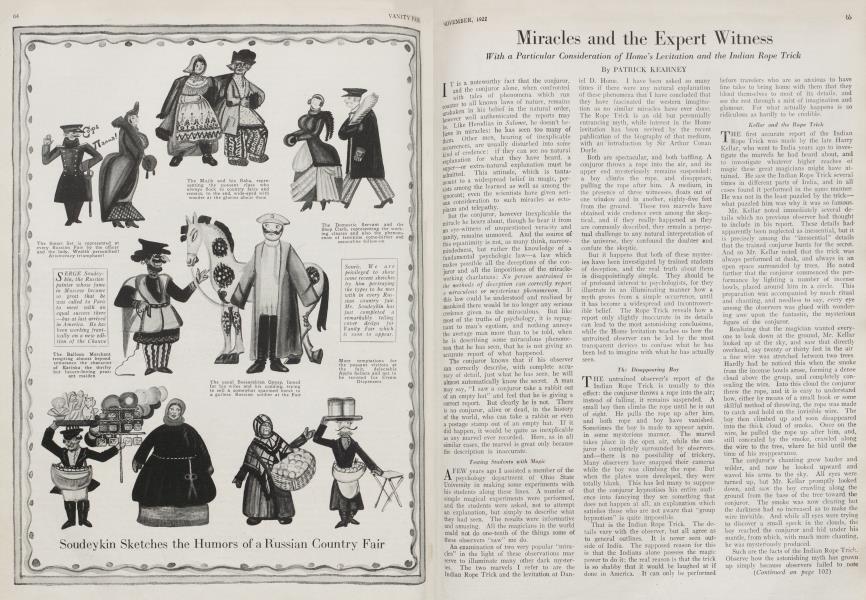
IT is a noteworthy fact that the conjuror, and the conjuror alone, when confronted with tales of phenomena which run counter to all known laws of nature, remains unshaken in his belief in the natural order, however well authenticated the reports may be Like Herodias in Salome, he doesn't believe in miracles: he has seen too many of them. Other men, hearing of inexplicable occurrences, are usually disturbed into some kind of credence: if they can see no natural explanation for what they have heard, a super—or extra-natural explanation must be admitted. This attitude, which is tantamount to a widespread belief in magic, persists among the learned as well as among the ignorant; even the scientists have given serious consideration to such miracles as ectoplasm and telepathy.
But the conjuror, however inexplicable the miracle he hears about, though he hear it from an eye-witness of unquestioned veracity and sanity, remains unmoved. And the source of this equanimity is not, as many think, narrowmindedness, but rather the knowledge of a fundamental psychologic law—a law which makes possible all the deceptions of the conjuror and all the impositions of the miracleworking charlatans: No person untrained in the methods of deception can correctly report a miraculous or mysterious phenomena. If this law could be understood and realized by mankind there would be no longer any serious credence given to the miraculous. But like most of the truths of psychology, it is repugnant to man's egotism, and nothing annoys the average man more than to be told, when he is describing some miraculous phenomenon that he has seen, that he is not giving an accurate report of what happened.
The conjuror knows that if his observer can correctly describe, with complete accuracy of detail, just what he has seen, he will almost automatically know the secret. A man may say, "I saw a conjuror take a rabbit out of an empty hat" and feel that lie is giving a correct report. But clearly he is not. There is no conjuror, alive or dead, in the history of the world, who can take a rabbit or even a postage stamp out of an empty hat. If it did happen, it would be quite as inexplicable as any marvel ever recorded. Here, as in all similar cases, the marvel is great only because the description is inaccurate.
Testing Students with Magic
A FEW years ago I assisted a member of the psychology department of Ohio State University in making some experiments with his students along these lines. A number of simple magical experiments were performed, and the students were asked, not to attempt an explanation, but simply to describe what they had seen. The results were informative and amusing. All the magicians in the world could not do one-tenth of the things some of these observers "saw" me do.
An examination of two very popular "miracles" in the light of these observations may serve to illuminate many other dark mysteries. The two marvels I refer to are the Indian Rope Trick and the levitation of Daniel D. Home. I have been asked so many times if there were any natural explanation of these phenomena that I have concluded that they have fascinated the western imagination as no similar miracles have ever done. The Rope Trick is an old but perennially entrancing' myth, while interest in the Home levitation has been revived by the recent publication of the biography of that medium, with an introduction by Sir Arthur Conan Doyle.
Both are spectacular, and both baffling. A conjuror throws a rope into the air, and its upper end mysteriously remains suspended: a boy climbs the rope, and disappears, pulling the rope after him. A medium, in the presence of three witnesses, floats out of one window and in another, eighty-five feet from the ground. These two marvels have obtained wide credence even among the skeptical, and if they really happened as they are commonly described, they remain a perpetual challenge to any natural interpretation of the universe, they confound the doubter and confute the skeptic.
But it happens that both df these mysteries have been investigated by trained students of deception, and the real truth about them is disappointingly simple. They should be of profound interest to psychologists, for they illustrate in an illuminating manner how a myth grows from a simple occurrence, until it has become a widespread and incontrovertible belief. The Rope Trick reveals how a report only slightly inaccurate in its details can lead to the most astonishing conclusions, while the Home levitation teaches us how the untrained observer can be led by the most transparent devices to confuse what he has been led to imagine with what he has actually seen.
The Disappearing Boy
THE untrained observer's report of the Indian Rope Trick is usually to this effect: the conjuror throws a rope into the air; instead of falling, it remains suspended. A small boy then climbs the rope until he is out of sight. He pulls the rope up after him, and both rope and boy have vanished. Sometimes the boy is made to appear again, in some mysterious manner. The marvel takes place in the open air, while the conjuror is completely surrounded by observers, and—there is no possibility of trickery. Many observers have snapped their cameras while the boy was climbing the rope. But when the plates were developed, they were totally blank. This has led many to suppose that the conjuror hypnotises his entire audience into fancying they see something that does not happen at all, an explanation which satisfies those who are not aware that "group hypnotism" is quite impossible.
That is the Indian Rope Trick. The details vary with the observer, but all agree as to general outlines. It is never seen outside of India. The supposed reason for this is that the Indians alone possess the magic power to do it; the real reason is that the trick is so shabby that it would be laughed at if done in America. It can only be performed before travelers who are so anxious to have fine tales to bring home with them that they blind themselves to most of its details, and see the rest through a mist of imagination and glamour. For what actually happens is so ridiculous as hardly to be credible.
Kellar and the Rope Trick
THE first accurate report of the Indian Rope Trick was made by the late Harry Kellar, who went to India years ago to investigate the marvels he had heard about, and to investigate whatever higher reaches of magic these great magicians might have attained. He saw the Indian Rope Trick several times in different parts of India, and in all cases found it performed in the same manner. He was not in the least puzzled by the trick— what puzzled him was why it was so famous.
Mr. Kellar noted immediately several details which no previous observer had thought to include in his report. These details had* apparently been neglected as inessential, but it is precisely among the "inessential" details that the trained conjuror hunts for the secret. And so Mr. Kellar noted that the trick was always performed at dusk, and always in an open space surrounded by trees. He noted further that the conjuror commenced the performance by lighting a number of incense bowls, placed around him in a circle. This preparation was accompanied by much ritual and chanting, and needless to say, every eye among the observers was glued with wondering awe upon the fantastic, the mysterious figure of the conjuror.
Realizing that the magician wanted everyone to look down at the ground, Mr. Kellar looked up at the sky, and saw that directly overhead, say twenty or thirty feet in the air a fine wire was stretched between two trees. Hardly had he noticed this when the smoke from the incense bowls arose, forming a dense cloud above the group, and completely concealing the wire. Into this cloud the conjuror threw the rope, and it is easy to understand how, either by means of a small hook or some skilful method of throwing, the rope was made to catch and hold on the invisible wire. The boy then climbed up and soon disappeared * into the thick cloud of smoke. Once on the wire, he pulled the rope up after him, and, still concealed by the smoke, crawled along the wire to the tree, where he hid until the time of his reappearance.
The conjuror's chanting grew louder and wilder, and now he looked upward and waved his arms to the sky. All eyes were turned up, but Mr. Kellar promptly looked down, and saw the boy crawling along the ground from the base of the tree toward the conjuror. The smoke was now clearing but the darkness had so increased as to make the wire invisible. And while all eyes were trying to discover a small speck in the clouds, the boy reached the conjuror and hid under his mantle, from which, with much more chanting, he was mysteriously produced.
Such are the facts of the Indian Rope Trick. Observe how the astonishing myth has grown up simply because observers failed to note and report a few "inessential facts"— notably the time and the place. It now becomes clear, I trust, why no camera has yet ' recorded the illusion. The ordinary photographic plate is not sensitive to things that happen in semi-darkness.
Continued on page 102
Continued from page 65
The other marvels of Indian magic, such as the Mango Growing, are even shabbier. Mr. Howard Thurston, the American magician, reports that when he toured India in search of marvels he found so little that, in desperation, he offered a large prize for any trick which he could not explain. The only good tricks which were entered in the competition were those which had been brought from America by Indians who had been sent to the Chicago World's Fair.
Daniel Home's Levitation
EVEN persons who do not believe in spiritualism are inclined to hesitate momentarily when confronted with the celebrated miracles accomplished by the English medium Daniel D. Home, who flourished some fifty years ago. His feat, in particular, of floating out of one window and into another, has become, like the Indian Rope Trick, a widely accepted myth. This famous levitation was performed in the presence of three witnesses, each of whom has written a description of what happened. The mystery in this case is not how Home floated out of the window, but what made anyone think he did. The descriptions of the witnesses are more accurate than we might expect; it is their conclusions that are far-fetched, and when we analyze their reports, and separate what they saw from what they merely concluded, the mystery dissolves into thin air.
The levitation took place in the presence of the Master of Lindsay, Lord Adair, and Captain Wynne, in December, 1868.
Captain Wynne, in a letter to Home nine years after the event, gave his report, which is brief, accurate, and inconsequential. All he has to say about the levitation is:
"The fact of your having gone out of one window and in at another I can swear to.1'
I have italicised a phrase in order to emphasize the fact that Captain Wynne does not say Home "floated" from one window to another.
Lord Adair's report, written in a few days after the incident, is equally accurate, and somewhat more informative:
"We heard Home go into the next room, heard the window thrown up, and presently Home appeared, standing upright outside our window; he opened the window and walked in quite cooly."
So far nothing has occurred which requires as explanation the supposition of a ghost come from the grave. But let us see the third report, that of the Master of Lindsay, the longest and most ecstatic.
This witness, writing a few days after the incident, gives us these details:
"I saw the levitation in Victoria Street when Home floated out of the window. He first went into a trance, and walked about uneasily. He then went into the hall. While he was away I heard a voice whisper in my ear; 'He will go out of one window and in at another.' I was alarmed and shocked at the idea of so dangerous an experiment. I told the company what I had heard, and then we waited for Home's return. Shortly afterwards he entered the room. I heard the window gb up but could not see it, for I had *n back to it. I, however, saw his shadol on the opposite wall. He went out of the window in a horizontal tion, and I saw him outside the other window, that in the next room, floating in the air. It was eighty-five feet from the ground."
Inconsistency of the Reports
NOTE the inconsistency of this report with the others and with itself The other witnesses report that Home came in their window, after having gone out the other. Lindsay reports the exact opposite. Furthermore, though he states his back was to the window and only Home's shadow was visible he also states that he saw him floating outside. It is clear that the portion of the report which says that Home floated is mere unwarranted conclusion and extremely far-fetched at that. Two years later the same witness wrote another report, which shows an even greater confusion between fact and unsupported conclusion:
"I was sitting with Mr. Home and Lord Adair and a cousin of his (Captain Wynne). During the sitting Mr. Home went into a trance, and in that state was carried out the window in the room next to where we sat, and was brought in at our window. The distance between the windows was about seven feet, six inches and there was not the slightest foothold between them, nor was there more than a twelve-inch projection to each window, which served as a ledge to put flowers on. We heard the window in the next room lifted up, and almost immediately after we saw Home floating in the air outside our window. The moon was shining full into the room, my back was to the light, and I saw the the shadow on the wall, of the window sill, and of Home's feet about six inches above it. He remained in this position for a few seconds, then raised the window and glided into the room feet foremost and sat down."
Here again we see the confusion of detail which always marks the report of an untrained observer. All he actually saw was a shadow on the wall; while his back was to the window he could not see Home floating in the air outside the window. He heard a window opened, and saw a shadow, and on the basis of these two facts he reports that Home floated in the air from one window to another.
It is easy to imagine how Home accomplished all he actually did by simply swinging on a rope suspended from an upper story or from the roof. It is much more difficult to imagine how he was able to create, in the minds of his observers, the impression that he had done anything extraordinary. To this mystery his personality gives the clue: he was, we are told by many who knew him, a man whom no one could suspect of the slightest dishonesty or guile, and it is clear that with such a personality a great deal of belief could be created with but little performance.
How Mr. Home Floated
THERE are records of another levitation which Home accomplished in a totally darkened room. He would be heard to say, "I'm floating, I'm floating! Grab my feet!" Someone would grab his feet, and, sure enough, they would rise and float around the room, occasionally touching the head of one of the sitters. Then he would return to his chair, and the lights would be turned on. This guileless, honest man produced this effect by slipping off his shoes, and holding them on his hands, and so raising and lowering them. I have tried this on several unknowing observers, and they report that it gives a weird and perfect illusion.
Continued on page 104
Continued from page 102
These marvels and their explanations may be accepted as typical of many minor ones. The effect is so bewildering and so startling that we can hardly withhold belief; the explanation is so simple that we are surprised that anyone could have been deceived. So it is that we who have entered upon the fascinating study of deception find ourselves incapable of believing in any reports, however authentic, of marvels which seem to overturn natural law, whether these marvels be spiritualistic, or psychic, or telepathic. When we hear of a great mystery we know from experience that the report is inaccurate, and before we allow our belief in the natural order to be disturbed we investigate the facts or suspend judgment until the natural explanation is forthcoming. For it will be forthcoming, however great the marvel, and when it does come it will be as ridiculously simple as the explanation of the Indian Rope Trick.
Subscribers have complete access to the archive.
Sign In Not a Subscriber?Join Now

