
Sign In to Your Account
Subscribers have complete access to the archive.
Sign In Not a Subscriber?Join NowA Portrait of Jo Davidson
An American Revolutionary of Prose Sets Down Her Impressions of an American Sculptor
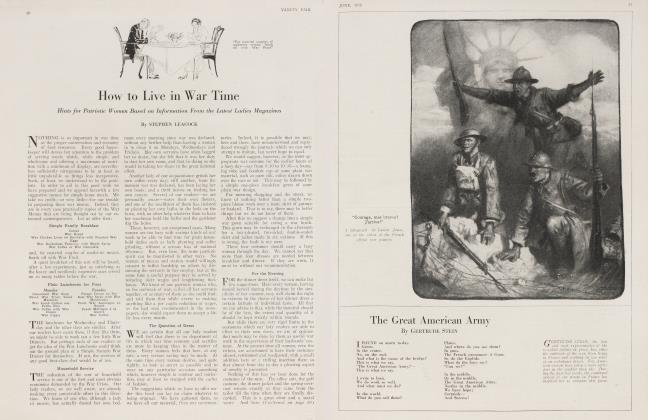
GERTRUDE STEIN
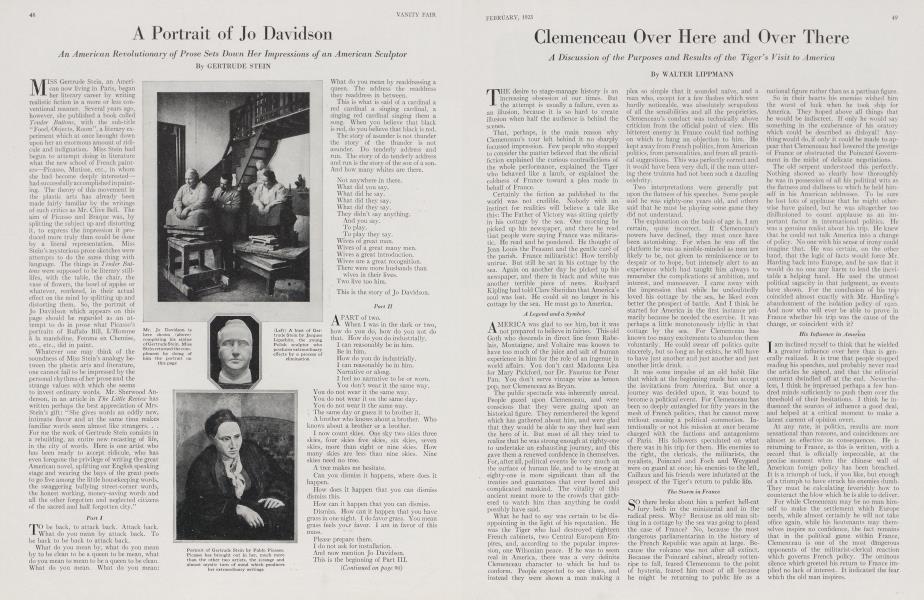
MISS Gertrude Stein, an American now living in Paris, began her literary career by writing realistic fiction in a more or less conventional manner. Several years ago, however, she published a book called Tender Buttons, with the sub-title "Food, Objects, Room", a literary experiment which at once brought down upon her an enormous amount of ridicule and indignation. Miss Stein had begun to attempt doing in literature what the new school of French painters—Picasso, Matisse, etc., in whom she had become deeply interested— had successfully accomplished in painting. The theory of this movement in the plastic arts has already been made fairly familiar by the writings of such critics as Mr. Clive Bell. The aim of Picasso and Braque was, by splitting the subject up and distorting it, to express the impression it produced more truly than could be done by a literal representation. Miss Stein's mysterious prose sketches were attempts to do the same thing with language. The things in Tender Buttons were supposed to be literary stililifes, with the table, the chair, the vase of flowers, the bowl of apples or whatever, rendered, in their actual effect on the mind by splitting up and distorting them. So, the portrait of Jo Davidson which appears on this page should be regarded as an attempt to do in prose what Picasso's portraits of Buffalo Bill, L'Homme a la mandoline, Femme en Chemise, etc., etc., did in paint.
Whatever one may think of the soundness of Miss Stein's analogy between the plastic arts and literature, one cannot fail to be impressed by the personal rhythms of her prose and the strange values with which she seems to invest ordinary words. Mr. Sherwood Anderson, in an article in The Little Review has written perhaps the best appreciation of Mrs. Stein's gift: "She gives words an oddly new, intimate flavor and at the same time makes familiar words seem almost like strangers. . . For me the work of Gertrude Stein consists in a rebuilding, an entire new recasting of life, in the city of words. Here is one artist who has been ready to accept ridicule, who has even foregone the privilege of writing the great American novel, uplifting our English speaking stage and wearing the bays of the great poets to go live among the little housekeeping words, the swaggering bullying street-corner words, the honest working, money-saving words and all the other forgotten and neglected citizens of the sacred and half forgotten city."
Part I
TO be back, to attack back. Attack back. What do you mean by attack back. To be back to be back to attack back.
What do you mean by, what do you mean by to be clean to be a queen to be mean, what do you mean to mean to be a queen to be clean. What do you mean. What do you mean:
What do you mean by readdressing a queen. The address the readdress they readdress in between.
This is what is said of a cardinal a red cardinal a singing cardinal, a singing red cardinal singing them a song. When you believe that black is red, do you believe that black is red.
The story of asunder is not thunder the story of the thunder is not asunder. Do tenderly address and run. The story of do tenderly address and run is the story of the son of a son. And how many whites are there.
Not anywhere in there.
What did you say.
What did he say.
What did they say.
What did they say.
They didn't say anything.
And you say.
To play.
To play they say.
Wives of great man.
Wives of a great many men.
Wives a great introduction.
Wives are a great recognition.
There were more husbands than wives in their lives.
Two live too him.
This is the story of Jo Davidson.
Part II
A PART of two. When I was in the dark or two, how do you do, how do you not do that. How do you do industrially.
I can reasonably be in him.
Be in him.
How do you do industrially.
I can reasonably be in him.
Narrative or along.
I feel no narrative to be or worn.
You don't wear it the same way.
You do not wear it the same way.
You do not wear it on the same day.
You do not wear it the same way.
The same day or guess it to brother it.
A brother who knows about a brother. Who knows about a brother or a brother.
I now count skies. One sky two skies three skies, four skies five skies, six skies, seven skies, more than eight or nine skies. How many skies are less than nine skies. Nine skies need no tree.
A tree makes me hesitate.
Can you dismiss it happens, where does it happen.
How does it happen that you can dismiss dismiss this.
How can it happen that you can dismiss.
Dismiss. How can it happen that you have grass in one night. I do favor grass. You mean grass feels your favor. I am in favor of this mass.
Please prepare there.
I do not ask for installation.
And now mention Jo Davidson.
This is the beginning of Part III.
Continued on page90
Continued from page 48
Part III
OME to come to.
Pardon the part
Apart.
A part of that is this.
Do you wish for he wishes for do you wish for do they wish for them. Does he wish for do they wish for him.
Many many tickle you for them. Many many tickle you for him.
Do you recognise this hymn.
It was written on the stairs.
Who cares that it was written on the wall and it was their wall and that's all.
Feel it so that children miss a kiss.
He liked to be there and to be there.
Why don't you sigh why don't you lly why don't you cry for me.
By this time we by this time we by this time we can see
We can see we can see what he says to me.
What does he say to me.
He says that it is furnished.
And now I know that I smile.
No not if it is you who are speaking to me.
When this you see learn to color for me. Color for color.
In the presence of the waiting for the having with the coming, for the moving by the pressing on the mingling with the reddening in the spreading out the leaning toward the feeling by the closing for the opening with the sinking on the riding in the fastening more more or the door.
More or the door. Where do you see that.
That is what I mean when I say that there are no hippodromes no oil and cloths no fountains no soldiers and no swings.
He has so often been seated.
You know and I know, I know and you know, you know and I know, we know and they know, they know and we know, they know and I know, they know and they know you know and you know I know and I know.
Subscribers have complete access to the archive.
Sign In Not a Subscriber?Join Now
