Sign In to Your Account
Subscribers have complete access to the archive.
Sign In Not a Subscriber?Join NowIt's Hard to be Bad When You're Good
Wherein a Young Gentleman of Twenty-one Steps Out a Bit in Paris
JULIAN FRANCIS THOMPSON
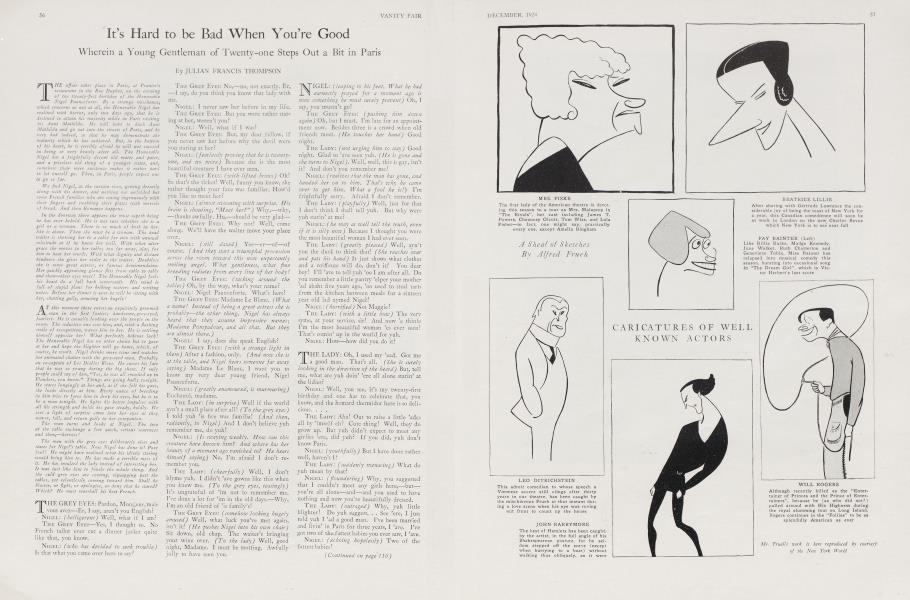
THE affair takes place in Paris, at Prunier's restaurant in the Rue Duphot, on the evening of the twenty-first birthday of the Honorable Nigel Paunceforte. By a strange mischance, which concerns us not at all, the Honorable Nigel has realized with horror, only two days ago, that he is destined to attain his majority while in Paris visiting his Aunt Mathilda. He will have to duck Aunt Mathilda and go out into the streets of Paris, and be very bad indeed, so that he may demonstrate the maturity which he has achieved. But, in the bottom of his heart, he is terribly afraid he will not succeed in being so very beastly after all. The Honorable Nigel has a frightfully decent old mater and pater, and a priceless old thing of a younger sister, and, somehow their mere existence makes it rather hard to let oneself go. Then, in Paris, people expect one to go so far.
We find Nigel, as the curtain rises, getting drearily along with his dinner, and nothing has unfolded but some French families who are eating ingenuously with their fingers and swabbing their plates with morsels of bread. And then Romance happens.
In the doorway there appears the most superb being he has ever beheld. He is not sure whether she is a girl or a woman. There is so much of both in her. She is alone. Then she must be a woman. The head waiter is showing her to a table for two with unusual solicitude as if he knew her well. With what utter grace she moves to her table, too far away, alas, for him to hear her words. With what dignity and distant kindness she gives her order to the waiter. Doubtless she is some great actress, or famous demimondaine. Her quickly appraising glance flits from table to table and then—their eyes meet! The Honorable Nigel feels his heart do a full back somersault. His mind is full of stupid plans for bribing waiters and writing notes. Before her dinner is over he will be sitting with her, chatting gaily, amusing her hugely!
AT this moment there enters an exquisitely groomed man in the first forties; handsome, grey-eyed, fearless. He is casually looking over the people in the room. The seductive one sees him, and, with a flashing smile of recognition, waves him to her. He is settling himself opposite her! What perfectly hideous luck! The Honorable Nigel has no other choice but to gaze at her and hope the blighter will go home, which, of course, he won't, Nigel drinks more wine and watches her animated chatter with the grey-eyed man. Probably an ex-captain of Les Diables Bleus. lie curses his fate that he was so young during the big show. If only people could say of him, "Yes, he was all smashed up in Fanders, you know." Things arc going badly tonight, He stares longingly at her and, as if she felt his gaze, she looks directly at him. Every ounce of breeding in him tries to force him to drop his eyes, but he is to be a man tonight. He fights his better impulses zvith all his strength and holds his gaze steady, boldly. He sees a light of surprise come into her eyes as they waver, fall, and return gaily to her companion.
The man turns and looks at Nigel. The two at the table exchange a few quick, serious sentences and then,—horrors!
The man with the grey eyes deliberately rises and starts for Nigel's table. Nozv Nigel has done it! Poor fool! He might have realized zvhat his idiotic staring would bring him to. He has made a terrible mess of it. He has insulted the lady instead of interesting her. It teas just like him to foozle the tvhole thing. And the cold grey eyes are coming, zigzagging past the tables, yet relentlessly coming lozvard him. Shall he bluster, or fight, or apologize, or deny that he stared? Which? He must marshall his best French.
THE GREY EYES: Pardon, Monsieur, mais vous avez—Er, I say, aren't you English? NIGEL: (belligerent) Well, what if I am? THE GREY Eyes—Yes, I thought so. No French tailor ever cut a dinner jacket quite like that, you know.
NIGEL: (who has decided to seek trouble) Is that what you came over here to sav?
THE GREY EYES: No,—no, not exactly. Er, —I say, do you think you know that lady with me.
NIGEL: I never saw her before in my life.
THE GREY EYES: But you were rather staring at her, weren't you?
NIGEL: Well, what if I was?
THE GREY EYES: But, my dear fellow, if you never saw her before why the devil were you staring at her?
NIGEL: (fearlessly proving that he is twenty-one, and no more) Because she is the most beautilul creature I have ever seen.
THE GREY EYES: (with lifted brows) Oh! So that's the ticket! Well, funny you know, she rather thought your face was familiar. How'd you like to meet her?
NIGEL: (almost swooning zvith surprise. His brain is shouting, "Meet her?") Why,—why, —thanks awfully. Hu,—should be very glad—
THE GREY EYES: Why not? Well, come along. We'll have the waiter move your place over.
NIGEL: (still dazed) Yes—er—of—of course. (And they start a triumphal procession across the room toward this nozv expectantly smiling angel. What gentleness, what fine breedmg radiates from every line of her body !
THE GREY EYES: (tacking around the tables) Oh, by the way, what's your name?
NIGEL: Nigel Paunceforte. What's hers?
THE GREY EYES: Madame Le Blanc. (What a name! Instead of being a great actress she is probably—the other thing. Nigel has alzvays heard that they assume impressive names; Madame Pompadour, and all that. But they are almost there.)
NIGEL: I say, does she speak English?
THE GREY EYES: (with a strange light in them) After a fashion, only. (A?id now she is at the table, and Nigel hears someone far away saying) Madame Le Blanc, I want you to know my very dear young friend, Nigel Paunceforte.
NIGEL: (greatly enamoured, is murmuring) Enchante, madame.
THE LADY: (in surprise) Well if the world ayn't a small place after all! (To the grey eyes) I told yuh 'is fice was familia! (And then, radiantly, to Nigel) And I don't believe yuh remember me, do yuh!
NIGEL: (Is swaying weakly. How can this creature have known him? And where has her beauty of a moment ago vanished to? He hears himself saying) No, I'm afraid I don't remember you.
THE LADY: (cheerfully) Well, I don't blyme yuh. I didn't 'ave gowns like this when you knew me. (To the grey eyes, teasingly) It's ungrateful of 'im not to remember me. I've done a lot for 'im in the old days.—Why, I'm an old friend of 'is family's!
THE GREY EYES: (somehow looking hugely amused) Well, what luck you've met again, isn't it? (He pushes Nigel into his own chair) Sit down, old chap. The waiter's bringing your wine over. (To the lady) Well, good night, Madame. I must be trotting. Awfully jolly to have seen you.
NIGEL: (leaping to his feet. What he had earnestly prayed for a moment ago is now something he must surely prevent) Oh, I say, you'mustn't go!
THE GREY EYES: (pushing him down again) Oh, but I must. I'm late for an appointment now. Besides three is a crowd when old friends meet. (He touches her hand) Good night.
THE LADY: (not urging him to stay) Good night. Glad to 'ave seen yuh. (He is gone and she turns to Nigel). Well, well, this is gay, isn't it! And don't you remember me?
NIGEL: (realizes that the man has gone, and handed her on to him. That's why he came over to get him. What a fool he is!) I'm frightfully sorry. Afraid I don't remember.
THE LADY: (playfully) Well, just for that I don't think I shall tell yuh. But why were yuh starin' at me?
NIGEL: (he may as well tell the truth, even if it is silly now) Because I thought you were the most beautiful woman I had ever seen.
THE LADY: (greatly pleased) Well, ayn't you the duck to think that! (She reaches over and pats his hasid) It just shows what clothes and a coiffeuse will do, don't it? You dear boy! I'll 'ave to tell yuh 'oo I am after all. Do you remember a little pantry 'elper your mother 'ad abaht five years ago, 'oo used to steal tarts from the kitchen between meals for a sixteen year old lad nymed Nigel?
NIGEL: (horrified) Not Maggie!
THE LADY: (with a little bow) The very syme, at your service, sir! And now 'e thinks I'm the most beautiful woman 'es ever seen! That's cornin' up in the world for yuh.
NIGEL: How—how did you do it?
THE LADY: Oh, I used my 'ead. Got me a good man. That's all. (She is surely looking in the direction of the beard) But, tell me, what are yuh doin' 'ere all alone starin' at the lidies?
NIGEL: Well, you see, it's my twenty-first birthday and one has to celebrate that, you know, and the homard thermidor here is so delicious. . . .
THE LADY: Aha! Out to raise a little 'ades all by 'imself eh? Cute thing! Well, they do grow up. But yuh didn't expect to meet any girlies 'ere, did yuh? If you did, yuh don't know Paris.
NIGEL: (youthfully) But I have done rather well, haven't I?
THE LADY: (suddenly menacing) What do yuh mean by that?
NIGEL: (floundering) Why, you suggested that I couldn't meet any girls here,—but— you're all alone—and—and you used to have nothing and now you're beautifully dressed.
THE LADY: (outraged) Why, yuh little blighter! Do yuh suggest. . . See 'ere, I just told yuh I 'ad a good man. I've been married and livin' in Paris for three years, I 'ave. I've got two of the fattest babies you ever saw, I 'ave.
NIGEL: (echoing hopelessly) Two of the fattest babies!
(Continued on page 110)
(Continued from page 56)
THE LADY: Yes, two babies, I said. And I think an apology is abaht in order, too.
Nigel: Oh—er—of course I Jo apologise—er—Maggie. I'm a stupid ass. (He must escape. H 'hat excuse can he find?) I say, that man with the beard is doing nothing but stare at you.
THE LADY: Well, wot if 'e is?
NIGEL: And you'd probably like to meet him.
THE LADY: Well, now, 'e does look interestin' don't 'e. Why not?
NIGEL: (rising triumphantly) Nothing simpler. I'll bring him over. (He arrives before the bearded one, who looks up curiously) Ehm! Er —pardon, monsieur, mais vous etais faisant des yeux a cette femme, n'est pas?
THE BEARDED ONE: (smiling) Perhaps I could understand you better if you spoke English, m'sieu'.
NIGEL: (stiffly) I beg your pardon.
I said you appeared to be staring at that lady.
THE BEARDED ONE: Well,—possibly.
NIGEL: May I ask you why?
THE BEARDED ONE: Certainly, m'sieu'.
NIGEL: Well, why?
THE BEARDED ONE: Because it happened to please me to do so, m'sieu'.
NIGEL: (Ye gods! He's getting into a fight! Not what he intended at all) But was it because you wanted to meet her? (Now he's leading it around)
THE BEADED ONE: NO, not at all.
NIGEL: (in great difficulty) But I say, you know, she noticed you were staring at her.
THE BEARDED ONE: Yes, I thought so.
NIGEL: And she would like to meet you.
THE BEARDED ONE: (rising abruptly) Ah, well! My dear sir, why did you not say so? Any thing I can do to accommodate a lady.
NIGEL: (delighted) Well—er— shall we go over now?
THE BEARDED ONE: Parfaitement. (The pair start across the room)
NIGEL: (as they reach the lady) Madame, I want you to know my very old friend, Monsieur—er (turns confusedly to the bearded one) So stupid of me; your name's slipped me for the moment.
THE BEARDED ONE: (bowing over her hand) Monsieur Le Blanc.
THE LADY: (bursts into a gay peal of laughter) I want yuh to know my 'usband, Master Nigel! (then, to the bearded one) Dearie, this is young Master Nigel. Yuh know, I used to work for 'is family.
THE BEARDED ONE: I have often heard my wife speak of your family.
NIGEL: (completely submerged) Your husband?
THE LADY: The very syme. Aynt 'e a daisy? I met 'im after I left your mother, when I was working at the Savoy and 'e was a chef there. French, originally, but passed most of 'is life in London. Now 'es chef 'ere in this restaurant and I often come an dine with 'im, late, after 'es finished supervising the regular dinners. Yes, 'e was late tonight and I was so 'ungrv I couldn't wait for him.
THE BEARDED ONE: (very gracious) It was m'sieur's homard that kept me. Had I known who you were I would have joined you at first, but my wife meets many of my clientele and, with some, I hesitate to intrude—so I took the other table.
NIGF.L : (his only thought is to escape) Oh, yes—of course—yes— quite. Well, I must be running on. Er—awfully glad to have seen you again Mag—er, Madame. (He discovers a waiter at his elbow murmuring, "L'Addition, m'sieu'." He to' es the bill) Oh, yes, I almost forgot. (He glances at the total. It seems large. He looks again. Her dinner is included in the bill. Better to pay it without argument and escape.)
THE LADY: And, do yuh know, dearie, Nigel paid your lobster dish a great compliment. This is 'is twenty-first birthday and 'is one idea of celebratin' it was to come 'ere all by 'isself to 'ave some of your homard thermidor. Wasn't it, Nigel?
NIGEL: Yes—rather—well, good night.
THE BEARDED ONE: What fine, moral people you English are. How different from the way one of our French boys would celebrate his birthday.
NIGEL: (backing away) Yes—er— well, good night (exit).
THE LADY: And to think, dearie, that 'e recognized me immediately 'e saw me—after five years. So nice an' democratic. And 'e didn't care if I 'ad ben 'is mother's pantry girl. (Nigel is by now tearing down the stairway to the street. In his ears there sounds a ringing of cockney and of French laughter, en casserole. Confusion, in him, has given wav to despair. As the curtain falls we can hear Nigel's voice on the sidewalk below giving the taxi driver his Aunt Mathilda's address. Nigel is twentyone.)
Subscribers have complete access to the archive.
Sign In Not a Subscriber?Join Now
