Sign In to Your Account
Subscribers have complete access to the archive.
Sign In Not a Subscriber?Join NowBertrand Russell—America's Distinguished Visitor
A Witty and Courageous Pessimist, Russell Builds for Man a Magnificent Domain of Thought
RAPHAEL DEMOS
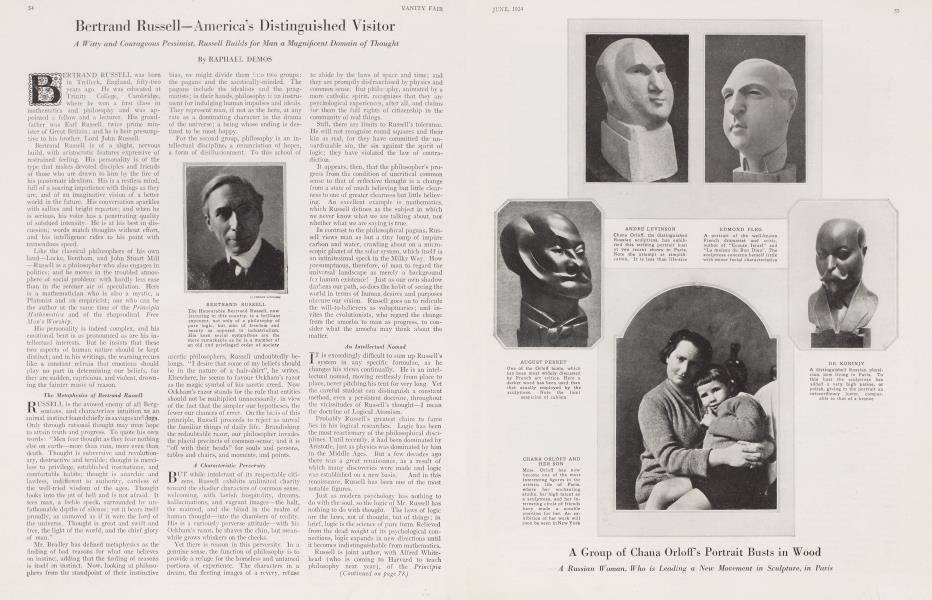
BERTRAND RUSSELL was bom in Trelleck, England, fifty-two years ago. He was educated at Trinity College, Cambridge, where he won a first class in mathematics and philosophy and was appointed a fellow and a lecturer. His grandfather was Earl Russell, twice prime minister of Great Britain; and he is heir presumptive to his brother, Lord John Russell.
Bertrand Russell is of a slight, nervous build, with aristocratic features expressive of restrained feeling. His personality is of the type that makes devoted disciples and friends of those who are drawn to him by the fire of his passionate idealism. His is a restless mind, full of a soaring impatience with things as they are, and of an imaginative vision of a better world in the future. His conversation sparkles with sallies and bright repartee; and when he is serious, his voice has a penetrating quality of subdued intensity. He is at his best in discussion; words match thoughts without effort, and his intelligence rides to his point with tremendous speed.
Like the classical philosophers of his own land—Locke, Bentham, and John Stuart Mill —Russell is a philosopher who also engages in politics; and he moves in the troubled atmosphere of social problem:: with hardly less ease than in the serener air of speculation. Here is a mathematician who is also a mystic, a Platonist and an empiricist; one who can be the author at the same time of the Principia Mathematica and of the rhapsodical Free Man's Worship.
His personality is indeed complex, and his emotional bent is as pronounced as are his intellectual interests. But he insists that these two aspects of human nature should be kept distinct; and in his writings, the warning recurs like a constant refrain that emotions should play no part in determining our beliefs, for they are sudden, capricious, and violent, drowning the fainter music of reason.
The Metaphysics of Bertrand Russell
RUSSELL is the avowed enemy of all Bergsonians, and characterizes intuition as an animal instinct found chiefly in savages and dogs. Only through rational thought may man hope to attain truth and progress. To quote his own words: "Men fear thought as they fear nothing else on earth—more than ruin, more even than death. Thought is subversive and revolutionary, destructive and terrible; thought is merciless to privilege, established institutions, and comfortable habits; thought is anarchic and lawless, indifferent to authority, careless of the well-tried wisdom of the ages. Thought looks into the pit of hell and is not afraid. It sees man, a feeble speck, surrounded by unfathomable depths of silence; yet it bears itself proudly, as unmoved as if it were the lord of the universe. Thought is great and swift and free, the light of the world, and the chief glory of man."
Mr. Bradley has defined metaphysics as the finding of bad reasons for what one believes on instinc:, adding that the finding of reasons is itself an instinct. Now, looking at philosophers from the standpoint of their instinctive bias, we might divide them into two groups: the pagans and the ascetically-minded. The pagans include the idealists and the pragmatists; in their hands, philosophy is an instrument for indulging human impulses and ideals. They represent man, if not as the hero, at any rate as a dominating character in the drama of the universe; a being whose ending is destined to be most happy.
For the second group, philosophy is an intellectual discipline, a renunciation of hopes, a form of disillusionment. To this school of ascetic philosophers, Russell undoubtedly belongs. "I desire that some of my beliefs should be in the nature of a hair-shirt", he writes. Elsewhere, he seems to favour Ockham's razor as the magic symbol of his ascetic creed. Now Ockham's razor stands for the rule that entities should not be multiplied unnecessarily, in view of the fact that the simpler our hypotheses, the fewer our chances of error. On the basis of this principle, Russell proceeds to reject as unreal the familiar things of daily life. Brandishing the redoubtable razor, our philosopher invades the placid precincts of common-sense; and it is "off with their heads" for souls and persons, tables and chairs, and moments, and points. Russell is joint author, with Alfred Whitehead (who is coming to Harvard to teach philosophy next year), of the Principia Mathcmatica, in three volumes, a veritable tour de force in which, from a fewultimate propositions and ideas, the whole fabric of logic and mathematics is strictly deduced and arranged in the form of an algebra. The appetite grows with the eating; and logic, encouraged by its absorption of mathematics, is eager to recover her old position - as queen of all knowledge. Indeed, Russell defines logic as the essence of philosophy itself; for philosophy and logic alike aim at turning the mind away from what is to what may be, and lifting it to the contemplation of the universe of possibility.
A Characteristic Perversity
BUT while intolerant of its respectable citizens, Russell exhibits unlimited charity toward the shadier characters of common sense, welcoming, with lavish hospitality, dreams, hallucinations, and vagrant images—the halt, the maimed, and the blind in the realm of human thought—into the chambers of reality. His is a curiously perverse attitude—with his Ockham's razor, he shaves the chin, but meanwhile grows whiskers on the cheeks.
Yet there is reason in this perversity. In a genuine sense, the function of philosophy is to provide a refuge for the homeless and untamed portions of experience. The characters in a dream, the fleeting images of a revery, refuse to abide by the laws of space and time; and they are promptly disfranchised by physics and common sense. But philo:ophy, animated by a more catholic spirit, recognizes that they are psychological experiences, after all, and claims for them the full rights of citizenship in the community of real things.
Still, there are limits to Russell's tolerance. He will not recognize round squares and their kin as real, for they have committed the unoardonable sin, the sin against the spirit of logic; they have violated the law of contradiction.
It appears, then, that the philosopher's progress from the condition of uncritical common sense to that of reflective thought is a change from a state of much believing but little clearness to one of greater clearness but little believing. An excellent example is mathematics, which Russell defines as the subject in which we never know what we are talking about, nor whether what we are saying is true.
In contrast to the philosophical pagans, Russell views man as but a tiny lump of impure carbon and water, crawling about on a microscopic planet of the solar system, which itself is an infinitesimal speck in the Milky Way. How presumptuous, therefore, of man to regard the universal landscape as merely a background fcr human existence! Just as our own shadow darkens our path, so does the habit of seeing the world in terms of human desires and purposes obscure our vision. Russell goes on to ridicule the will-to-believers as voluptuaries; and invites the evolutionists, who regard the change from the amoeba to man as progress, to consider what the amoeba may think about the matter.
An Intellectual Nomad
IT is exceedingly difficult to sum up Russell's system in any specific formulae, as he changes his views continually. He is an intellectual nomad, moving restlessly from place to place, never pitching his tent for very long. Yet the careful student can distinguish a constant method, even a persistent doctrine, throughout the vicissitudes of Russell's thought—I mean the doctrine of Logical Atomism.
Probably Russell's greatest claim to fame lies in his logical researches. Logic has been the most reactionary of the philosophical disciplines. Until recently, it had been dominated by Aristotle, just as physics was dominated by him in the Middle Ages. But a few decades ago there was a great renaissance, as a result of which many discoveries were made and logic was established on a new basis. And in this renaissance, Russell has been one of the most notable figures.
Just as modern psychology has nothing to do with the soul, so the logic of Mr. Russell has nothing to do with thought. The laws of logic are the laws, not of thought, but of things; in brief, logic is the science of pure form. Relieved from the dead weight of its psychological connections, logic expands in new directions until it becomes indistinguishable from mathematics.
Continued on page 78
Continued from page 54
Russell on War and Industry
AS soon as the war broke out, Mr. Russell declared himself a pacifist and engaged in speech-making against the war. Sometimes he had to face the violence of intolerant audiences. On one occasion, the meeting-place was set on fire and he himself was attacked by the mob. The police looked on indifferently, until one of the party had the happy idea of calling out that Mr. Russell was a lord; thereupon the policeman instantly intervened and— his Britisher's ingrained respect for the titled nobility overcoming his patriotic scruples—rescued the philosopher from the mob. At last, the government found a pretext and put him in jail, the college authorities following suit by depriving him of his lectureship at Trinity. While registering his name in the prison record, he was asked his religious affiliation. "I am an agnostic," answered Mr. Russell. The warden looked puzzled, and Mr. Russell repeated his reply. "I guess every one has his own religion," commented the warden, as he wrote the answer down, with puzzlement still pictured on his face.
In the course of his five months' imprisonment, the philosopher-pacifist received weekly visits from disciples and friends, who discussed with him, across a long table and with a guard on the watch, problems in logic and philosophy, and war and peace. Often, one of the visitors would engage the genial guard in conversation, so that the rest might talk freely about the Russian Revolution. Mr. Russell sent occasional letters from prison on the cause of peace, which were eagerly perused by a wider host of followers.
His imprisonment was marked by intense philosophical activity; he consumed an enormous number of books, and produced one on the philosophy of mathematics. One might go so far as to suggest that, for the benefit of philosophy, every philosopher might be put in prison for a term of six months or so once in his life.
At the conclusion of the war, Trinity College rescinded its vote of dismissal; but Mr. Russell refused to return, and now he has no academic position whatever. Soon after the armistice he visited Russia, where he lost his faith in Bolshevism ; and then spent a year in China, lecturing at a university. He returned, a fervent admirer of the urbane, non-industrial culture of the Celestial Empire.
IN Mr. Russell's political writings, the reader finds a defense of socialism, as viewed by an intellectual. It is socialism tempered with a love of individual liberty and a concern for beauty and the amenities of life. Mr. Russell is but little sympathetic with the socialism of the Marxian school. He deeply distrusts the state, regarding it as an instrument of coercion; and he fears that, in the bureaucratic state of Marx, all beauty would perish.
Russell would like to advocate anarchy; but he is forced to admit that anarchy is a utopian ideal, owing to the fact that man has a number of aggressive impulses whch require forcible restraint. The state must be allowed to exist as a necessary evil; but its authority must be restricted to the narrowest possible limits. Its power should be comparable to that of the janitor, who sits at the doorstep, but has no authority over what goes on within the house. Russell, therefore, inclines toward guild socialism, which allows full autonomy to the individual and to voluntary organizations. He is the enemy of all regimentation; he would make even work free, since then there would be every inducement to make work interesting.
The greatest of all goods is individuality; there is in all human beings "something sacred, indefinable, unlimited; something individual and strangely precious: the growing principle of life, an embodied fragment of the dumb striving of the world".
Of this individuality, the greatest enemies now are war and industrialism : the first, because it destroys life itself; the second, because it kills whatever is unique and spontaneous in the individual. War is the incarnation of the aggressive, animal impulses of men; an idealistic war is an absurdity. "A war has a momentum of its own, which is quite independent of the wishes of those who set it going. To start war for an idealistic end is as absurd as it would be to put a match to a ton of dynamite, in the hope of making toast at the resulting blaze."
Of industry, Russell claims that man has become emancipated from the bondage of nature, only to become the slave of the machine; industrialism generates the habit of valuing things for their material results, and threatens to destroy all beauty from the world. Yet Russell is no utopian advocating a "return to nature"; rather, is he concerned to discover how, by diminishing the hours of labour and encouraging liberal education, we might confine the area of industry in human life to a reasonable minimum.
Man and the Ultimate
ON the problem of man's relation to ultimate things, Russell is profoundly pessimistic. Any one who takes up his philosophy in the hope of gaining assurance of God, freedom, and immortality is certain to be disappointed. For Russell, "the life of Man is a long march through the night, surrounded by invisible foes, tortured by weariness and pain, towards a goal that few can hope to reach, and where none may tarry long. One by one, as they march, our comrades vanish from our sight, seized by the silent orders of omnipotent Death." We know from science "that Man is the product of causes which had no prevision of the end they were achieving; that his origin, his growth, his hopes and fears, his loves and his beliefs, are but the outcome of accidental collocations of atoms; that no fire, no heroism, no intensity of thought and feeling, can preserve an individual life beyond the grave; that all the labours of the ages, all the devotion, all the inspiration, all the noonday brightness of human genius, are destined to extinction in the vast death of the solar system, and that the whole temple of Man's achievement must inevitably be buried beneath the debris of a universe in ruins."
Subscribers have complete access to the archive.
Sign In Not a Subscriber?Join Now
