Sign In to Your Account
Subscribers have complete access to the archive.
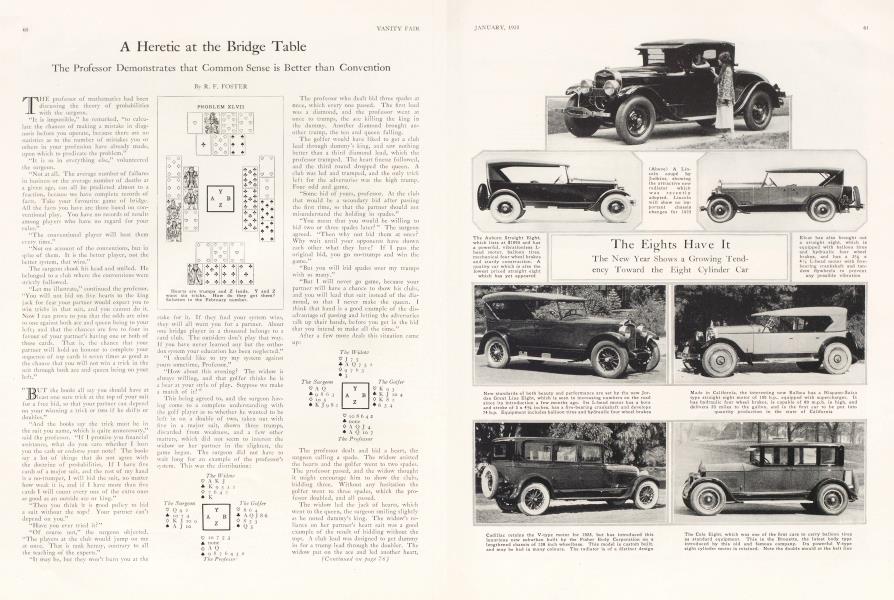
Sign In Not a Subscriber?Join NowA Heretic at the Bridge Table
R. F. FOSTER
The Professor Demonstrates that Common Sense is Better than Convention
THE professor of mathematics had been discussing the theory of probabilities with the surgeon.
"It is impossible," he remarked, "to calculate the chances of making a mistake in diagnosis before you operate, because there are no statistics as to the number of mistakes you or others in your profession have already made, upon which to predicate the problem."
"It is so in everything else," volunteered the surgeon.
"Not at all. The average number of failures in business or the average number of deaths at a given age, can all be predicted almost to a fraction, because we have complete records ol facts. Take your favourite game of bridge. All the facts you have arc those based on conventional play. You have no records of results among players who have no regard for your rules."
"'Fhe conventional player will beat them every time."
"Not on account of the conventions, but in spite of them. It is the better player, not the better system, that wins."
The surgeon shook his head and smiled. He belonged to a club where the conventions were strictly followed.
"Let me illustrate," continued the professor. "You will not bid on five hearts to the king jack for fear your partner would expect you to win tricks in that suit, and you cannot do it. Now 1 can prove to you that the odds are nine to one against both ace and queen being to your left; and that the chances are five to four in favour of your partner's having one or both of those cards. That is, the chance that your partner will hold an honour to complete your sequence of top cards is seven times as good as the chance that you will not win a trick in the suit through both ace and queen being on your left."
"BUT the books all say you should have at least one sure trick at the top of your suit for a free bid, so that your partner can depend on your winning a trick or two if he shifts or doubles."
"And the books say the trick must be in the suit you name, which is quite unnecessary," said the professor. "If I promise you financial assistance, what do you care whether I loan you the cash or endorse your note? The books sav a lot of things that do not agree with the doctrine of probabilities. If I have five cards of a major suit, and the rest of my hand is a no-trumper, I will bid the suit, no matter how weak it is, and if I have more than five cards I will count every one of the extra ones as good as an outside ace or king."
"Then you think it is good policy to bid a suit without the tops? Your partner can't depend on you."
"Have you ever tried it?"
"Of course not," the surgeon objected. "'Fhe players at the club would jump on me at once. That is rank heresy, contrary to all the teaching of the experts."
"It mav be, but they won't burn you at the stake for it. If they find your system wins, they will all want you for a partner. About one bridge player in a thousand belongs to a card club. The outsiders don't play that way. If you have never learned any but the orthodox system your education has been neglected."
"I should like to try my system against yours sometime, Professor."
"How about this evening? The widow is always willing, and that golfer thinks he is a bear at your style of play. Suppose we make a match of it?"
This being agreed to, and the surgeon having come to a complete understanding with the golf player as to whether he wanted to be left in on a double of two, taken out with five in a major suit, shown three trumps, discarded from weakness, and a few other matters, which did not seem to interest the widow or her partner in the slightest, the game began. The surgeon did not have to wait long for an example of the professor's system. This was the distribution:
The professor who dealt bid three spades at once, which every one passed. The first lead was a diamond, and the professor went at once to trumps, the ace killing the king in the dummy. Another diamond brought another trump, the ten and queen falling.
The golfer would have liked to get a club lead through dummy's king, and saw nothing better than a third diamond lead, which the professor trumped. The heart finesse followed, and the third round dropped the queen. A club was led and trumped, and the only trick left for the adversaries was the high trump. Four odd and game.
"Some bid of yours, professor. At the club that would be a secondary bid after passing the first time, so that the partner should not misunderstand the holding in spades."
"You mean that you would be willing to bid two or three spades later?" The surgeon agreed. "Then why not bid them at once? Why wait until your opponents have shown each other what they have? If I pass the original bid, you go no-trumps and win the game."
"But you will bid spades over my trumps with so many."
"But I will never go game, because your partner will have a chance to show his clubs, and you will lead that suit instead of the diamond, so that I never make the queen. I think that hand is a good example of the disadvantage of passing and letting the adversaries talk up their hands, before you get in the bid that you intend to make all the time."
After a few more deals this situation came up:
The professor dealt and bid a heart, the surgeon calling a spade. The widow assisted the hearts and the golfer went to two spades. The professor passed, and the widow thought it might encourage him to show the clubs, bidding three. Without any hesitation the golfer went to three spades, which the professor doubled, and all passed.
The widow led the jack of hearts, which went to the queen, the surgeon smiling slightly as he noted dummy's king. 'Flic widow's reliance on her partner's heart suit was a good example of the result of bidding without the tops. A club lead was designed to get dummy in for a trump lead through the doubler. The widow put on the ace and led another heart, which went to the ace. The surgeon looked pityingly at the widow as a victim of misplaced confidence. She, however, seemed unperturbed.
(Continued on page 76)
(Continued from page 60)
NOT liking to let the professor make a little trump on the clubs, the surgeon switched to the diamond, killing the king, and allowing the professor to get home two diamond tricks at once. A third heart, hoping his partner might trump, went around to the king.
Of course the trump came through, the professor playing small, and the finesse of the jack held. After that it did not matter what was led, as the professor could force the declarer with a diamond and make three trump tricks, setting the con true for 200 and simple honours.
"My spade bid was forced, you know," remarked the surgeon to his partner, as if he did not think the assists justified.
"We can make two by cards, if not three, at hearts, if your partner leaves my partner's assist alone," interposed the professor, thereby closing the discussion.
By this time the surgeon was beginning to think there was something in this system of bidding on length without the tops, and made up his mind to try it himself. The opportunity came in this deal:
The surgeon dealt and bid a heart. The widow and the golfer both passed, but the professor went at once to two no-trumps. This everyone passed, and the heart queen was led.
As the ace went up third hand and a small heart was returned, the professor rightly judged that it was perfectly safe to win the trick. Incorrectly placing the surgeon with strength in both the minor suits, the professor led through him in diamonds, so as to get a spade lead from dummy. The finesse of the jack went to the ace, prompting a slight elevation of the eyebrows from the professor, who glanced curiously at the surgeon.
The golfer came back with the king of clubs. The ace went up, and another diamond allowed dummy to lead the spade. When the finesse of the jack held, the professor had the game.
"Some heart bid of yours," remarked the professor drily.
"We should consider your notrumper, with six spades to three honours, very bad bidding," retorted the surgeon. "I was simply experimenting with your system of bidding."
"And it would'have worked perfectly against your club players," suggested the professor. "They would, of course, have called the spades. My partner would have denied them with the diamonds, and yours would have bid the clubs or more hearts. Either bid would have the same result, as you must know that the assist was based on club strength after my partner bids diamonds."
"Yes, I see that, and I think we could have made thi ; hearts," said the surgeon.
"Of course you could, and your partner would bid three over two spades, I am sure." The golfer nodded his assent to this. "Then, if I go to no trumps, you lead clubs and I do not even make the odd trick. If I go on to three spades, I am set, because I must lose five tricks. I figured on losing four tricks, but that left me enough to go game at no-trump, but not at spades."
"Well, my heart was a rotten bid and gave you your chance. They would refuse to play with me at the club if I bid on such hands as that."
"And I suppose they would not care to play with me, if I bid notrumps with a spade suit like that?"
"They would call you down pretty hard if you lost out on it."
As the defeated pair sat back in the taxi, going home, the surgeon asked the golfer what he thought of the professor's game.
"I think lie's the best bidder I have ever seen," was the unexpected answer.
ANSWER TO THE DECEMBER PROBLEM
This was the distribution in Problem LX VI,
There are no trumps and Z leads. Y and Z want five tricks. This is how they get them:
Z leads a spade, which Y wins with the king, A passing. Y leads the king of diamonds, which goes to A's ace, 11 and Z both playing small. A leads the spade ace, B discarding a small club. A follows with the spade ten, which Y wins with the jack, while B sheds another club, Z letting go the heart queen.
Y now leads a small heart, B still discarding clubs. A is forced to win the heart and to return that suit, Y winning with the ace. On this trick B is forced to discard.
If B unguards the diamonds, Z will make two tricks with the queen and seven by discarding his four of clubs. If B lets go his last club, Z will keep.the four, discarding a low diamond, and get in with the high diamond to make a trick in clubs.
Subscribers have complete access to the archive.
Sign In Not a Subscriber?Join Now
