
Sign In to Your Account
Subscribers have complete access to the archive.
Sign In Not a Subscriber?Join NowOut Of The Frying Pan
A Discussion of the Lamentable Failure of America to Produce a Single Great Chef
HEYWOOD BROUN
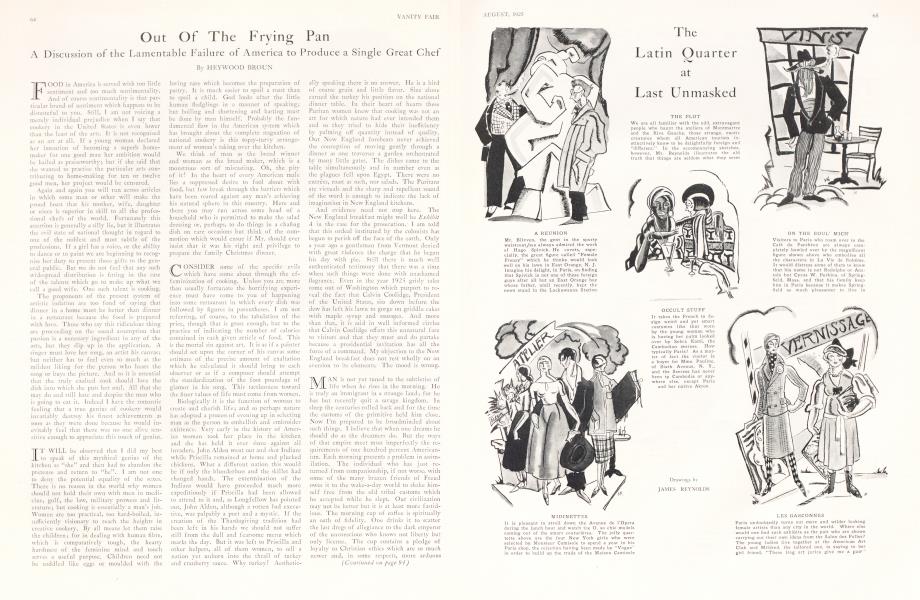
FOOD in America is served with too little sentiment and too much sentimentality. And of course sentimentality is that particular brand of sentiment which happens to be distasteful to you. Still, I am not voicing a merely individual, prejudice when I say that cookery in the United States is even lower than the least of the arts. It is not recognised as an art at all. If a young woman declared her intention of becoming a superb homemaker for one good man her ambition would be hailed as praiseworthy; but if she said that she wanted to practise the particular arts contributing to home-making for ten or twelve good men, her project would be censured.
Again and again you will run across articles in which some man or other will make the proud boast that his mother, wife, daughter or niece is superior in skill to all the professional chefs of the world. Fortunately this assertion is generally a silly lie, but it illustrates the evil state of national thought in regard to one of the noblest and most subtle of the professions. If a girl has a voice, or the ability to dance or to paint we are beginning to recognise her duty to present those gifts to the general public. But we do not feel that any such widespread distribution is fitting in the case of the talents which go to make up what we call a good wife. One such talent is cooking.
The proponents of the present system of artistic isolation are too fond of saying that dinner in a home must be better than dinner in a restaurant because the food is prepared with love. Those who say this ridiculous thing are proceeding on the sound assumption that passion is a necessary ingredient in any of the arts, but they slip up in the application. A singer must love her song, an artist his canvas; but neither has to feel even so much as the mildest liking for the person who hears the song or buys the picture. And so it is essential that the truly exalted cook should love the dish into which she puts her soul. All that she may do and still hate and despise the man who is going to eat it. Indeed I have the romantic feeling that a true genius of cookery would invariably destroy his finest achievements as soon as they were done because he would inevitably feel that there was no one alive sensitive enough to appreciate this touch of genius.
IT WILL be observed that I did my best to speak of this mythical genius of the kitchen as "she" and then had to abandon the pretense and return to "he". I am not one to deny the potential equality of the sexes. There is no reason in the world why women should not hold their own with men in medicine, golf, the law, military prowess and literature; but cooking is essentially a man's job. Women are too practical, too hard-boiled, insufficiently visionary to reach the heights in creative cookery. By all means let them raise the children; for in dealing with human fibre, which is comparatively tough, the hearty harshness of the feminine mind and touch serves a useful purpose. Children need not be coddled like eggs or moulded with the loving care which becomes the preparation of pastry. It is much easier to spoil a roast than to spoil a child. God looks after the little human fledglings in a manner of speaking; but boiling and shortening and basting must be done by man himself. Probably the fundamental flaw in the American system which has brought about the complete stagnation of national cookery is this topsy-turvy arrangement of woman's taking over the kitchen.
We think of man as the bread winner and woman as the bread maker, which is a monstrous sort of miscasting. Oh, the pity of it! In the heart of every American male lies a suppressed desire to fool about with food, but few break through the barriers which have been reared against any man's achieving his natural sphere in this country. Here and there you may run across some head of a household who is permitted to make the salad dressing or, perhaps, to do things in a chafing dish on rare occasions but think of the commotion which would ensue if Mr. should ever insist that it was his right and privilege to prepare the family Christmas dinner.
CONSIDER some of the specific evils which have come about through the effeminization of cooking. Unless you are more than usually fortunate the horrifying experience must have come to you of happening into some restaurant in which every dish was followed by figures in parentheses. I am not referring, of course, to the tabulation of the price, though that is gross enough, but to the practice of indicating the number of calorics contained in each given article of food. This is the mortal sin against art. It is as if a painter should set upon the corner of his canvas some estimate of the precise amount of exaltation which he calculated it should bring to each observer or as if a composer should attempt the standardization of the foot poundage of glamor in his song. This tactlessness toward the finer values of life must come from women.
Biologically it is the function of woman to create and cherish life; and so perhaps nature has adopted a process of evening up in selecting man as the person to embellish and embroider existence. Very early in the history of America woman took her place in the kitchen and she has held it ever since against all invaders. John Alden went out and shot Indians while Priscilla remained at home and plucked chickens. What a different nation this would be if only the blunderbuss and the skillet had changed hands. The extermination of the Indians would have proceeded much more expeditiously if Priscilla had been allowed to attend to it and, as Longfellow has pointed out, John Alden, although a rotten bad executive, was palpably a poet and a mystic. If the creation of the Thanksgiving tradition had been left in his hands we should not suffer still from the dull and fearsome menu which marks the day. But it was left to Priscilla and other helpers, all of them women, to sell a nation yet unborn into the thrall of turkey and cranberry sauce. Why turkey? Aesthetically speaking there is no answer. He is a bird of coarse grain and little flavor. Size alone earned the turkey his position on the national dinner table. In their heart of hearts these Puritan women knew that cooking was not an art for which nature had ever intended them and so they tried to hide their inefficiency by palming off quantity instead of quality. Our New England forebears never achieved the conception of moving gently through a dinner as one traverses a garden orchestrated by many little gates. The dishes came to the table simultaneously and in number even as the plagues fell upon Egypt. There were no entrees, roast as such, nor salads. The Puritans ate victuals and the sharp and repellent sound of the word is enough to indicate the lack of imagination in New England kitchens.
And evidence need not stop here. The New England breakfast might well be Exhibit A in the case for the prosecution. I am told that this ordeal instituted by the colonists has begun to perish off the face of the earth. Only a year ago a gentleman from Vermont denied with great violence the charge that he began his day with pie. Still there is much well authenticated testimony that there was a time when such things were done with unashamed flagrance. Even in the year 1925 grisly tales come out of Washington which purport to reveal the fact that Calvin Coolidge, President of the United States, sits down before the dew has left his lawn to gorge on griddle cakes with maple syrup and sausages. And more than that, it is said in well informed circles that Calvin Coolidge offers this unnatural fare to visitors and that they must and do partake because a presidential invitation has all the force of a command. My objection to the New England breakfast does not rest wholly on an aversion to its elements. The mood is wrong.
MAN is not yet tuned to the subtleties of life when he rises in the morning. He is truly an immigrant in a strange land; for he has but recently quit a savage kingdom. In sleep the centuries rolled back and for the time the customs of the primitive held him close. Now I'm prepared to be broadminded about such things. I believe that when one dreams he should do as the dreamers do. But the ways of that empire meet most imperfectly the requirements of one hundred percent Americanism. Each morning presents a problem in assimilation. The individual who has just returned from companionship, if not worse, with some of the many brazen friends of Freud owes it to the wake-a-day world to shake himself free from the old tribal customs which he accepted while he slept. Our civilization may not be better but it is at least more fastidious. The morning cup of coffee is spiritually an oath of fidelity. One drinks it to scatter the last dregs of allegiance to the dark emperor of the unconscious who knows not liberty but only license. The cup contains a pledge of loyalty to Christian ethics which are so much newer and, in some respects, more arduous than the morality prevalent in dreams nor does it seem to me seditious to supplement the draught with a roll and perhaps a little honey. But griddle cakes, and more particularly sausage, suggest that the breakfaster is attempting to retain into waking hours much of the lustful voraciousness which animated his ego while the censors of his mind were stilled.
(Continued on page 94)
(Continued from page 64)
Eyes newly opened blink awhile. One would not try to mend a little watch immediately after waking. And other senses besides that of sight lag at the beginning of the day. Thus, the man who eats heavily while his faculties are still impaired is yielding merely to gross appetite and violates his better nature. Obviously no niceness of taste can enter into a breakfast. The best that can be expected of the morning meal is that it should serve to sustain life and that is not enough for anyone who tries to live fully and keenly. Nor does lunch offer any fair opportunity for the artistic nature—certainly not in America. "Come and have lunch with me," says the American business man, "and we'll iron out the contract." The heart of any great chef would break if he knew that his sauce must savor a trade agreement rather than a sole. Dinner alone suffices for selfexpression, but even here distracting elements are allowed to enter in. The average American has the feeling that a superb dinner is not good enough to stand alone. Guests are invited to dine and go to the theatre, or to dine and dance, or to dine and play bridge. All such arrangements demean a great art. After an inspired dinner there should be need of nothing but low voices saying not too much, music heard from a little distance and that divine peace which permits memory to heighten and repeat this late adventure of your soul among the masterpieces.
Probably the most damning thing that can be said against American cooking is that strictly speaking there is no such thing.
To be sure, there are many excellent restaurants in America even after the padlock campaign. Most of them are in New York. And those which are in other towns try to imitate New York as closely as possible. And this is not said sneeringly for New York in turn imitates Paris. Before the great war German cooking flourished in this country. It is a school without much finesse but it expresses vigor and ruggedness nor is it destitute of invention. But of course German cooking has died utterly in this land by now. Not the war but prohibition killed it. The French alone have risen to sublimity. They have touched the abstract. They have made the shadow more than the substance. All the great sauces of the world arc French. Is there, indeed, any such thing as an American sauce? Oh yes, tomato catsup. Well, there you have your answer.
Subscribers have complete access to the archive.
Sign In Not a Subscriber?Join Now
