

Sign In to Your Account
Subscribers have complete access to the archive.
Sign In Not a Subscriber?Join NowThe Importance of Being Nobody
How to Write Ideal Criticism: An Inquiry Into the Functions of a Critic
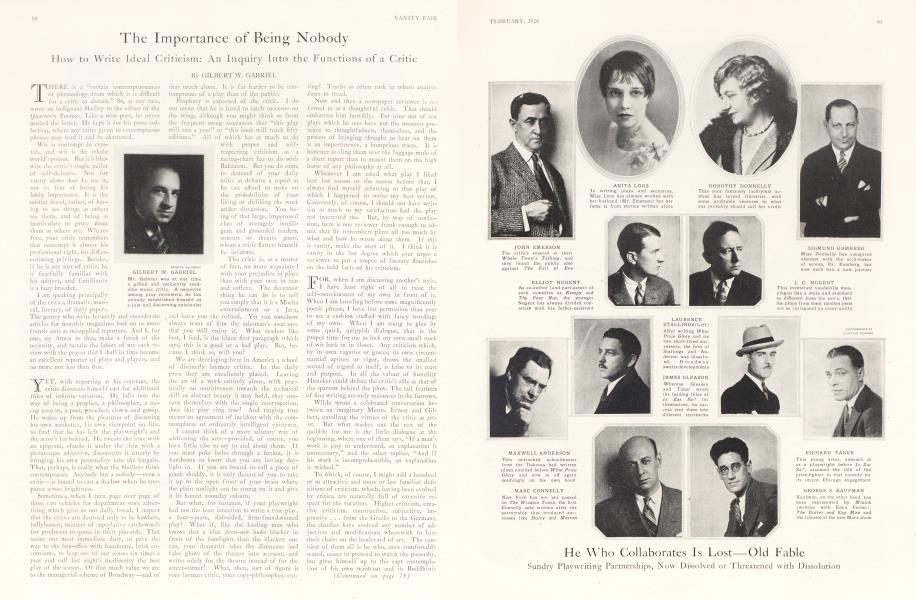
GILBERT W. GABRIEL
THERE is a "certain contemptuousness of phraseology from which it is difficult for a critic to abstain." So, at any rate, wrote an indignant Shelley to the editor of the Quarterly Review. Like a wise poet, he never mailed the letter. He kept it for his prose collection, where any critic given to contemptuous phrases may read it and be chastened.
Wit is contempt in crystals, and wit is the whole world's poison. But it is likewise the critic's single pellet of self-defence. Not for vanity alone does he use it, nor in fear of losing his lobby importance. It is the subtler dread, rather, of having to see things as others see them, and of being as inarticulate or prosy about them as others are. Wherefore, your critic remembers that contempt is almost his professional right, his differentiating privilege. Besides, if he is any sort of critic, he is fearfully familiar with his subject, and familiarity is a busy breeder.
I am speaking principally of the critics, dramatic, musical, literary, of daily papers. The gentry who write leisurely and considerate articles for monthly magazines look on us more frantic ants as misapplied reporters. And I, for one, say Amen to that, make a fetish of the necessity, and sustain the labors of my each review with the prayer that I shall in time become an excellent reporter of plays and players, and no more nor less than that.
YET, with reporting as his constant, the critic discovers himself cast for additional roles of infinite variation. He falls into the way of being a prophet, a philosopher, a teacup essayist, a poet, preacher, clown and gossip. He wakes up from the pleasures of discussing his own aesthetics, his own viewpoint on life, to find that he has left the playwright's and the actor's far behind. He tweaks the issue with an epigram, chucks it under the chin with a picturesque adjective, disconcerts it utterly by bringing his, own personality into the bargain. That, perhaps, is really what the Shelleys think contemptuous. Anybody but a nobody—even a critic—is bound to cast a shadow when he trespasses across brightness.
Sometimes, when I turn page over page of those vast vehicles for department store advertising which give us our daily bread, I suspect that the critics are destined only to be hawkers, ballyhoocrs, minters of superlative catch-words for producers to quote in their placards. That seems our most immediate duty, to pave the way to the box-office with handsome, brisk encomiums, to leap out of our senses six times a year and call last night's mediocrity the best play of the season. Of that much value we are to the managerial scheme of Broadway—and of that much alone. It is far harder to be contemptuous of a play than of the public.
Prophecy is expected of the critic. I do not mean that he is hired to catch successes on the wing, although you might think so from the frequent smug assurances that "this play will run a year" or "this book will reach fifty editions." All of which has as much to do with proper and selfrespecting criticism as a racing-chart has to do with Bahaaism. But you do come to demand of your daily critic as definite a report as he can afford to make on the probabilities of your liking or disliking the work under discussion. You being of that large, impersonal class of averagely intelligent and grounded readers, concert or theatre goers, whom a critic flatters himself he informs.
The critic is, as a matter of fact, no more acquainted with your prejudice in plays than with your taste in teas and coffees. The decentest thing he can do is to tell you simply that it is a Mocha entertainment or a Java, and leave you the refusal. Yet you somehow always want of him the salesman's assurance that you will enjoy it. What readers like best, I find, is the blunt first paragraph which says, this is a good or a bad play. But, because I think so, will you?
We are developing here in America a school of distinctly laymen critics. In the daily press they are excellently placed. Leaving the art of a work entirely alone, with practically no sensitiveness towards the technical skill or abstract beauty it may hold, they concern themselves with the single interrogation, does this play ring true? And ringing true means an agreement of incident with the commonplaces of ordinarily intelligent existence.
I cannot think of a more salutary way of addressing the arts—provided, of course, you have little else to say to and about them. If you must poke holes through a fiction, it is handsome to know that you are letting daylight in. If you arc bound to call a piece of goods shoddy, it is only decent of you to take it up to the open front of your brain where the plain sunlight can be strong on it and give it its honest noonday colours.
But what, for instance, if your playwright had not the least intention to write a true play, a four-square, slab-sided, firm-foundationed play? What if, like the leading man who knows that a blue dress-suit looks blacker in front of the footlights than the blackest one can, your dramatist takes the dimnesses and false glows of the theatre into account, and writes solely for the theatre instead of for the street-corner? What, then, sort of figure is your layman critic, your copy-philosopher, cutting: Truths so often rush in where analysis fears to tread.
Now and then a newspaper reviewer is referred to as a thoughtful critic. That should embarrass him horribly. For nine out of ten plays which he sees have not the meanest pretence to thoughtfulness, themselves, and the process of bringing thought to bear on them is an impertinence, a bumptious waste. It is honester to sling them over the baggage mule of a short report than to mount them on the high horse of any philosophy at all.
Whenever I am asked what play I liked best last season or the season before that, I always find myself referring to that play of which I happened to write my best review. Conversely, of course, I should not have written so much to my satisfaction had the play not interested me. But, by way of confession, here is one reviewer frank enough to admit that he remembers plays all too much by what and how he wrote about them. If this is vanity, make the most of it. I think it is vanity in the last degree which ever urges a reviewer to put a toupee of literary flourishes on the bald facts of his criticism.
FOR, when I am discussing another's style, I have least right of all to raise the self-consciousness of my own in front of it. When I am kneeling before some magnificently poetic phrase, I have less permission than ever to use a cushion stuffed with fancy wordings of my own. When I am stung to glee by some quick, quippish dialogue, that is the proper time for me to lock my own small stock of wit back in its closet. Any criticism which, by its own vagaries or graces, its own circumstantial aptness or vigor, draws the smallest second of regard to itself, is false to its trust and purpose. In all the valour of humility Huneker could define the critic's role as that of the sparrow behind the plow. The tail feathers of fine writing arc only nuisances in the furrows.
Wilde wrote a celebrated conversation between an imaginary Messrs. Ernest and Gilbert, extolling the virtues of the critic as artist. But what washes out the rest of the quibble for me is the little dialogue at the beginning, where one of them says, "If a man's work is easy to understand, an explanation is unnecessary," and the other replies, "And if his work is incomprehensible, an explanation is wicked."
To which, of course, I might add a hundred or so attractive and more or less familiar definitions of criticism, which, having been evolved by critics, are naturally full of excessive respect for the vocation. Higher criticism, creative criticism, constructive, subjective, impressive . . . from the Greeks to the Germans, the dandies have evolved any number of adjectives and modifications wherewith to hire their chairs on the boulevard of art. The canniest of them all is he who, once comfortably seated, ceases to pretend to watch the passersby, but gives himself up to the rapt contemplation of his own waistcoat and its Buddhistic images beneath. For then he shall have given up hoodwinking himself.
Continued on page 78
Continued from page 58
Here in America, where so-called criticism must slam out its judgment of a new play within an hour after the first performance, or its impression of a new symphony without any recourse to the score, what is left to the daily reviewer but the courage of his ridiculousness?
It passes for modern criticism, this falsetto carolling of backstage anecdotes and alley puns. Because, lumps in sawdust, there are compliments and condemnations coagulated in it here and there. Because, too, the public will always prefer tales of the frail flesh and empty noddle to the theorems of an art, will always find armchairs for a Lauzun or an Evelyn while Descartes cools his heels in the hallway.
In short, the perfect criticism should be a pleasant-tempered, fairly noncommittal report which, on second reading, would say absolutely nothing. Three-quarters of it ought to be devoted to a rehearsal of the plot of the play, or to an analysis of the symphony, or to a discussion of the picture-frames in an art exhibit. The fourth quarter might well be given up to naming the notables present in the audience. Plainly it should be written for everybody— by a nobody.
Please God, I shall never attain it.
Subscribers have complete access to the archive.
Sign In Not a Subscriber?Join Now
