
Sign In to Your Account
Subscribers have complete access to the archive.
Sign In Not a Subscriber?Join NowA Napoleon of Shadows
An Estimate of Cecil B. De Mille, an Amazing Potentate of Filmdom
JIM TULLY
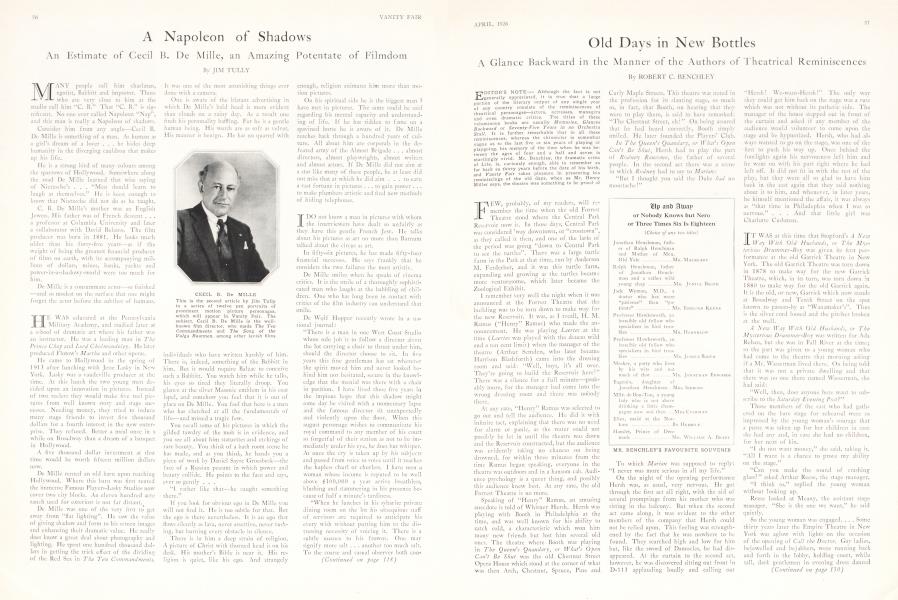
MANY people call him charlatan, egotist, Babbitt and impostor. Those who are very close to him at the studio call him "C. B." That "C. B." is significant. No one ever called Napoleon "Nap", and this man is really a Napoleon of shadows.
Consider him from any angle—Cecil B. Dc Mille is something of a man. As human as a girl's dream of a lover . . . he hides deep humanity in the diverging cauldron that makes up his life.
He is a strong bird of many colours among the sparrows of Hollywood. Somewhere along the road De Mille learned that wise saying of Nietzsche's . . . "Men should learn to laugh at themselves." He is keen enough to know that Nietzsche did not do as he taught.
C. B. De Mille's mother was an English Jewess. His father was of French descent . . . a professor at Columbia University and later a collaborator with David Bclasco. The film producer was born in 1881. He looks much older than his forty-five years—as if the weight of being the greatest financial producer of films on earth, with its accompanying millions of dollars, mines, banks, yachts and powcr-in-a-shadowy-world were too much for him.
De Mille is a consummate actor—so finished —and so modest on the surface that one might forget the actor before the subtlest of humans.
HE WAS educated at the Pennsylvania Military Academy, and studied later at a school of dramatic art where his father was an instructor. He was a leading man in 'The Prince Chap and Lord Cholmondeley. He later produced Flotow's Martha and other operas.
He came to Hollywood in the spring of 1913 after lunching with Jesse Lasky in New York. Lasky was a vaudeville producer at the time. At this lunch the two young men decided upon an innovation in pictures. Instead of two reelers they would make five reel pictures from well known story and stage successes. Needing money, they tried to induce many stage friends to invest five thousand dollars for a fourth interest in the new enterprise. They refused. Better a meal once in a while on Broadway than a dream of a banquet in Hollywood.
A five thousand dollar investment at that time would be worth fifteen million dollars now.
De Mille rented an old barn upon reaching Hollywood. Where this barn was first rented the immense Famous Players-Lasky Studios now cover two city blocks. An eleven hundred acre ranch used for exteriors is not far distant.
De Mille was one of the very first to get away from "flat lighting". He saw the value of giving shadow and form to his screen images and enhancing their dramatic value. He really docs know a great deal about photography and lighting. He spent one hundred thousand dollars in getting the trick effect of the dividing of the Red Sea in The Ten Commandments. It was one of the most astonishing things ever done with a camera.
One is aware of the blatant advertising in which De Mille's bald head is more evident than clouds on a rainy day. As a result one finds his personality baffling. For he is a gentle human being. His words are as soft as velvet. His manner is benign. He has no quarrel with individuals who have written harshly of him. There is, indeed, something of the Babbitt in him. But it would require Balzac to conceive such a Babbitt. You watch him while he talks, his eyes so tired they literally droop. You glance at the silver Masonic emblem in his coat lapel, and somehow you feel that it is out of place on De Mille. You feel that here is a man who has clutched at all the fundamentals of life—and missed a tragic few.
You recall some of his pictures in which the gilded tawdry of the mob is in evidence, and you see all about him statuettes and etchings of rare beauty. You think of a bath room scene he has made, and as you think, he hands you a piece of work by Daniel Sayre Groesbeck—the face of a Russian peasant in which power and beauty collide. He points to the face and says, ever so gently . . .
"I rather like that—he caught something there."
If you look for obvious ego in De Mille you will not find it. He is too subtle for that. But the ego is there nevertheless. It is an ego that flows silently as lava, never assertive, never rushing, but burning every obstacle in silence.
There is in him a deep strain of religion. A picture of Christ with thorned head is on his desk. His mother's Bible is near it. His religion is quiet, like his ego. And strangely enough, religion animates him more than motion pictures.
On his spiritual side he is the biggest man I have met in pictures. T he same could be said regarding his mental capacity and understanding of life. If he has ridden to fame on a spavined horse he is aware of it. Dc Mille reaches back through a hundred years of culture. All about him are corporals in the defeated army of the Almost Brigade . . . almost directors, almost playwrights, almost writers and almost actors. If De Mille did not aim at a star like many of these people, he at least did not miss that at which he did aim ... to earn a vast fortune in pictures ... to gain power . . . to make plumbers artistic and find new methods of hiding telephones.
I DO not know a man in pictures with whom the interviewers have dealt so unfairly as they have this gentle French Jew. He talks about his pictures as art no more than Barnum talked about the circus as art.
In fifty-six pictures, he has made fifty-four financial successes. He says frankly that he considers the two failures the most artistic.
De Mille smiles when he speaks of cinema critics. It is the smile of a thoroughly sophisticated man who laughs at the babbling of children. One who has long been in contact with critics of the film industry can understand that smile.
De Wolf Hopper recently wrote in a national journal:
"There is a man in one West Coast Studio whose sole job is to follow a director about the lot carrying a chair to thrust under him, should the director choose to sit. In five years this fine gentleman has sat wherever the spirit moved him and never looked behind him nor hesitated, secure in the knowledge that the menial was there with a chair in position. I have lived these five years in the impious hope that this shadow might some day be visited with a momentary lapse and the famous director sit unexpectedly and violently upon the floor. When this august personage wishes to communicate his royal command to any member of his court so forgetful of their station as not to be immediately under his eye, he does but whisper. At once the cry is taken up by his subjects and passed from voice to voice until it reaches the hapless churl or churless. I have seen a woman whose income is reputed to be well above $100,000 a year arrive breathless, blushing and stammering in his presence because of half a minute's tardiness.
"When he lunches in his sybarite private dining room on the lot his obsequious staff of servitors are required to anticipate his every wish without putting him to the distressing necessity of voicing it. There is a subtle nuance to his frowns. One may signify more salt . . . another too much salt. To the coarse and casual observer both contractions of the eyebrow may seem identical, but to the apprehensive eye of the submissive figure behind the master's chair each is eloquent and ominous."
(Continued on page 118)
(Continued from page 56)
After reading this I looked forward to a lunch in the sybarite dining room. Dc Mille took me into a room that was plainer than George Eliot. We had sausages, spaghetti, and no nuances for lunch. The servants were obsequious, as servants should be the wide world over. If anything, I would consider De Mille too courteous to them. I mentioned the article quoted above.
"When did that appear?" lie asked. I told him.
"Let's see—I was reading a series of articles by Professor Milliken at that time and did not get to it. I seldom read light literature."
"I have never seen such bathrooms as in your pictures, Mr. De Mille," I remarked a moment later.
"Well," he answered, "I have only put bathrooms in three pictures out of the fifty-six I've made. But I will admit they were good ones. Before I started— bathrooms were catch-alls for everything in the family. Now look at them." "Yes, look at them," I said.
He smiled tiredly.
We talked of his financial masterpiece, The Ten Commandments.
"The critics have been quite harsh about that picture," I said.
"Yes ... I know," he answered quietly, and motioned to a servant. "Bring me the Exhibitor's Herald."
That journal was brought to him. He turned to a page which showed that the picture under discussion had made more money than any film ever made. "That's the answer," he said.
"How do you account for your prescience in having chosen so many famous screen women, such as Gloria Swanson, Leatrice Joy, Bebe Daniels, Jetta Goudal, Nita Naldi, Irene Rich, and many others?" I asked.
"I have one method. I see the girl on the screen first. That keeps her living personality from conflict with her most essential attribute to me . . . her screen personality."
He is the first man in such a position I have met who knows the mob without thinking on their level. Sometimes I think lie smiles at them. He is really a cultivated Barnum. His whole attitude indicates that one cannot make pictures for the elite and survive. "I would rather have ten million friends than five thousand," he said.
He has the weakness of those who have tasted power. He has the mentality of those who realize the futility of it.
Subscribers have complete access to the archive.
Sign In Not a Subscriber?Join Now
