
Sign In to Your Account
Subscribers have complete access to the archive.
Sign In Not a Subscriber?Join NowThe Iron Master
A Drama of Love, Sacred and Profane, Occurring in the Shadow of Industry
FERENC MOLNÁR
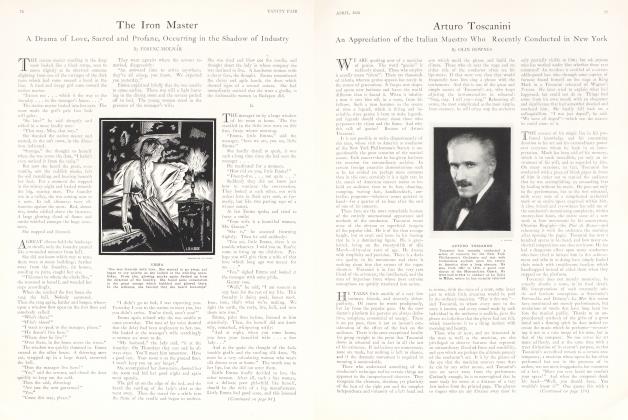
THE station master standing in the deep snow looked like a black statue, seen to -Hmove slightly as he observed someone alighting from one of the carriages of the dark train which had come around a bend in the line. A tired and sleepy girl came toward the station master.
"Excuse me . . . which is the way to the foundry ... to the manager's house. . . ."
The station master looked into her eyes. The snow made the girl's pale face look still paler.
"So later" he said abruptly and added in a more kindly tone:
"That way, Miss, that way."
She thanked the station master and started, in the soft snow, in the direction indicated.
"Strange," she thought to herself when she was across the dam, "I hadn't even noticed it from the train."
But now she heard the great, even rumble, saw the reddish smoke, feit the soil trembling and heaving beneath her feet. For a moment she stopped in the wintry night and looked towards the big, rearing mass. The foundry was in a valley, she was coming near to it now. Its tall chimneys were silhouettes against the snow. Red, almost fire, smoke eddied above the furnaces.
A large glowing cloud of flames and smoke whirled amongst the huge structures.
She stopped and listened.
A GREAT silence held the landscape _/j\_in thrall; only the foundry panted like a wounded monster from hell.
She did not know which way to turn, there were so many buildings; further away from the foundry, six houses, standing in pairs, caught her eye.
"Thismust be where the clerks live," she reasoned to herself, and wended her steps accordingly.
When she reached the first house she rang the bell. Nobody answered.
Then she rang again, harder and longer, whereupon a window flew open on the first floor and somebody called:
"Who's there?"
"Who's there?"
"I want to speak to the manager, please."
"He doesn't live here."
"Where does he live?"
"Over there, in the house across the street."
The window was quickly slammed to. Emma crossed to the other house. A shivering servant, wrapped up in a large shawl, answered the bell.
"Does the manager live here?"
"Yes," said the servant, and closed the door quickly to keep out the cold.
Then she said, shivering:
"Are you the new governess?"
"Yes."
"Come this way, please." They went upstairs where the servant remarked, disagreeably:
"An awkward time to arrive anywhere; they're all asleep, you know. We expected you yesterday."
Emma explained briefly that she was unable to come earlier. There was still a light burning in the dining room and the servant packed off to bed. The young woman stood in the presence of the manager's wife.
"I didn't go to bed, I was expecting you. Yesterday I sent to the station to meet you, but you didn't arrive. You're tired, aren't you?"
Emma again related why she was unable to come yesterday. The tone of her voice showed that the delay had been unpleasant to her, too. She looked at the manager's wife scarchingly as women are wont to do.
"My husband," the lady said, "is at the foundry. On Thursdays they cast and he always stays. You'll meet him tomorrow. Have a good rest. Your room is on the ground floor. I won't keep you up any longer."
She accompanied her downstairs, showed her the room and bid her good night and again went upstairs.
The girl sat on the edge of the bed, and she heard the rustling of the lady's skirt as she went away. I hen she stared for a while into the flame of the candle and began to undress. She was tired and blew out the candle, and thought about the lady in whose company she was destined to live. A handsome woman with a clever face, she thought. Emma remembered the clever and agile hands, the dress which showed signs of a sensual nature. She had immediately noticed that she wore a girdle, ns the fashionable women in Budapest did.
II.
THE manager sat by a large window of his room at home. The fire crackled in the little iron stove on this fine, frosty winter morning.
"Emma, little Emma," said the manager, "here we are, you sec, little Em ma."
She hardly dared to speak, it was such a long time since she had seen the manager . . .
He meditated for a moment.
"How old are you, little Emma?" "Twenty-five . . . not quite . . ." Suddenly they did not know just how to continue the conversation. They looked at each other, not with ardent love in their eyes now, as formerly, but like two parting rays of a winter sunset.
At last Emma spoke, and tried to force a smile:
"Your wife is a beautiful woman, Mr. Gan tar."
"She is," he assented frowning slightly. Then he said suddenly:
"You sec, little Emma, there is no trouble whatever. I told you so. You've come to bring up my children. Perhaps you will give them a trifle of that love which long ago was meant for me . . ."
"Yes," sighed Emma and looked at the manager with some pride.
Gan tar rose.
"Well," lie said, "I am content to stay here for the rest of my life. This foundry is doing good, honest work. Iron, iron, that's what we're making. We fight the earth, the rocks, fire, hell, and turn them into iron."
Emma, paler than before, listened to him attentively. Then, she herself did not know why, remarked, whispering softly:
"And at night, when you come home, you have your beautiful wife . . . a fine lady . . ."
And as she spoke she thought of the fashionable girdle and the rustling silk dress. "It must be a very calculating woman who wears silk dresses even at home." The words rose to her lips, but she did not utter them.
Little Emma finally decided to love the other woman. After all, such a fine woman, not a delicate poor girl-child like herself, should be the wife of a big manufacturer. Little Emma had good sense, and this lessened the pain of her little tragedy. They sat there in silence looking out of the window, and watching the falling snow; but now and again they cast a furtive glance at each other. The wife entered, and Emma rose respectfully. She was not dressed in a pale blue dressing gown, like the naughty wives described in novels, but in villainous, sinful silk which clung to her body, soft and flattering, concealing and revealing. As she sat in the rocking chair she looked, for all the world, like a lustful French marquise of the Faublas age, expectant of embrace, not passionate, but with a longing face rather pale and ingenuous in appearance, but capable of any cunning and intrigue for a trifle of love.
(Continued on page 94)
(Continued from page 76)
The conversation suddenly turned into another direction. They spoke of the children's education, of Emma's employment. Then the lady surveyed the girl with a pitying look.
"Well, I must be going," the manager remarked simply, and said, "Good morning." From the window they could see him walking in the snow, toward the foundry. His wife stood quite close to her, even touched her with her warm arm and said to her, quite without guile:
"You knew my husband before, didn't you?"
"I knew him . . . we met. ..."
The lady needed only a glance to understand quite plainly. Site smiled at the girl, then went upstairs, lightlv, lifting up her dress a little as she went. She seemed like a Madame Bovary who in the end grew old with so many sins that she had not enough time left to atone for them. Emma looked after her.
She was annoyed that this woman looked so beautiful so early in the morning. In her innocence, she imagined an embrace between the manager and his wife. She closed her eyes, even caught hold of the banister to steady herself when this picture presented itself to her virgin mind. This powerful man, nothing but muscle and bones, embracing tliis soft, undulating eastern body. Strength and lust clinging together like iron and velvet. These two, kissing each other wildly. She almost heard the woman's languid sigh of passion. . . .
"Emma," a voice called from upstairs.
Emma began to ascend.
"Emma. ..."
She received her wages in advance.
III.
For a week the snow fell incessantly. Emma had gone to bed, but could not sleep.
She rose and stood by the window feverish with love. She wanted to go away, and began to cry quietly as she looked at the whirling snow flakes. From afar, glowing specks again flashed up from the direction of the foundry. It was Thursday, they were casting again.
She found some consolation in the great energy which bubbled and glowed there, and she put her hand on her heart so that its increased beating would not disturb her.
She fancied that she heard stealthy gliding steps pass the door. Soft steps were audible, someone had gone upstairs. She heard a few incriminating sounds from inside the wife's room. The visitor was the secretary who roomed in the house. After a certain time has elapsed enamoured women do not cling to the adored one's neck with ardent laughter, but receive him as, for instance, they would the doctor. Especially clever, cunning women, who welcome him quietly and seriously, but hurriedly. They suddenly left off speaking, and it seemed that they had gone to another room.
Emma hurried out, closed the door behind her, and ran across the snow, towards the foundry. She looked back and saw a light in the wife's window. There was so much innate honesty in the girl's nature that her heart almost broke when she thought of the deception of this fine man. She pondered whether to keep silent, or to betray everything. The figure of a man approached. He called to her.
It was Gantar, and Emma hid her face from him. He asked her, alarmed:
"Emma, what do you want out here, in such weather? . . . Go home . . . you'll catch cold. ..."
"No, no."
She clung to his arm convulsively. She cried now and stammered:
"Let's go to the foundry . . . there I shall tell you everything. . . ."
Gantar took her into the large workshop. Full of light and thronging workmen—up, up—to the large moving iron bridge . . . beneath the roof . . . there the girl grasped his arm stammering:
"Your wife . . ." cried the girl into the deafening roar. Gantar stroked his forehead. He looked down at the red smoking streams of fire and said aloud:
"I know: I know."
He seemed to suffer terribly. The iron bridge was moving and carrying iron towards the moulds.
Emma looked at him surprised. Her crying suddenly stopped.
"You know about it, Sandy?"
He sat down on a chair and bowed his head on his hands.
"Yes, I know," he answered.
The girl looked at him, and thought the world was crushing about her heels. Docs one "know" of this so simply?
Again the loud roar as before. The iron bubbled out from another furnace. The large machinery started, with such a deafening roar that every pillar in the building shook.
This was no earthly howl, now, but a hellish crash, into which hundreds of workmen shouted, running, here and there. The iron rushed out into the moulds hissing and sparkling, victor of all. An engine whistled, the large iron bridge creaked and the electric motor droned loudly. Nothing but feverish, rushing work glowed here in the hellish heat.
"Look . . . little Emma . . . there is the iron . . . do you see it? ... and they at home now whisper of soft kisses ... do you hear how it roars? . . . do you see how it rushes? . . . Every Thursday I come here to bury my sorrow ..."
(Continued on page 144)
(Continued from page 94)
The girl nestled, frightened, to his broad chest, clutching his arm.
"Do you seer" shouted the iron master . . . "God is wrestling with me here . . . earth, this jealous scoundrel . . . they whisper and he kisses the tips of her white fingers. Look how this force drowns everything."
The whistling continued.
"Here I weep on these hellish fires. I know very well that she is deceiving me then. He will go away in another month perhaps, . . . somehow I shall stand it till then. I don't want a scandal, no . . . no . . . for anything on earth . . . there is so much force, so much power here, man is nothing compared to it."
The girl listened to him with closed eyes, leaning against his shoulder. The man grew excited as he spoke.
"There is the iron, do you see it? Do you hear how it roars? Because we drew it out of the earth, and it makes the earth shake. Do I think of perfume now, or of her little hands? Do I care that he kisses her eyelids? Do I care because she doesn't love me? Don't you see that I don't want a lean dog for an adversary, when down below nature itself is ringing, thundering and glowing?"
The girl felt that she would die of love. She clung feverishly to the man's arm.
Then as if Gantar had collapsed, he spoke in a deep hoarse voice :
"But then, in the morning in the silence . . . then it hurts ..."
Subscribers have complete access to the archive.
Sign In Not a Subscriber?Join Now

