Sign In to Your Account
Subscribers have complete access to the archive.
Sign In Not a Subscriber?Join NowThe Famous Golf Links at Muirfield
Where the British Amateur Championship Will Be Held
BERNARD DARWIN
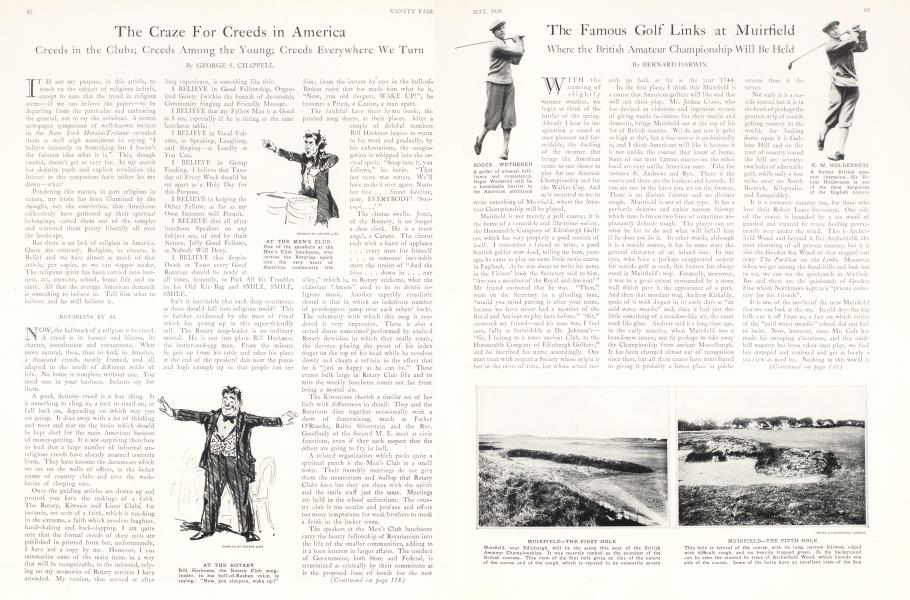
WITH the coming of slightly warmer weather, we begin to think of the battles of the spring. Already I hear in imagination a sound once pleasant and formidable, the docking of the steamer that brings the American teams to our shores to play for our Amateur Championship and for the Walker Cup. And so it occurred to me to write something of M in irfield, where the Amateur Championship will be played.
Muirfield is not merely a golf course; it is the home of a venerable and illustrious society, the Honourable Company of Edinburgh Golfers, which has very properly a good conceit of itself. I remember a friend of mine, a good Scottish golfer now dead, telling me how, years ago, he came to play on some little rustic course in England. As he was about to write his name in the Visitors' book the Secretary said to him, "Are you a member of the Royal and Ancient? " Mv friend answered that he was. "Then," went on the Secretary in a pleading tone, "would you mind putting it after your name, because we have never had a member of the Roval and Ancient to play here before." "Sir," answered my friend—and his tone was, I feel sure, fully as formidable as Dr. Johnson's— "Sir, I belong to a more ancient Club, to the Honourable Company of Edinburgh Golfers;" and he inscribed his name accordingly. One must treat with respect a Society whose origin is lost in the mists of time, but whose actual records go back as far as the year 1744.
In the first place, I think that Muirfield is a course that American golfers will like and that will suit their play. Mr. Joshua Crane, who has devised an elaborate and ingenious system of giving marks to courses for their merits and demerits, brings Muirfield out at the top of his list of British courses. We do not rate it quite so high as that, but a fine course it undoubtedly is, and I think Americans will like it because it is not unlike the courses they know at home. Some of our most famous courses on the other hand are very unlike American ones. 'I'ake for instance St. Andrews and Rye. There is the course and there are the bunkers and hazards. If you arc not in the latter you are on the former. There is no distinct fairway and no distinct rough. Muirfield is not of that type. It has a perfectly definite and rather narrow fairway which runs between two lines of sometimes unpleasantly definite rough. The player can see what he has to do and what will befall him if he does not do it. In other words, although it is a seaside course, it has in some ways the general character of an inland one. In our eyes, who have a perhaps exaggerated respect for seaside golf as such, this feature has always stood in Muirfield's way. Formerly, moreover, it was to a great extent surrounded by a stone wall which gave it the appearance of a park. And then that mordant wag, Andrew Kirkaldy, spoke of it with disgust in its early days as "an auld water mcadic" and, since it had just this little something of a meadow-like air, the taunt stuck like glue. Andrew said it a long time ago, in the early nineties, when Muirfield was a brand-new course, not fit perhaps to take away the Championship from ancient Musselburgh. It has been changed almost out of recognition since then, but all these causes have contributed to giving it probably a lower place in public esteem than it deserves.
Not only is it a seaside course, but it is in t h e hca rt o f pe rh aps t h e greatest strip of seaside golfing country in the world, for looking down upon it is Gullanc Hill and on the tract of country round the hill arc seventytwo holes of admirable golf, while only a few miles away are North Berwick, Kilspindie, and Longniddry.
It is a romantic country too, for those who love their Robert Louis Stevenson. One side ot the course is bounded by a sea wood of gnarled and stunted fir trees, heeling permanently over under the wind. This is Archerfield Wood and beyond it lies Archerfield, the most charming of all private courses; but it is also the Graden Sea Wood of that magnificent story The Pavilion- on the Links. Moreover when we get among the Sand-hills and look out to sea, we can see the quicksands in Aberladv Bay and there are the quicksands of Graden Floe which Northmore kept as a "private cemetery for his friends".
It is one of the merits of the new Muirfield that we can look at the sea. In old days the big hills cut it off from us, a fact on which critics of the "auld water mcadie" school did not fail to insist. Now, however, since Mr. Colt has made his sweeping alterations, and this sandhill country has been taken into play, we feel less cramped and confined and get as lovely a sea view as need be. Nothing in this world is ever quite what it was, so everybody does not approve of the change. It is alwavs hard not to regret an historic hole, even if it be not a very good one, such for instance as the old first hole, now vanished, at which Mr. Tolley holed his putt for two to beat Mr. Robert Gardner at the 37th in 1920. Putting aside regrets for buried time, there is no doubt that Mr. Colt has done his work skilfully as he always does in his own characteristic manner, and that Muirfield, whether pleasanter or not, is a sterner test of modern golf than it was five years ago. Very likely when we have got over our conservatism, we may all think it a pleasanter one too.
Continued on page 140
Continued front fage 83
I am not going through the holes, which would he tedious, hut I ought to say—or try to—what are the qualities which the present Muirfield demands and rewards. Well, accuracy is certainly one of them, and length is another. Accuracy is not perhaps quite so essential as it once was. At the Championship of 1920 the rough had lost much of its pristine fierceness and strong players could take driving irons where once they would have had to content themselves with niblicks. But with the coining into being of new holes and consequently virgin rough, the old balance of power may he somewhat restored; and so much the better if it is. As to the necessity for length there is, I think, no question. The consistently strong hitter—if he be also straight— will be rewarded every time. Moreover since the ground is rather on the soft side, with none of that hardness which has saved St. Andrews from being trampled to pieces, the man who can hit a long carrying ball will profit.
As regards the putting I refuse to prophesy. I have seen the Muirfield greens very soft and meadowy; I have seen them sufficiently fast and a little tricky. I have certainly seen them good but I do not think I have ever seen them Very easy for the stranger, for the reason that they vary a good deal from one another in pace and consistency, and it is difficult in the agitation of the moment to remember which is which. The man who knows the course generally does well at Muirfield. Certainly Mr. Robert Maxwell, great player though he was on all courses, was infinitely more alarming there than anywhere else; witness the fact that he won both his Championships there and won them, I might say, comfortably.
So much for the course of Muirfield, and now I must say something of the ancient and romantic Society that owns it. As I said, no one knows how old it is. It may even be older than Blackheath, for that story about James the First and his Scottish courtiers bringing their game to the English heath is not too well authenticated. At any rate we know this, that, in 1744 "several Gentlemen of Honour, skilfull in the ancient and healthful exercise of the golf" used to play on the Links of Leith; that they had "from time to time applied" to the Magistrates at Edinburgh and at last the Magistrates caused their Treasurer to make a silver club to be played for by such "Noblemen or Gentlemen or other Golfers" who should inscribe their names beforehand at Mrs. Clephan's and pay five shillings. Further the Magistrates stipulated that they should not be put to any sort of expense in the affair except that of sending the silver club to Leith on the proper day and to announce that day beforehand through the City "by Tuck of Drum." They were canny persons but they had, unwittingly perhaps, the romantic touch. "By Tuck of Drum"! We feel as if we could hear the throbbing of those drums yet. And save for one year—and that sad omission is ISO years ago—the silver club has been played for ever since.
The old minutes of the Society make pleasant reading, many of them being of a convivial character as were those of Blackheath and other ancient clubs. Indeed it seems that a day's golf was a very incomplete affair without a dinner. Thus in 1776 "Lieut. James Dalrymple of the 43rd Regiment being convicted of playing five different times at Golf without his uniform (his golfing and not his military one) was fined only in Six Pints, having confessed the heinousness of his crime." Apparently his penitence did not go all the way round for there is a footnote to add that "At his own request he was fined in Three Pints more." Port and Punch were, according to another minute, "the ordinary drink of the Society" except on the days when the Silver Club was played for when "Claret or any other liquor more agreeable will he permitted." In 1792 a highly distinguished new member was admitted in the person of Mr. Henry Raeburn, the painter, and thereby hangs a sad story. The Society owned several pictures by Raeburn, but when it left Leith for Mussellburgh (which happened between 18 30 and 1840) these pictures were sold for trifling sums and alas! they have never come back. It is said that three Raeburns were bought by a caddie for as many pounds. At any rate there are no Raeburns now.
One of the pictures that used to be in the Leith Club house—I fancy it was by Raeburn—was of a famous and engaging character Singing Jamie Balfour. Many legends clustered round his name, and there is one particularly pleasing. Going home very late one night he chanced to fall into a hole made for the foundations of a new house. He hailed a passerby and entreated to be helped out. This passer-by was a cautious as well as a good Samaritan. "What would be the use of helping you out," he asked, "when you could not stand though you were oufr" "Very true, perhaps," answered the incorrigible Mr. Balfour. "Yet if you help me up, I'll run you to the Tron Kirk for a bottle of Claret." He was helped up accordingly, and set off running at such a pace that he won easily.
There will be no such frolics as this when the American team come to Muirfield. Championship Golf is a more serious business than Mr. Balfour would have approved of. But it may be promised that the Honourable Company will live up to all proper hospitable traditions worthy of its ancestors.
Subscribers have complete access to the archive.
Sign In Not a Subscriber?Join Now
