Sign In to Your Account
Subscribers have complete access to the archive.
Sign In Not a Subscriber?Join NowThe Nebulous Nineties
Being Certain Pensive Notes Prompted by Mr. Beer's "The Mauve Decade"
ALEXANDER WOOLLCOTT
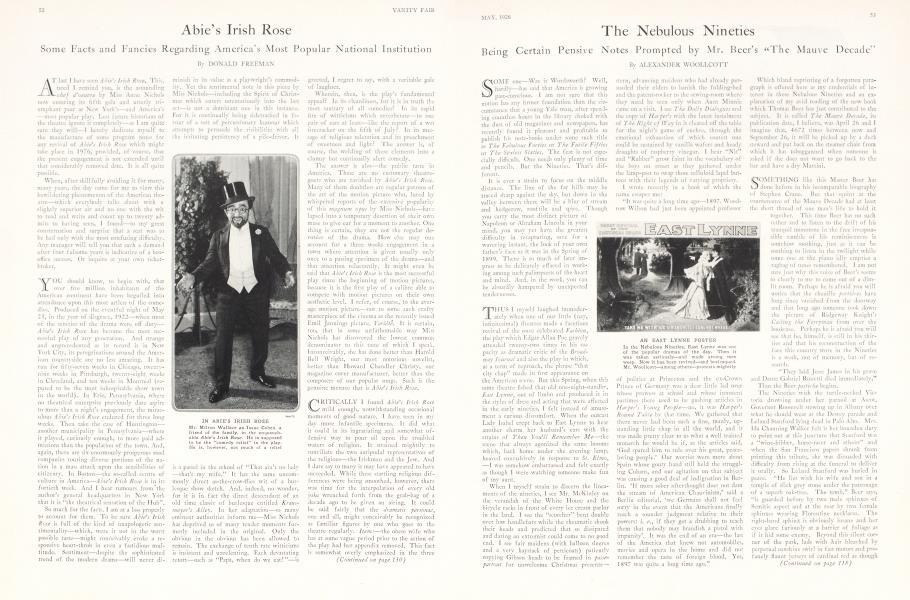
SOME one—Was it Wordsworth? Well, hardly—has said that America is growing past-conscious. I am not sure that this notion has any firmer foundation than the circumstance that a young Yale man, after spending countless hours in the library choked with the dust of old magazines and newspapers, has recently found it pleasant and profitable to publish his note-books under some such title as The Fabulous Forties or The Futile Fifties or The Sexless Sixties. The feat is not especially difficult. One needs only plenty of time and pencils. But the Nineties. That's different.
It is ever a strain to focus on the middle distance. The line of the far hills may be traced sharp against the sky, but down in the valley between there will be a blur of stream and hedgerow, rooftile and spire. 'Though you carry the most distinct picture of Napoleon or Abraham Lincoln in your mind, you may yet have the greatest difficulty in recapturing, save for a wavering instant, the look of your own father's face as it was in the Spring of 1899. There is so much of later impress to be delicately effaced in working among such palimpsests of the heart and mind. And, in the work, you can be absurdly hampered by unexpected tendernesses.
THUS I myself laughed immoderately when one of our little (nay, infinitesimal) theatres made a facetious revival of the once celebrated Fashion, the play which Edgar Allan Poe gravely attended twenty-two times in his capacity as dramatic critic of the Broadway Journal and also the play in which, as a term of reproach, the phrase "that city chap" made its first appearance on the American scene. But this Spring, when this same theatre fished that old one-night-standby, East Lynne, out of limbo and produced it in the styles of dress and acting that were affected in the early nineties, I felt instead of amusement a curious discomfort. When the outcast Lady Isabel crept back to East Lynne to hear another charm her husband's ears with the strains of Then You'll Remember Me—the scene that always agonized the same bosoms which, back home under the evening lamp, heaved convulsively in response to St. Elmo, —I was somehow embarrassed and felt exactly as though I were watching someone make fun of my aunt.
When I myself strain to discern the lineaments of the nineties, I see Mr. McKinley on the verandah of the White House and the bicycle racks in front of every ice cream parlor in the land. I see the "scorcher" bent double over low handlebars while the rheumatic shook their heads and predicted that so dissipated and daring an extremist could come to no good end. I sec fair maidens (with balloon sleeves and a very haystack of petticoats) patiently copying Gibson heads to be framed in passepartout for unwelcome Christmas presents— stern, advancing maidens who had already persuaded their elders to banish the folding-bed and the patent-rocker to the sewing-room where they need be seen only when Aunt Minnie came on a visit. I see The Dolly Dialogues and the copy of Harper's with the latest instalment of The Right of Hay in it cleared off the table for the night's game of euchre, through the emotional exhaustion of which contest one could be sustained by vanilla wafers and heady draughts of raspberry vinegar. I hear "Nit" and "Rubber" grow faint in the vocabulary of the boys on street as they gathered under the lamp-post to swap those celluloid lapel buttons with their legends of varying propriety.
I wrote recently in a book of which the name escapes me:
"It was quite a long time ago—1897. Woodrow Wilson had just been appointed professor of politics at Princeton and the ex-Crown Prince of Germany was a dear little lad over whose prowess at school and whose innocent pastimes there used to be gushing articles in Harper's Young People—no, it was Harper's Round Table by that time. We gathered that there never had been such a fine, manly, upstanding little chap in all the world, and it was made pretty clear to us what a well trained monarch he would be if, as the articles said, 'God spared him to rule over his great, peaceloving people.' Our worries were more about Spain whose gouty hand still held the struggling Cubans, and our agitation on that subject was causing a good deal of indignation in Berlin. 'If more sober afterthought does not dam the stream of American Chauvinism,' said a Berlin editorial, 'we Germans shall not feel sorry in the event that the Americans finally reach a sounder judgment relative to their powers: i. e., if they get a drubbing to teach them that nobody may brandish a pistol with impunity'. It was the end of an era—the last of the America that knew not automobiles, movies and opera in the home and did not remember the taste of foreign blood. Yes, 1897 was quite a long time ago."
Which bland reprinting of a forgotten paragraph is offered here as my credentials of interest in these Nebulous Nineties and an explanation of my avid reading of the new book which Thomas Beer has just contributed to the subject. It is called The Mauve Decade, its publication date, I believe, was April 26 and I imagine that, 4672 times between now and September 26, it will be picked up by a deck steward and put back on the steamer chair from which it has tobogganned when someone is asked if she does not want to go back to the bar and have a dry Martini.
SOMETHING like this Master Beer has done before in his incomparable biography of Stephen Crane. But that squint at the countenance of the Mauve Decade had at least the short thread of one man's life to hold it together. This time Beer has no such tether and to listen to the drift of his tranquil monotone in the free irresponsible ramble of his reminiscences is somehow soothing, just as it can be soothing to listen in the twilight while some one at the piano idly empties a ragbag of tunes remembered. I am not sure just why this voice of Beer's seems so clearly to me to come out of a dimlit room. Perhaps he is afraid you will notice that the chenille portieres have long since vanished from the doorway and that long ago someone took down the picture of Ridgeway Knight's Calling the Ferryman from over the bookcase. Perhaps he is afraid you will see that he, himself, is still in his thirties and that his reconstruction of the face this country wore in the Nineties is a work, not of memory, but of research.
"They laid Jesse James in his grave and Dante Gabriel Rossetti died immediately."
Thus the Beer pastiche begins.
'The Nineties with the turtle-necked Victoria drowsing under her parasol at Ascot, Governor Roosevelt stewing up in Albany over what he should wear at the Dewey parade and Leland Stanford lying dead in Palo Alto. Mrs. Ida Channing Walker felt it her bounden duty to point out at this juncture that Stanford was a "wine-bibber, horse-racer and atheist" and when the San Francisco papers shrank from printing this tribute, she was dissuaded with difficulty from rising at the funeral to deliver it orally. So Leland Stanford was buried in peace. "He lies with his wife and son in a temple of slick grey stone under the patronage of a superb oak-tree. The tomb," Beer says, "is guarded before by two male sphinxes ol Semitic aspect and at the rear by two female sphinxes wearing Florentine necklaces. The right-hand sphinx is obviously insane and her eves glare furiously at a barrier of foliage as if it hid some enemy. Beyond this silent corner of the park, lads with hair bleached by perpetual sunshine swirl in fast motors and profanely flaunt jerseys of cardinal red as though death and judgment did not matter much." I quote for those who would savour Beer.
Continued on page 118
Continued from page 53
The Nineties. The World's Fair, with Mr. Edison's perfected bulbs dripping glitter on the lagoons at night and a procuress from New Orleans arriving with her entire stable for their education, while ladies wearing white ribbons for purity harried the Mayor of Chicago for an order forbidding the admission of painted women to the Midway. Then Trilby came out in Harfer's and for two years virgins posed as Trilby in her Greek gown in the dreadful tableaux which were a favourite art-form of the era. Myself, I was "le fauvre fetit Jeannot" when Eugene Field's daughter Trotty was the Trilby.
The Nineties. Saffho at the Casino in New York, with Olga Nethersolc and much agitation. A minor actor in her company received a note from the head mistress of a school for girls in the Hudson Valley, requesting him to remove his eleven-year old girl "as several mothers of several students have seen the play in which you are appearing and they cannot consider Margaret a fit companion for their daughters in consequence."
The Nineties, with Rebecca Harding Davis writing in pity of the undedicate virgins of New England and suggesting that they be shipped to the Far West where men were not only men but many. Frances Willard was horrified at the suggestion— Frances Willard of whom the acrid Stephen Crane said that Miss Willard's affair with Miss Willard should really be stopped by the police. Miss Willard explained patiently to Mrs. Davis that "membership in the greatest spiritual movement since our Saviour's time" should be excitement enough for the virgins of New England.
The Nineties, with Irving Bacheller hotly rebuked by a critic for mentioning a man's navel in one of his stories. From all the pulpits sermons were preached against the remote, elegant and but dimly comprehended Oscar Wilde. Trusting small boys asked their aunts why the pastor talked so about Mr. Wilde and one of them was told that the poet ate babies. "Which," Mr. Beer adds justly, "was untrue." In 1899, an agent was selling at twenty dollars among undergraduates a set of photographs in a scarlet cover, lettered: The Si>is of Oscar Wilde. It was, you see, at times the Ultra-Violet Decade.
And The Rubaiyat. "It was imitated, apostrophized and parodied. They found some escape from ordinary theology in thinking that God was a good fellow and 'twould all be well, that they could take the cash and let the credit go and that the world would last a long, long time and they might as well go to hear the Bostonians in Robin Hood. This hedonism was involved with a rising passion for urbanity, champagne and Anna Held, beside them singing in the wilderness."
The Nineties. Anna Held. Harry Thurston Peck. Altgeld. Acton Davies. The Pullman strike. Carmencita dancing in the smoke at Koster and Bial's with five matrons from Chicago bearding Mr. Dana in his den at The Sim to insist that he drive her from the stage. Re jane weeping and raging in a Passy garden over her cartoon by Aubrey Beardsley, Bryan rising to speak his piece about the cross of gold.
Thus the Beer fastiche. And as one reads one wonders what in 1955 will seem salient about the Tottering Twenties. Marion Talley, perhaps, and the strange case of Lady Cathcart. The ofera-bouffe, viewed in amused retrospect, I trust and set down as an incomprehensible madness. The trial at Dayton, Tennessee, of course, Then all of Hollywood. And what else? What else?
Subscribers have complete access to the archive.
Sign In Not a Subscriber?Join Now
