
Sign In to Your Account
Subscribers have complete access to the archive.
Sign In Not a Subscriber?Join NowAll's Right With the Theatrical World
The Third Article in Vanity Fair's Symposium on the Future of the American Theatre
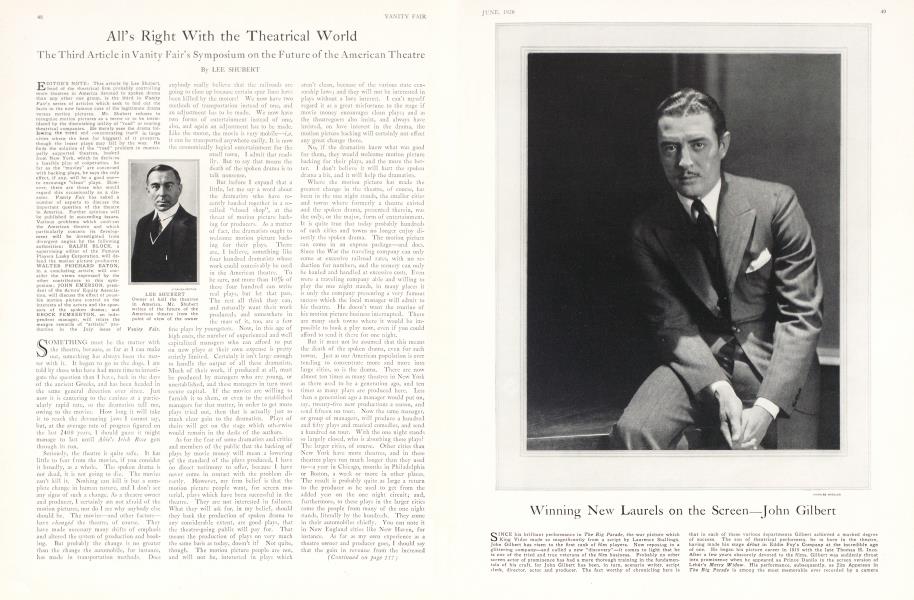
LEE SHUBERT
EDITOR'S NOTE: This article by Lee Shubert, head of the theatrical firm probably controlling more theatres in America devoted to spoken drama than any other one group, is the third in Vanity Fair's series of articles which seek to find out the facts in the now famous case of the legitimate drama versus motion pictures. Mr. Shubert refuses to recognize motion pictures as a terror or to be intimidated by the diminishing utility of "road" or touring theatrical companies. He merely sees the drama following the trend and concentrating itself in large cities where the best (or biggest) of it prospers, though the lesser plays may fall by the way. He finds the solution of the "road" problem in municipally supported theatres, booked from New York, which he declares a feasible plan of cooperation. So far as the "movies" are concerned with backing plays, he says the only effect, if any, will be a good one— to encourage "clean" plays. However, there are those who would regard this occasionally as a disaster. Vanity Fair has asked a number of experts to discuss the important question of the theatre in America. Further opinions will be published in succeeding issues. Various problems which confront the American theatre and which particularly concern its development will be investigated from divergent angles by the following authorities: RALPH BLOCK, a supervising editor of the Famous Players Lasky Corporation, will defend the motion picture producers; WALTER PRICHARD EATON, in a concluding article, will consider the views expressed by the other contributors to this symposium; JOHN EMERSON, president of the Actors' Equity Association, will discuss the effect of possible motion picture control on the interests of the actors and the sponsors of the spoken drama; and BROCK PEMBERTON, an independent manager, will relate the meagre rewards of "artistic" production in the July issue of Vanity Fair.
SOMETHING must be the matter with the theatre, because, as far as I can make out, something has always been the matter with it. It began to go to the dogs, I am told by those who have had more time to investigate the question than I have, back in the days of the ancient Greeks, and has been headed in the same general direction ever since. Just now it is cantering to the canines at a particularly rapid rate, so the dramatists tell me, owing to the movies. How long it will take it to reach the devouring jaws I cannot say, but, at the average rate of progress figured on the last 2400 years, I should guess it might manage to last until Abie's Irish Rose gets through its run.
Seriously, the theatre is quite safe. It has little to fear from the movies, if you consider it broadly, as a whole. The spoken drama is not dead, it is not going to die. The movies can't kill it. Nothing can kill it but a complete change in human nature, and I don't see any signs of such a change. As a theatre owner and producer, I certainly am not afraid of the motion pictures, nor do I see why anybody else should be. The movies—and other factors— have changed the theatre, of course. They have made necessary many shifts of emphasis and altered the system of production and booking. But probably the change is no greater than the change the automobile, for instance, has made in transportation methods. Does anybody really believe that the railroads are going to close up because certain spur lines have been killed by the motors? We now have two methods of transportation instead of one, and an adjustment has to be made. We now have two forms of entertainment instead of one, also, and again an adjustment has to be made. Like the motor, the movie is very mobile—i.e. it can be transported anywhere easily. It is now the economically logical entertainment for the small town. I admit that readily. But to say that means the death of the spoken drama is to talk nonsense.
But before I expand that a little, let me say a word about the dramatists who have recently banded together in a socalled "closed shop", at the threat of motion picture backing for producers. As a matter of fact, the dramatists ought to welcome motion picture backing for their plays. There are, I believe, something like four hundred dramatists whose work could conceivably be used in the American theatre. To be sure, not more than 10% of these four hundred can write real plays, but let that pass. The rest all think they can, and naturally want their work produced; and somewhere in the mass of it, too, are a few fine plays by youngsters. Now, in this age of high costs, the number of experienced and well capitalized managers who can afford to put on new plays at their own expense is pretty strictly limited. Certainly it isn't large enough to handle the output of all these dramatists. Much of their work, if produced at all, must be produced by managers who are young, or unestablished, and these managers in turn must secure capital. If the movies are willing to furnish it to them, or even to the established managers for that matter, in order to get more plays tried out, then that is actually just so much clear gain to the dramatists. Plays of theirs will get on the stage which otherwise would remain in the desks of the authors.
As for the fear of some dramatists and critics and members of the public that the backing of plays by movie money will mean a lowering of the standard of the plays produced, I have no direct testimony to offer, because I have never come in contact with the problem directly. However, my firm belief is that the motion picture people want, for screen material, plays which have been successful in the theatre. They are not interested in failures. What they will ask for, in my belief, should they back the production of spoken drama to any considerable extent, are good plays, that the theatre-going public will pay for. That means the production of plays on very much the same basis as today, doesn't it? Not quite, though. The motion picture people are not, and will not be, interested in plays which aren't clean, because of the various state censorship laws; and they will not be interested in plays without a love interest. I can't myself regard it as a great misfortune to the stage if movie money encourages clean plays; and as the theatregoers also insist, and always have insisted, on love interest in the drama, the motion picture backing will certainly not effect any great change there.
No, if the dramatists knew what was good for them, they would welcome motion picture backing for their plays, and the more the better. I don't believe it will hurt the spoken drama a bit, and it will help the dramatists.
Where the motion picture has made the greatest change in the theatre, of course, has been in the one night stands, the smaller cities and towns where formerly a theatre existed and the spoken drama, presented therein, was the only, or the major, form of entertainment. It is quite true that today probably hundreds of such cities and towns no longer enjoy directly the spoken drama. The motion picture can come in an express package—and does. Since the War the traveling company can only come at excessive railroad rates, with no reduction for numbers, and the scenery can only be hauled and handled at excessive costs. Even were a traveling company able and willing to play the one night stands, in many places it is only the company presenting a very famous success which the local manager will admit to his theatre. He doesn't want the routine of his motion picture business interrupted. There are many such towns where it would be impossible to book a play now, even if you could afford to send it there for one night.
But it must not be assumed that this means the death of the spoken drama, even for such towns. Just as our American population is ever tending to concentrate more and more into large cities, so is the drama. There are now almost ten times as many theatres in New York as there used to be a generation ago, and ten times as many plays are produced here. Less than a generation ago a manager would put on, say, twenty-five new productions a season, and send fifteen on tour. Now the same manager, or group of managers, will produce a hundred and fifty plays and musical comedies, and send a hundred on tour. With the one night stands so largely closed, who is absorbing these plays? The larger cities, of course. Other cities than New York have more theatres, and in these theatres plays run much longer than they used to—a year in Chicago, months in Philadelphia or Boston, a week or more in other places. The result is probably quite as large a return to the producer as he used to get from the added year on the one night circuit; and, furthermore, to these plays in the larger cities come the people from many of the one night stands, literally by the hundreds. They come in their automobiles chiefly. You can note it in New England cities like New Haven, for instance. As far as my own experience as a theatre owner and producer goes, I should say that the gain in revenue from the increased number of theatres in New York, and from the very much longer runs in other large cities, has better than compensated for the loss of the socalled "road" business. In other words, taken as a whole, the theatre seems very far from dead or dying.
(Continued on fage 117)
(Continuedfrom page 48)
Another, and very noticeable, change which has come about—I'm not sure how much the movies have had to do with it—is in the public reception of plays and musical pieces. Formerly a production could be what I might call a "mild success", and get along quite comfortably. But there aren't any more mild successes. A production is either a knockout, or it is a failure. That is true in New York, and it is even more noticeable, I think, on tour. The big success makes a lot of money in New York and it makes a lot of money in other cities, too. But if it isn't a big success it doesn't make money anywhere. I'm free to admit that this change works a certain hardship on many people, and on many worthy plays. But I don't quite see who is to be blamed, or what is to be done about it, because it seems to me largely a result of our modern era. With so many theatres, so many kinds of amusements, so many rival distractions, it requires a loud noise to get the ear of the public. The play which makes the loud noise—I mean, of course, which has about it the authentic air of a big success—is the play the public will go to. They won't go to the others. Blame whom you like for it—that is the fact; and to me it seems, as I said, the result of the time-spirit, not of any individuals, nor of the movies.
Some people, I am aware, blame the system of guarantees demanded by New York theatres. These guarantees are so high, they say, that the ordinary attraction, capable of doing perhaps a profitable little business for its producer, is none the.less unable to stay in New York. The theatre owners, they declare, are unwilling to take a gamble on the play with the producer. Even this is only half true. Theatre owmers in New York—and I can speak with some authority here—are willing to take a gamble with the producer when they are moderately sure the producer has a success. They go out of town and see the try-outs, and endeavor to pick successes. Any producer with a success can get into New York without any guarantees, and stay there. The reason the theatre owners cannot take a gamble with the producer on all occasions is because it costs a great deal of money to erect and run a theatre in New York, there arc never enough successes to go around, with seventy-five theatres to fill, and, unless the theatre owner demanded a guarantee from plays of uncertain drawing power, he would very soon be bankrupt. I don't see how you can get around that, except to reduce the number of theatres; and the moment you did that, you'd reduce the opportunities for new plays to get a hearing.
There is, I admit, something to be said for closing a certain number of theatres elsewhere than in New York. I can think of cities—which I won't name—where there are rival theatres, neither one of them prosperous enough perhaps to spruce itself up and give real battle to the great movie "palaces" which have been built in such towns. Competition is supposed to be a good thing, but occasionally it doesn't work for the best interests of the theatre. Perhaps some day a way will be found to eliminate competition in places where a united front would mean a better theatre.
And that brings me, in closing, to the road again, and to a suggestion for any cities which now complain that they are deprived of spoken drama. We—that is, the theatre owners and booking offices—cannot afford to maintain theatres any longer in towns where we cannot play, let us say, to a week's business. The theatre which housed a show once a week, perhaps, is no more—or practically no more. We don't book such places because there is no theatre in them now to play in, or because business is too uncertain and costs too high. But—we still have the plays, and we would still be glad to book them, if we could be fairly certain of business, and if we didn't have the expense of maintaining a theatre. In other words, any community which really wants plays has only to build and equip a municipal or community theatre, which can be used for all sorts of community purposes, and we will send to it any plays we have, which it wants, and will prove that it wants by patronage.
New York is the producing centre of the country, but New York can no longer shoulder the burden of maintaining the local playhouses in the smaller places, especially against the competition of the new and elegant movie palaces. If there could be cooperation—if we could furnish the productions and the cities furnish the theatres, there might conceivably once more be a very considerable rejuvenation of the so-called "road business", and the spoken drama could be taken again to the smaller places. I think myself there is going to be considerable of such cooperation in the future, and I think it will be a valuable thing for all concerned.
But meanwhile, cheer up! The drama isn't going to die. It will last quite as long as the movies.
Subscribers have complete access to the archive.
Sign In Not a Subscriber?Join Now
