
Sign In to Your Account
Subscribers have complete access to the archive.
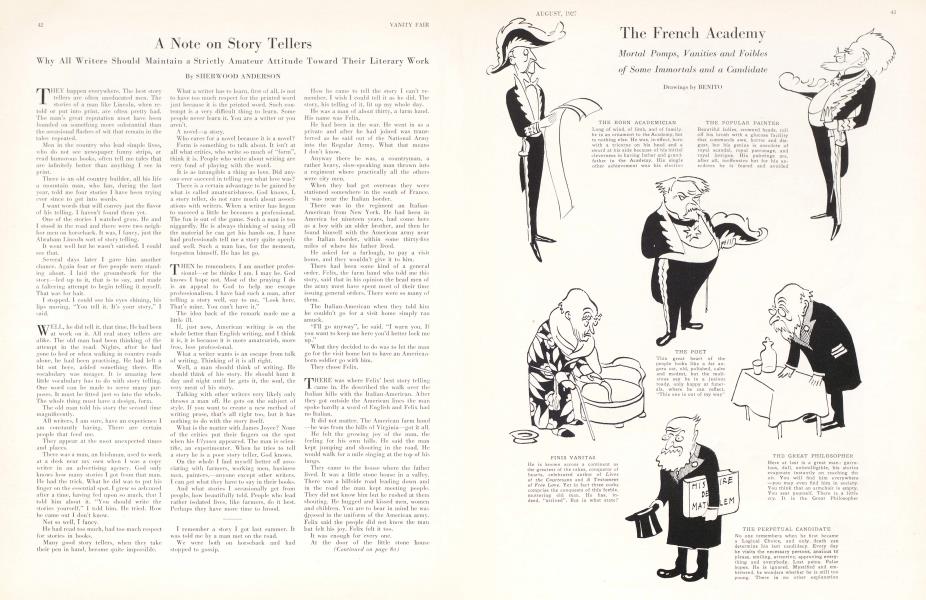
Sign In Not a Subscriber?Join NowA Note on Story Tellers
Why All Writers Should Maintain a Strictly Amateur Attitude Toward Their Literary Work
SHERWOOD ANDERSON
THE happen everywhere. The best story tellers are often uneducated men. The stories of a man like Lincoln, when retold or put into print, are often pretty bad. The man's great reputation must have been founded on something more substantial than the occasional flashes of wit that remain in the tales repeated.
Men in the country who lead simple lives, who do not see newspaper funny strips, or read humorous books, often tell me tales that are infinitely better than anything I see in print.
There is an old country builder, all his life a mountain man, who has, during the last year, told me four stories 1 have been trying ever since to get into words.
I want words that will convey just the flavor of his telling. I haven't found them yet.
One of the stories I watched grow. He and I stood in the road and there were two neighbor men on horseback. It was, I fancy, just the Abraham Lincoln sort of story telling.
It went well but he wasn't satisfied. I could see that.
Several days later I gave him another chance. Again four or five people were standing about. I laid the groundwork for the story led up to it, that is to say, and made a faltering attempt to begin telling it myself. That was for bait.
1 stopped. I could see his eyes shining, his lips moving. "You tell it. It's your story," I said.
WELL he did tell it, that time. He had been at work on it. All real story tellers are alike. The old man had been thinking of the attempt in the road. Nights, after he had gone to bed or when walking in country roads alone, he had been practising. He had left a hit out here, added something there. 11 is vocabulary was meager. It iamazing how little vocabulary has to do with story telling. One word can be made to serve many purposes. It must be fitted just so into the whole. The whole thing must have a design, form.
The old man told his story the second time magnificent I v.
All writers, I am sure, have an experience I am constantly having. There are certain people that feed me.
They appear at the most unexpected times and places.
There was a man, an Irishman, used to work at a desk near my own when 1 was a copy writer in an advertising agency. God only knows how many stories l got from that man. He had the trick. What he did was to put his finger on the essential spot. I grew so ashamed after a time, having fed upon so much, that I told him about it. "You should write the stories yourself," 1 told him. He tried. How he came out I don't know.
Not so well, T fancy.
lie had read too much, had too much respect for stories in books.
Many good story tellers, when they take their pen in hand, become quite impossible. What a writer has to learn, first of all, is not to have too much respect for the printed word just because it is the printed word. Such contempt is a very difficult thing to learn. Some people never learn it. You are a writer or you aren't.
A novel—a story.
Who cares for a novel because it is a novel?
Form is something to talk about, ft isn't at all what critics, who write so much of "form", think it is. People who write about writing are very fond of playing with the word.
It is as intangible a thing as love. Did anyone ever succeed in telling you what love was?
There is a certain advantage to be gained by what is called amateurishness. God knows, I, a story teller, do not care much about associations with writers. When a writer has begun to succeed a little he becomes a professional. The fun is out of the game. Such a man is too niggardly. He is always thinking of using all the material he can get his hands on. I have had professionals tell me a story quite openly and well. Such a man has, for the moment, forgotten himself. He has let go.
THEN he remembers. I am another professional—-or he thinks I am. I may be. God knows I hope not. Most of the praying I do is an appeal to God to help me escape professionalism. I have had such a man, after telling a story well, say to me, "Look here. That's mine. You can't have it."
The idea back of the remark made me a little ill.
If, just now, American writing is on the whole better than English writing, and I think it is, it is because it is more amateurish, more free, less professional.
What a writer wants is an escape from talk of writing. Thinking of it is all right.
Well, a man should think of writing. He should think of his story. He should hunt it day and night until he gets it, the soul, the very meat of his story.
Talking with other writers very likely only throws a man off. He gets on the subject of style. If you want to create a new method of writing prose, that's all right too, but it has nothing to do with the story itselt.
What is the matter with James Joyce? None of the critics put their fingers on the spot when his Ulysses appeared. The man is scientific, an experimenter. When he tries to tell a story he is a poor story teller, God knows.
On the whole I find myself better off associating with farmers, working men, business men, painters,—anyone except other writers. I can get what they have to say in their books.
And what stories I occasionally get from people, how beautifully told. People who lead rather isolated lives, like farmers, do it best. Perhaps they have more time to brood.
I remember a story I got last summer. It was told me by a man met on the road.
We were both on horseback and had stopped to gossip. How he came to tell the story I can t remember. I wish I could tell it as he did. The story, his telling of it. lit up my whole day.
He was a man of about thirty, a farm hand. His name was Felix.
He had been in the war. He went in as a private and after he had joined was transferred as he said out of the National Army into the Regular Army. What that means I don't know.
Anyway there he was, a countryman, a rather heavy, slow-speaking man thrown into a regiment where practically all the others were city men.
When they had got overseas they Avere stationed somewhere in the south of France. It Avas near the Italian border.
There was in the regiment an ItalianAmerican from New York. He had been in America for nineteen years, had come here as a boy with an older brother, and then he found himself with the American army near the Italian border, within some thirty-five miles of where his father lived.
He asked for a furlough, to pay a visit home, and they wouldn't give it to him.
There had been some kind of a general order. Felix, the farm hand who told me this story, said that in his opinion the head men of the army must have spent most of their time issuing general orders. There were so many of them.
The Italian-American when they told him he couldn't go for a visit home simply ran amuck.
"I'll go anyway", he said. "I warn you. If you want to keep me here you'd better lock me up."
What they decided to do was to let the man go for the visit home but to have an Americanborn soldier go with him.
They chose Felix.
THERE was where Felix' best story telling came in. He described the walk over the Italian hills with the Italian-American. After they got outside the American lines the man spoke hardly a word of English and Felix had no Italian.
It did not matter. The American farm hand —he was from the hills of Virginia—got it all.
He felt the growing joy of the man, the feeling for his own hills. He said the man kept jumping and shouting in the road. He would walk for a mile singing at the top of his lungs.
They came to the house Avhere the father lived. It Avas a little stone house in a valley. There was a hillside road leading down anil in the road the man kept meeting people. They did not knoAv him but he rushed at them shouting. He hugged and kissed men, women and children. You are to bear in mind he Avas dressed in the uniform of the American army. Felix said the people did not know the man but felt his joy. Felix felt it too.
It was enough for every one.
At the door of the little stone house Continued from page 42
Continued on page 82
in the valley, when they came to it. the father and the son stood facing each other. The older man, the father, was almost deaf, he was almost blind.
However he felt something. He just stood staring at the two men in the American uniforms. Minutes passed, helix said he could hear nothing but the ticking of a clock in the house. A young woman came into the room where the old man was and stood with her arms crossed.
There was a gun hanging on pegs on the wall.
Suddenly the old Italian man grabbed the gun and, pushing the two young men out of the doorway, ran into the yard.
He began loading and shooting.
He shot a rooster, a goose, a pig, a goat, and then another pig.
All the time he laughed and shouted and screamed. Felix, the man from the mountains of Virginia, as I have said, knew no Italian and yet he knew just Avhat was going on. He even kneAv the old man's words. As the old man loaded and shot off his gun, making a regular slaughter house out of the barnyard, he kept yelling,
"My son! My son! My son!
"A feast! A feast! A feast!"
That, I thought, when Felix told me the incident, was story telling. Giving me, as he did, just the sense of that heme-coming, the joy and wonder of it.
He did it with less words than any story teller I have ever heard. It Avas like Old Testament story telling.
And there was something else added. It concerned the woman who was the Italian-American soldier's sister. She had been a babe in arms
when her brother left for America and did not, of course, remember him at all. His coming home couldn't have meant much to her but her father's joy meant a lot.
Well, IIOAV she was a grown woman and married. Her husband, a poor laborer, was in the Italian army. They hadn't any possessions but she was living for the time in her father's house and he had given her a goose. He wanted it back to make a part of the feast for his son. He, the son and Felix had eaten up everything else on the place and had drunk all the Avine.
She hung onto the goose because she wanted to give it to Felix as a present when he and her brother had to go back to the army. It was her way of expressing her thanks to him for bringing her brother home and making the old father so happy.
Felix said he carried the goose under his arm the whole thirty-five miles back to camp. It wobbled its long neck and hissed at everyone along the road but he hung onto it. When he got back to camp he made a pet of it and for a month or two it went waddling and hissing up and down the company street. Then, he said, the regiment had to move to another place and he put the goose into the company mess. He said the piece he got—a wing it was—didn't taste very good. He said he kept thinking of the Italian-American's sister. "I Avas kind of stuck on her," he said. "When I was carrying the goose home," he said, "over the Italian hills I kept shutting my eyes and trying to imagine I had her instead of the goose held tight like that in my arms."
Subscribers have complete access to the archive.
Sign In Not a Subscriber?Join Now
