Sign In to Your Account
Subscribers have complete access to the archive.
Sign In Not a Subscriber?Join NowPHILIP SNOWDEN AT THE HAGUE
WALTER LIPPMANN
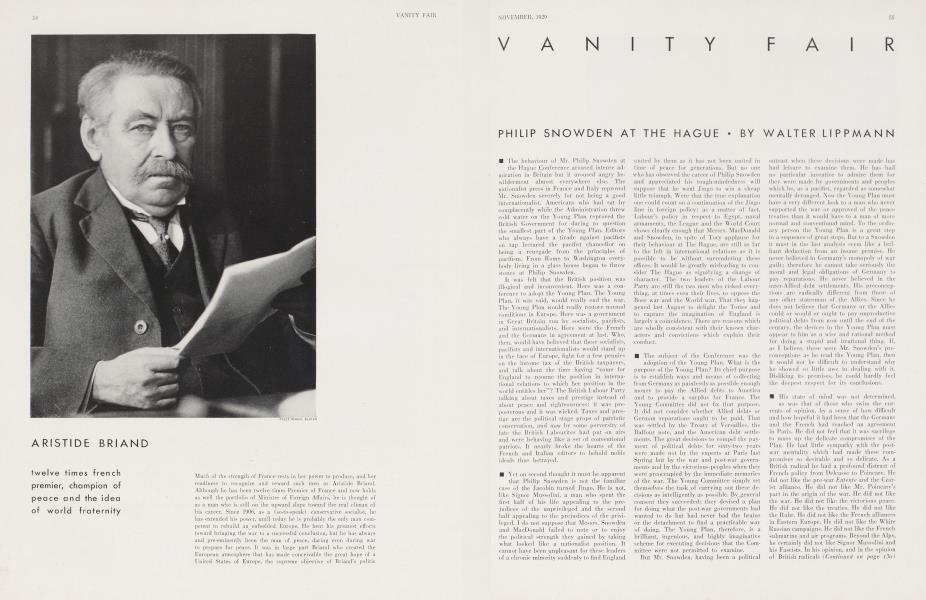
The behaviour of Mr. Philip Snowden at the Hague Conference aroused intense admiration in Britain but it aroused angry bewilderment almost everywhere else. The nationalist press in France and Italy reproved Mr. Snowden severely for not being a good internationalist. Americans who had sat by complacently while the Administration threw cold water on the Young Plan reproved the British Government for daring to question the smallest part of the Young Plan. Editors who always have a tirade against pacifists on tap lectured the pacifist chancellor on being a renegade from the principles of pacifism. From Rome to Washington everybody living in a glass house began to throw stones at Philip Snowden.
It was felt that the British position was illogical and inconvenient. Here was a conference to adopt the Young Plan. The Young Plan, it was said, would really end the war. The Young Plan would really restore normal conditions in Europe. Here was a government in Great Britain run by socialists, pacifists, and internationalists. Here were the French and the Germans in agreement at last. Who, then, would have believed that these socialists, pacifists and internationalists would stand up in the face of Europe, fight for a few pennies on the income tax of the British taxpayers, and talk about the time having "come for England to resume the position in international relations to which her position in the world entitles her"? The British Labour Party talking about taxes and prestige instead of about peace and righteousness: it was preposterous and it was wicked. Taxes and prestige are the political stage props of patriotic conservation, and now by some perversity of fate the British Labourites had put on airs and were behaving like a set of conventional patriots. It nearly broke the hearts of the French and Italian editors to behold noble ideals thus betrayed.
Yet on second thought it must be apparent that Philip Snowden is not the familiar case of the Jacobin turned Jingo. He is not, like Signor Mussolini, a man who spent the first half of his life appealing to the prejudices of the unprivileged and the second half appealing to the prejudices of the privileged. I do not suppose that Messrs. Snowden and MacDonald failed to note or to enjoy the political strength they gained by taking what looked like a nationalist position. It cannot have been unpleasant for these leaders of a chronic minority suddenly to find England united by them as it has not been united in time of peace for generations. But no one who has observed the career of Philip Snowden and appreciated his tough-mindedness will suppose that he went Jingo to win a cheap little triumph. Were that the true explanation one could count on a continuation of the Jingo line in foreign policy: as a matter of fact, Labour's policy in respect to Egypt, naval armaments, the League and the World Court shows clearly enough that Messrs. MacDonald and Snowden, in spite of Tory applause for their behaviour at The Hague, are still as far to the left in international relations as it is possible to be without surrendering these offices. It would be greatly misleading to consider The Hague as signifying a change of character. The two leaders of the Labour Party are still the two men who risked everything, at times even their lives, to oppose the Boer war and the World war. That they happened last August to delight the Tories and to capture the imagination of England is largely a coincidence. There are reasons which are wholly consistent with their known characters and convictions which explain their conduct.
The subject of the Conference was the adoption of the Young Plan. What is the purpose of the Young Plan? Its chief purpose is to establish ways and means of collecting from Germany as painlessly as possible enough money to pay the Allied debts to America and to provide a surplus for France. The Young Committee did not fix that purpose. It did not consider whether Allied debts or German reparations ought to be paid. That was settled by the Treaty of Versailles, the Balfour note, and the American debt settlements. The great decisions to compel the payment of political debts for sixty-two years were made not by the experts at Paris last Spring but by the war and post-war governments and by the victorious peoples when they were preoccupied by the immediate memories of the war. The Young Committee simply set themselves the task of carrying out these decisions as intelligently as possible. By general consent they succeeded: they devised a plan for doing what the post-war governments had wanted to do but had never had the brains or the detachment to find a practicable way of doing. The Young Plan, therefore, is a brilliant, ingenious, and highly imaginative scheme for executing decisions that the Committee were not permitted to examine.
But Mr. Snowden, having been a political outcast when these decisions were made has had leisure to examine them. He has had no particular incentive to admire them for they were made by governments and peoples which he, as a pacifist, regarded as somewhat mentally deranged. Now the Young Plan must have a very different look to a man who never supported the war or approved of the peace treaties than it would have to a man of more normal and conventional mind. To the ordinary person the Young Plan is a great step in a sequence of great steps. But to a Snowden it must in the last analysis seem like a brilliant deduction from an insane premise. He never believed in Germany's monopoly of war guilt; therefore he cannot take seriously the moral and legal obligations of Germany to pay reparations. He never believed in the inter-Allied debt settlements. His preconceptions are radically different from those of any other statesman of the Allies. Since he does not believe that Germany or the Allies could or would or ought to pay unproductive political debts from now until the end of the century, the devices in the Young Plan must appear to him as a wise and rational method for doing a stupid and irrational thing. If, as I believe, these were Mr. Snowden's preconceptions as he read the Young Plan, then it would not be difficult to understand why he showed so little awe in dealing with it. Disliking its premises, he could hardly feel the deepest respect for its conclusions.
His state of mind was not determined, as was that of those who swim the currents of opinion, by a sense of how difficult and how hopeful it had been that the Germans and the French had reached an agreement in Paris. He did not feel that it was sacrilege to muss up the delicate compromises of the Plan. He had little sympathy with the postwar mentality which had made these compromises so desirable and so delicate. As a British radical he had a profound distrust of French policy from Delcasse to Poincare. He did not like the pre-war Entente and the Czarist alliance. He did not like Mr. Poincare's part in the origin of the war. He did not like the war. He did not like the victorious peace. He did not like the treaties. He did not like the Ruhr. He did not like the French alliances in Eastern Europe. He did not like the White Russian campaigns. He did not like the French submarine and air programs. Beyond the Alps, he certainly did not like Signor Mussolini and his Fascists. In his opinion, and in the opinion of British radicals and pacifists like him, the history of British foreign policy from Sir Edward Grey to Sir Austen Chamberlain is a history of Britain's seduction by continental wiles into disastrous and unrighteous ways. The theory that it was worth while to buy French and Italian support to offset the menace of Germany, and then to buy French and Italian support to stop France from crushing Germany never appealed to Philip Snowden. He had fought the policy in the face of angry mobs, and when the chance came he fought it at The Hague in the face of the world.
(Continued on page 130)
(Continued from page 55)
Bearing in mind these considerations we can, I think, understand better what he meant when he said that the time had come for England to resume the position in international relations to which her position in the world entitles her. He meant that the era .of British acquiescence in French diplomatic initiative had ended.
It was the rise of the German imperial power which forced Britain to align itself with the Triple Entente. It was the Triple Entente, helped by America, which smashed the Triple Alliance. Having smashed it the victory was used to make a settlement which had not the strength to endure unless Britain and America remained permanently aligned with the French system. America promptly withdrew from the alignment, and it was only a question of time when Britain would follow. For while Britain plus America might have supported the French postwar policy, Britain alone could not do it except at intolerable cost. For ten years Lord Curzon and Sir Austen Chamberlain had vacillated, now supporting the French system and now withdrawing from it. The British Labour Party, following its own principles, which happen at this juncture to coincide with the deepest political instincts and traditions of the British peoples, has made a sharp break. The applause in England signifies the delight of a people who at last have seen done what they really wanted to have done. For France has been an exacting mistress, and the British people are plainly enough tired of the affair.
Henceforth, we may assume, France will have to live within her political income in Europe, rather more moderately and without the gallant attentions which Sir Austen Chamberlain showed her. As for Britain, no longer a lover, it will resume its role of uncle on the continent of Europe.
Subscribers have complete access to the archive.
Sign In Not a Subscriber?Join Now
