
Sign In to Your Account
Subscribers have complete access to the archive.
Sign In Not a Subscriber?Join NowLiving Dangerously
An Adventurous Novelist Confutes Nietzsche by Resorting to Some Desperate Measures
LOUIS GOLDING
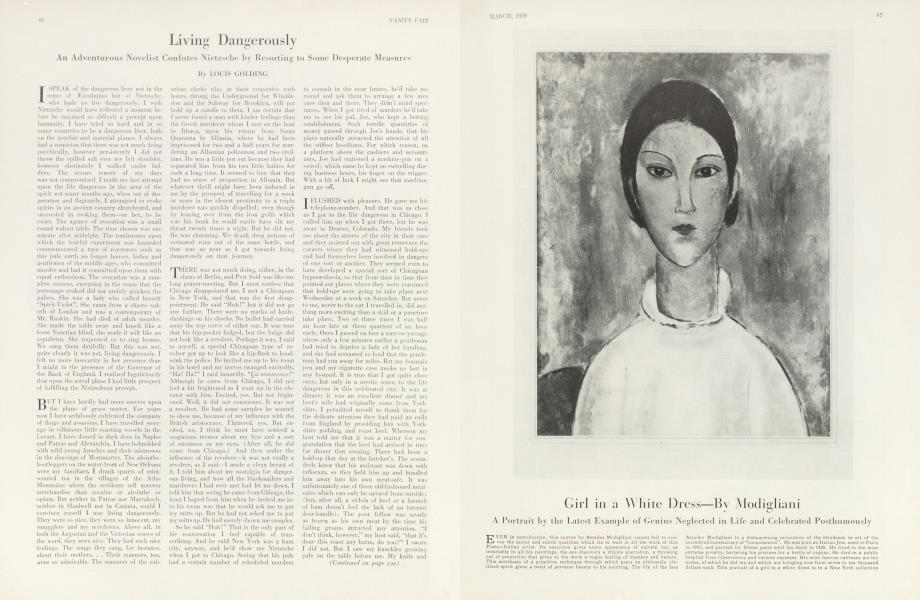
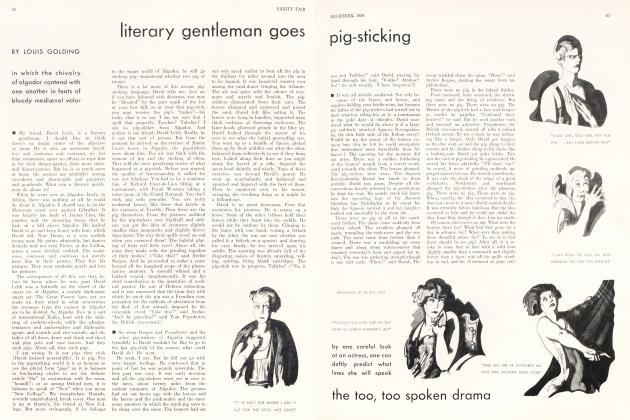
I SPEAK of the dangerous liver not in the sense of &sculapius but of Nietzsche, who bade us live dangerously. I wish Nietzsche would have reflected a moment before be enjoined so difficult a precept upon humanity. I have tried so hard and in so many countries to be a dangerous liver, both on the psychic and material planes. I always had a suspicion that there was not much doing psychically, however persistently I did not throw the spilled salt over my left shoulder, however obstinately I walked under ladders. The secure tenure of my days was not compromised. I made my last attempt upon the life dangerous in the area of the spirit not many months ago, when out of desperation and flagrantly, I attempted to evoke spirits in an ancient country churchyard, and succeeded in evoking them—or her, to be exact. The agency of evocation was a small round walnut table. The time chosen was one minute after midnight. The tombstones upon which the fearful experiment was hazarded commemorated a race of roysterers such as this pale earth no longer houses, ladies and gentlemen of the middle ages, who committed murder and had it committed upon them with equal enthusiasm. The evocation was a complete success, excepting in the sense that the personage evoked did not unduly quicken the pulses. She was a lady who called herself "Spirit-\ iolet''. She came from a chaste suburb of London and was a contemporary of Mr. Ruskin. She had died of adult measles. She made the table sway and knock like a loose Venetian blind, she made it wilt like an aspidistra. She requested us to sing hymns. We sang them dutifully. But this was not, quite clearly it was not, living dangerously. I felt no more insecurity in her presence than I might in the presence of the Governor of the Bank of England. I realized lugubriously that upon the astral plane I had little prospect of fulfilling the Nietzschean precept.
BUT I have hardly had more success upon the plane of gross matter. For years now I have sedulously cultivated the company of thugs and assassins. I have travelled steerage in villainous little coasting vessels in the Levant. I have dossed in dark dens in Naples and Patras and Alexandria. I have hobnobbed with wild young Apaches and their mistresses in the dancings of Montmartre. The absinthebootleggers on the water-front of New Orleans were my familiars. I drank quarts of mintscented tea in the villages of the Atlas Mountains where the residents sell queerer merchandise than cocaine or absinthe or opium. But neither in Patras nor Marrakech, neither in Shadwell nor in Catania, could I convince myself I was living dangerously. They were so nice, they were so innocent, my smugglers and my murderers. Above all, in both the Augustan and the Victorian senses of the word, they were nice. They had such nice feelings. The songs they sang, for instance, about their mothers. . . Their manners, too, were so admirable. The manners of the suburban clerks who, at their respective rush hours, throng the Underground for Wimbledon and the Subway for Brooklyn, will not hold up a candle to them. I am certain that I never found a man with kinder feelings than the Greek murderer whom I met on the boat to Ithaca, upon his return from Santa Quaranta in Albania, where he had been imprisoned for two and a half years for murdering an Albanian policeman and two civilians. lie was a little put out because they had separated him from his two little babies for such a long time. It seemed to him that they had no sense of proportion in Albania. But whatever thrill might have been induced in me by the prospect of travelling for a week or more in the closest proximity to a triple murderer was quickly dispelled; even though by leaning over from the iron grille which was his bunk he could easily have slit my throat twenty times a night. But he did not. He was charming. V e drank deep potions of resinated wine out of the same bottle, and that was as near as I got towards living dangerously on that journey.
THERE was not much doing, either, in the slums of Berlin, and Port Said was like one long prayer-meeting. But I must confess that Chicago disappointed me. I met a Chicagoan in New York, and that was the first disappointment. He said "Huh!" but it did not go any further. There were no marks of knifeslashings on his cheeks. No bullet had carried away the top curve of either ear. It was true that his hip-pocket bulged, but the bulge did not look like a revolver. Perhaps it was, I said to myself, a special Chicagoan type of revolver got up to look like a hip-flask to hoodwink the police. He invited me up to his room in his hotel and my nerves twanged excitedly. "Ha! Ha!" I said inwardly. "Ca commence/" Although he came from Chicago, I did not feel a bit frightened as I went up in the elevator with him. Excited, yes. But not frightened. Well, it did not commence. It was not a revolver. He had some samples he wanted to show me, because of my influence with the British aristocracy. Flattered, yes. But excited, no. I think he must have noticed a suspicious tremor about my lips and a sort of mistiness on my eyes. (After all, he did come from Chicago.) And then under the influence of the revolver—it was not really a revolver, as I said—I made a clean breast of it. I told him about my nostalgia for dangerous living, and how all the blackmailers and murderers I had ever met had let me down. I told him that seeing he came from Chicago, the least I hoped from him when he invited me into his room was that he would ask me to put my mitts up. But he had not asked me to put my mitts up. He had merely shown me samples.
So he said "Huh!" That is the only part of his conversation I feel capable of transcribing. And he said New York was a bum city, anyway, and he'd show me Nietzsche when I got to Chicago. Seeing that his pals had a certain number of scheduled murders to commit in the near future, he'd take me round and ask them to arrange a few nice ones then and there. They didn't mind spectators. When I got tired of murders lie'll take me to see his pal, Joe, who kept a betting establishment. Such terrific quantities of money passed through Joe's hands, that his place naturally attracted the attention of all the stiffest hoodlums. For which reason, on a platform above the cashiers and accountants, Joe had stationed a machine-gun on a swivel; which same he kept on swivelling during business hours, his finger on the trigger. With a bit of luck I might see that machinegun go off.
I FLUSHED with pleasure. He gave me his telephone-number. And that was as close as I got to the life dangerous in Chicago. I called him up when I got there, but he was away in Denver, Colorado. My friends took me about the streets of the city in their cars and they pointed out with great reverence the corners where they had witnessed hold-ups and had themselves been involved in dangers of one sort or another. They seemed even to have developed a special sort of Chicagoan hyperassthesia, so that from time to time they pointed out places where they were convinced that hold-ups were going to take place next Wednesday or a week on Saturday. But never to me, never to the car I travelled in, did anything more exciting than a skid or a puncture take place. Two or three times I was half an hour late or three quarters of an hour early. Once I passed on foot a narrow passage where only a few minutes earlier a gentleman had tried to deprive a lady of her handbag, and she had screamed so loud that the gentleman had run away for miles. But my fountain pen and my cigarette case awoke no lust in any footpad. It is true that I got quite close once, but only in a mystic sense, to the life dangerous in this celebrated city. It was at dinner; it was an excellent dinner and my host's wife had originally come from Yorkshire. I permitted myself to thank them for the delicate attention they had paid an exile from England by providing him with Yorkshire pudding and roast beef. Whereon my host told me that it was a matter for congratulation that the beef had arrived in time for dinner that evening. There had been a hold-up that day at the butcher's. The scoundrels knew that his assistant was down with influenza, so they held him up and bundled him away into his own meat-safe. It was unfortunately one of those old-fashioned meatsafes which can only be opened from outside: (but, after all, a sirloin of beef or a haunch of ham doesn't feel the lack of an interior door-handle). The poor fellow was nearly as frozen as his own meat by the time his failing groans attracted any attention. "I don't think, however," my host said, "that it's done this roast any harm, do you?" I swore I did not. But I saw my knuckles growing pale on the table before me. My knife and fork played a weak tattoo. I could taste frozen butcher with each mouthful. "Excuse me," I said. "The queer tricks this old malaria plays on my appetite. . . ."
Continued on page 120
Continued from page 66
I suppose you might, at a pinch, call that living dangerously. But only in a mystic sense, and only at second-hand; excepting for the butcher, who must have consoled himself during the arctic hours of his incarceration by chanting Nietzsche in plain-song. Yet I don't think I ought to conclude this article on a negative note. For after all, if only for a few seconds, I succeeded in living so dangerously that it ought to have kept me going for years. It happened one winter in the Floriansthal, over in the Austrian Alps. I had been asked to join a skiing expedition, and seeing that I was not certain how to pronounce skis, let alone how to make use of them, I had a sort of instinct that perhaps now at last there was a (diance of entering the austere fellowship of dangerous livers. I was told to begin. I was told that I might ski in all directions save one. And that way lay death. For there the mountain broke off suddenly and a precipice yawned below.
At last, thank Goodness, the marvellous moment occurred. I had struggled
on to my skis again after a somewhat protracted effort to dig down to naked rock through the heaped drifts. I started skiing again. I awaited with resignation the inevitable moment of collapse, which I had never before staved off for more than ten seconds. It did not come. I had acquired the faculty of perpendicularity. A sharp cry ripped down the hillside. I was heading for the precipice. My extinction in the ravine below was quite certain. I realized that not merely was I incapable of arresting my descent, I did not desire to. At last, at last, superbly, like a doomdevoted bird, like a meteor, I was living dangerously. I held out my arms to the white annihilation.
I was a few yards from the rim of the ravine, a few feet. And then the craven instinct for self-preservation surged like a gross leviathan from the ocean of my sub-conscious mind. I turned in my traces with a fastidiously tasteful and exact Telemark—it may have been a Schtvungbogen—a n d resumed my commerce with the unblissful world. But I had attained the ecstasy. Though so briefly, so briefly, I had lived dangerously. The ghost of Nietzsche whistled his approval among the tips of the snow-entombed pine,.
Subscribers have complete access to the archive.
Sign In Not a Subscriber?Join Now
