Sign In to Your Account
Subscribers have complete access to the archive.
Sign In Not a Subscriber?Join NowWhy They Got Married
How One Marriage Was Accomplished—A Study in The Technique of a Determined Woman
SHERWOOD ANDERSON
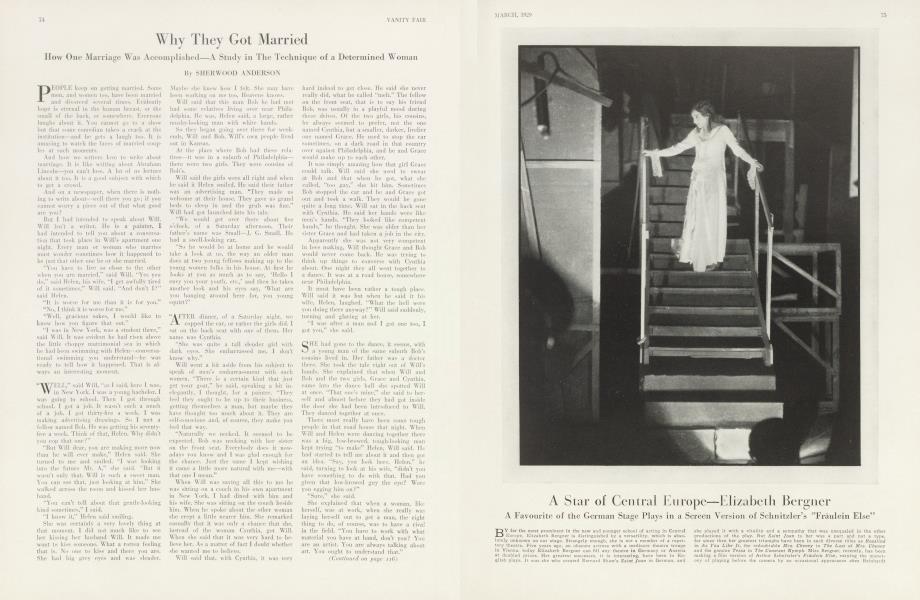
PEOPLE keep on getting married. Some men, and women too, have been married and divorced several times. Evidently hope is eternal in the human breast, or the small of the back, or somewhere. Everyone laughs about it. ^ ou cannot go to a show hut that some comedian takes a crack at the institution—and he gets a laugh too. It is amusing to watch the faces of married couples at such moments.
And how we writers love to write about marriage. It is like writing about Abraham Lincoln—you can't lose. A lot of us lecture about it too. It is a good subject with which to get a crowd.
And on a newspaper, when there is nothing to write about—well there you go; if you cannot worry a piece out of that what good are you?
But I had intended to speak about Will. Will isn't a writer. lie is a painter. I had intended to tell you about a conversation that took place in Will's apartment one night. Every man or woman who marries must wonder sometimes how it happened to he just that other one he or she married.
"You have to live so close to the other when you are married,"' saicl W ill. '"Yes you do," said Helen, his wife. "I get awfully tired of it sometimes," Will said. "And don't I? " said Helen.
"It is worse for me than it is for you."
"No, I think it is worse for me."
"Well, gracious sakes, I would like to know how you figure that out."
"I was in New York, was a student there," said Will. It was evident he had risen above the little choppy matrimonial sea in which he had been swimming with Helen—conversational swimming you understand—he was ready to tell how it happened. That is always an interesting moment.
WELL," said Will, "as I said, here I was, in New York. 1 was a young bachelor. I was going to school. Then 1 got through school. I got a job. It wasn't such a much of a job. I got thirty-five a week. I was making advertising drawings. So I met a fellow named Bob. He was getting his seventyfive a week. Think of that, Helen. Why didn't you cop that one?"
"But Will dear, you are making more now than he will ever make," Helen said. She turned to me and smiled. "I was looking into the future Mr. A," she said. "But it wasn't only that. Will is such a sweet man. You can see that, just looking at him." She walked across the room and kissed her husband.
"You can't tell about that gentle-looking kind sometimes," I said.
"I know it," Helen said smiling.
She was certainly a very lovely thing at that moment. I did not much like to see her kis;-ing her husband W ill. It made me want to kiss someone. What a rotten feeling that is. No one to kiss and there you are. She had big grey eyes and was slender.
Maybe she knew how I felt. She may have been working on me too, Heavens knows.
W ill said that this man Boh he had met had some relatives living over near Philadelphia. He was, Helen said, a large, rather mushy-looking man with white hands.
So they began going over there for weekends, W ill and Bob. W ill's own people lived out in Kansas.
At the place where Bob had these relativesit was in a suburb of Philadelphia— there were two girls. They were cousins of Bob's.
Will said the girls were all right and when he said it Helen smiled. He said their father was an advertising man. "They made us welcome at their house. They gave us grand beds to sleep in and the grub was fine." Will had got launched into his tale.
"We would get over there about five o'clock, of a Saturday afternoon. Their father's name was Small—J. C. Small. He had a swell-looking car.
"So he would he at home and he would take a look at us, the way an older man does at two young fellows making up to the young women folks in his house. At first he looks at you as much as to say, 'Hello I envy you your youth, etc.,' and then he takes another look and his eyes say, 'W hat are you hanging around here for, you young squirt?'
"AFTER dinner, of a Saturday night, we Lk copped the car, or rather the girls did. I sat on the hack seat with one of them. Her name was Cynthia.
"She was quite a tall slender girl with dark eyes. She embarrassed me. I don't knowr why."
Will went a hit aside from his subject to speak of men's embarrassment with such women. "There is a certain kind that just get your goat," he said, speaking a hit inelegantly, I thought, for a painter. "They feel they ought to lie up to their business, getting themselves a man, hut mayhe they have thought too much about it. They are self-conscious and, of course, they make you feel that way.
"Naturally we necked. It seemed to he expected. Boh was necking with her sister on the front seat. Everybody does it nowadays you know and I was glad enough for the chance. Just the same I kept wishing it came a little more natural with me—with that one I mean."
When Will was saying all this to me he was sitting on a couch in his own apartment in New York. I had dined with him and his wife. She was sitting on the couch beside him. When he spoke about the other woman she crept a little nearer him. She remarked casually that it was only a chance that she, instead of the woman Cynthia, got Will. When she said that it was very hard to believe her. As a matter of fact I doubt whether she wanted me to believe.
\\ ill said that, with Cynthia, it was very
hard indeed to get close. He said she never really did, what he called "melt." The fellow on the front seat, that is to say his friend Bob, was usually in a playful mood during these drives. Of the two girls, his cousins, he always seemed to prefer, not the one named Cynthia, hut a smaller, darker, livelier one named Grace. He used to stop the car sometimes, on a dark road in that country over against Philadelphia, and he and Grace would make up to each other.
It was simply amazing how that girl Grace could talk. ill said she used to swear at Boh and that when he got, what she called, "too gay,'' she hit him. Sometimes Boh stopped the car and he and Grace got out and took a walk. They would he gone quite a long time. Will sat in the hack seat with Cynthia. He said her hands were like men's hands. "They looked like competent hands, ' he thought. She was older than her sister Grace and had taken a job in the city.
Apparently she was not very competent in love making, Will thought Grace and Bob would never come hack. He was trying to think up things to converse with Cynthia about. One night they all went together to a dance. It was at a road house, somewhere near Philadelphia.
It must have been rather a tough place. Will said it was hut when he said it his wife, Helen, laughed. "What the hell were you doing there anyway?" Will said suddenly, turning and glaring at her.
"I was after a man and I got one too, I got you," she said.
SHE had gone to the dance, it seems, with a young man of the same suburb Bob's cousins lived in. Her father was a doctor there. She took the tale right out of Will's hands. She explained that when Will and Boh and the two girls, Grace and Cynthia, came into the dance hall she spotted Will at once. "That one's mine," she said to herself and almost before they had got inside the door she had been introduced to Will. They danced together at once.
There must really have been some tough people in that road house that night. When Will and Helen were dancing together there was a big, low-browed, tough-looking man kept trying "to make" Helen, Wi 11 said. He had started to tell me about it and then got an idea. "Say, you look here, Helen," he said, turning to look at his wife, "didn't you have something to do with that. Had you given that low-browed guy the eye? Were you egging him on?"
"Sure," she said.
She explained that when a woman, like herself, was at work, when she really was laying herself out to get a man, the right thing to do, of course, was to have a rival in the field. "You have to work with what material you have at hand, don't you? You are an artist. You are always talking about art. You ought to understand that."
Continued on page 116
Continued from page 74
There came very near being a row. Will had taken Helen to a table where Hob sat with Grace and Cynthia. The young tough swaggered up —a little high he was—and demanded to dance with Helen.
Helen got indignant. She looked frightened and Will felt it was up to him and he isn't the kind that are good at rows. Some women surely do know their trade. Will is the kind that in such an emergency grows helpless. I know. I am that way too.
Such a man begins to tremble. His back hurts. He dreams of being cool and determined but is so helpless that very likely he shouts, goes too far. What happened was that Helen settled the matter. She had already become a little tender about
"What did you do?" I asked. "I understood you had become indignant." "I had," she said, "but I backtracked. I got up and danced with him. I liked it. He was a good dancer."
Helen, like Grace and Cynthia, had copped her father's car for the evening. When they left that tough place the young man who had come with her was on the back seat of the other car with Cynthia and Will was in the car with her. That did not go very well with Cynthia but it seemed Cynthia had very little to do with it. She had been outplayed.
So it seems they hail got started in that way. Afterward Will continued to go to Philadelphia with Bob at the week-end but things were different at the cousin's house. "It was never so warm and cheerful there any more," Will said. Helen was always dropping in. Pretty soon the two young men began stopping at a hotel in Philadelphia itself. Bob had also got interested in Helen. They stopped at a cheap hotel, not having much money and Helen came in to see them. Will said she came right up into the hotel bedroom. As he began thinking of what went on during that time Will looked at Helen with a kind of wonder in his eyes. "I guess you could have had either of us," he said with a note of awe in his voice. It was obvious be admired his wife. "I'm not so sure about Bob," Helen said.
She wrote letters to both of them during the week, when they were in NewYork, at work, and when they arrived in Philadelphia, there she was. She always managed to get
her father's car. She went home to her suburb late on Saturday night and came back again early on Sunday. Saturday night they all went together to a dance.
One day her father grew alarmed and angry and followed her. He saw her go to the two men. right into their room, in the cheap hotel.
She, it seems, had to decide the matter. She had made up her mind to marry one of them, was tired of living at home. Things, I gathered, were rather warm there. She was an only child. She said her mother was crying all the time and her father was furious. "I had to be hardboiled with them for the time," she explained. She was rather like a surgeon about to perform an operation on a frightened patient. She cajoled and bullied them. When her father tried to put his foot down she issued an ultimatum. "I'm twenty-one," she said. "If you interfere with me I shall leave home." "But how will you live?" "Don't be silly, father, a woman can always live."
She went right out to the garage, got the car and drove to Philadelphia. In the room in the hotel she was studying the two men. One Sunday night she got Will to go down to the car with her. "Get in," she said. They drove away from the hotel. "I don't know where we were going," Will said.
They drove and drove. Will spoke of her mood that night. He was in love. When I heard this tale he was still very much in love. "It was a soft clear night with stars," he said. He said she was like the night, like the stars. Speaking of it he took hold of his wife's hand.
"Let's get married," she said to Will that night. "But when?" he asked. She thought they had better do it at once. "But think of my salary," Will said. "I am thinking about it. It isn't much is it?" It didn't seem to alter her determination however. "I can't wait any longer," was what she said. She said they would drive around all night and get married the next morning.
And so they did. Her people, the doctor and his wife, were in a terrible stew, of course.
Will and his wife came there the next day. "How were you received?" I asked Will. "Fine," he said. He said that the doctor and his wife would have been happy no matter who she married. "I had arranged for that," said Helen.
Subscribers have complete access to the archive.
Sign In Not a Subscriber?Join Now
