Sign In to Your Account
Subscribers have complete access to the archive.
Sign In Not a Subscriber?Join NowClothes and the Man
A Few Random Reflections on Dressing-Up and Its Curious Effect on the Masculine Ego
HAROLD NICOLSON
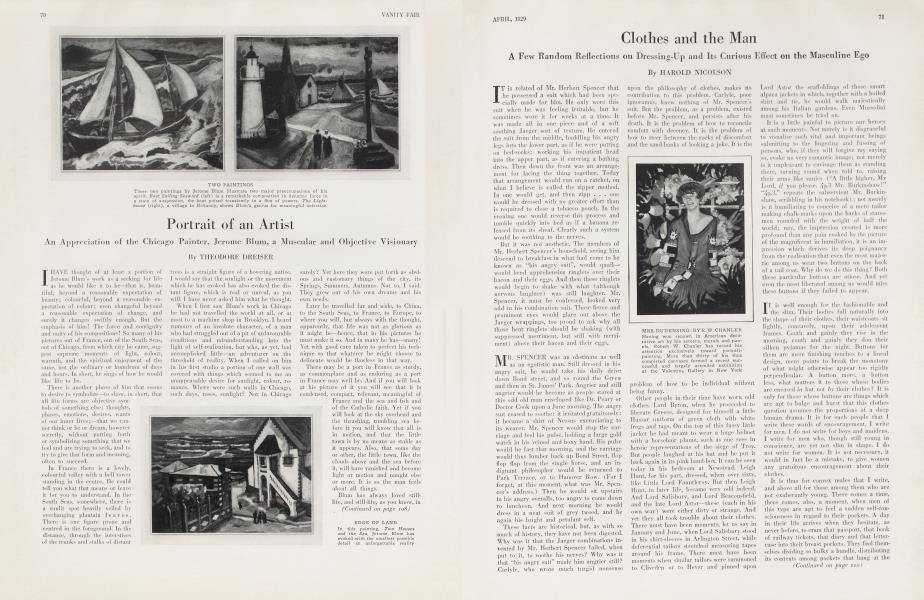
IT is related of Mr. Herbert Spencer that he possessed a suit which had been specially made for him. He only wore this suit when he was feeling irritable, but he sometimes wore it for weeks at a time. It was made all in one piece and of a soft soothing Jaeger sort of texture. He entered the suit from the middle, huddling his angry legs into the lower part, as if he were putting on bed-socks; working his impatient head into the upper part, as if entering a bathing dress. Then down the front was an arrangement for lacing the thing together. Today that arrangement would run on a ratchet, on what I believe is called the zipper method. In one would get, and then zipp . . . one would be dressed with no greater effort than is required to close a tobacco pouch. In the evening one would reverse this process and tumble quickly into bed as if a banana released from its sheaf. Clearly such a system would be soothing to the nerves.
But it was not aesthetic. The members of Mr. Herbert Silencer's household, seeing him descend to breakfast in what had come to be known as "his angry suit", would quail— would bend apprehensive ringlets over their bacon and their eggs. And then these ringlets would begin to shake with what (although nervous laughter) was still laughter. Mr. Spencer, it must be confessed, looked very odd in his combination suit. Those fierce and prominent eyes would glare out above the Jaeger wrappings, too proud to ask why all those bent ringlets should be shaking (with suppressed merriment, but still with merriment) above their bacon and their eggs.
MR. SPENCER was an obstinate as well as an egotistic man. Still dressed in his angry suit, he would take his daily drive down Bond street, and so round the Green and then in St. James' Park. Angrier and still angrier would he become as people stared at this odd old man enveloped like Dr. Peary or Doctor Cook upon a June morning. The angry suit ceased to soothe: it irritated gratuitously: it became a shirt of Nessus excruciating to its wearer. Mr. Spencer would stop the carriage and feel his pulse, holding a large gold watch in his veined and bony hand. His pulse would be fast that morning, and the carriage would thus lumber back up Bond Street, flop flop flop from the single horse, and an indignant philosopher would be returned to Park Terrace, or to Hanover Row. (For I forget, at this moment, what was Mr. Spencer's address.) Then he would sit upstairs in his angry overalls, too angry to come down to luncheon. And next morning he would dress in a neat suit of grey tweed, and be again his bright and petulant self.
These facts are historical, but, as with so much of history, they have not been digested. Why was it that the Jaeger combinations invented by Mr. Herbert Spencer failed, when put to it, to soothe his nerves? Why was it that "his angry suit" made him angrier still? Carlyle, who wrote much turgid nonsense upon the philosophy of clothes, makes no contribution to this problem. Carlyle, poor ignoramus, knew nothing of Mr. Spencer's suit. But the problem, as a problem, existed before Mr. Spencer, and persists after his death. It is the problem of how to reconcile comfort with decency. It is the problem of how to steer between the rocks of discomfort and the sand-hanks of looking a joke. It is the problem of how to be individual without being funny.
Other people in their time have worn odd clothes. Lord Byron, when he proceeded to liberate Greece, designed for himself a little Hussar uniform of green cloth with white frogs and tags. On the top of this fussy little jacket he had meant to wear a huge helmet with a horsehair plume, such as one sees in heroic representations of the siege of I roy. But people laughed at his hat and he put it back again in its pink band-box. It can be seen today in his bedroom at Newstead. Leigh Hunt, for his part, dressed, when over sixty, like Little Lord Fauntleroy. But then Leigh Hunt, in later life, became very odd indeed. And Lord Salisbury, and Lord Beaconsfield, and the late Lord Astor—these (each in his own way) were either dirty or strange. And yet they all took trouble about their clothes. There must have been moments, let us say in January and June, when Lord Salisbury stood in his shirt-sleeves in Arlington Street, while deferential tailors stretched measuring tapes around his frame. There must have been moments when similar tailors were summoned to Cliveden or to Hever and pinned upon Lord Astor the scaffoldings of those smart alpaca jackets in which, together with a boiled shirt and tie, he would walk majestically among his Italian gardens. Even Mussolini must sometimes be tried on.
It is a little painful to picture our heroes at such moments. Not merely is it disgraceful to visualise such vital and important beings submitting to the fingering and fussing of persons, who, if they will forgive my saying so, evoke no very romantic image; not merely is it unpleasant to envisage them as standing there, turning round when told to, raising their arms like zanies ("A little higher, My Lord, if you please. 49.3 Mr. Burkinshaw!" "49.3," repeats the subservient Mr. Burkinshaw, scribbling in his notebook); not merely is it humiliating to conceive of a mere tailor making chalk-marks upon the backs of statesmen rounded with the weight of half the world; nay, the impression created is more profound than any pain evoked by the picture of the magnificent in humiliation, it is an impression which derives its deep poignancy from the realisation that even the most majestic among us wear two buttons on the back of a tail coat. Why do we do this thing? Both these particular buttons are otiose. And yet even the most liberated among us would miss these buttons if they failed to appear.
IT is well enough for the fashionable and A the slim. Their bodies fall naturally into the shape of their clothes, their waistcoats sit lightly, concavely, upon their adolescent frames. Couth and gainly they rise in the morning, couth and gainly they don their silken pyjamas for the night. Buttons for them are mere finishing touches to a lineal design, mere points to break the monotony of what might otherwise appear too rigidly perpendicular. A button more, a button less, what matters it to those whose bodies are encased in but not by their clothes? It is only for those whose buttons are things which are apt to bulge and burst that this clothes question assumes the proportions of a deep human drama. It is for such people that I write these words of encouragement. I write for men. I do not write for boys and maidens. I write for men who, though still young in conscience, are yet not slim in shape. I do not write for women. It is not necessary, it would in fact be a mistake, to give women any gratuitous encouragement about their clothes.
It is thus for convex males that I write, and above all for those among them who are not exuberantly young. There comes a time, there comes, alas, a moment, when men of this type are apt to feel a sudden self-consciousness in regard to their pockets. A day in their life arrives when they hesitate, as never before, to cram that passport, that book of railway tickets, that diary and that letter-case into their breast pockets. They find themselves dividing so bulky a bundle, distributing its contents among pockets that hang at the sides of one, placing the lot in some separate bag. That is the first stage. The second stage centres around the strap which sustains, maintains and retains the waistcoat at the hack. With the slim and the adolescent, this strap is a static object; it is just a strap; it is just there. But after the age, let us say, of twenty-seven, there are times when that strap, by a deft backward movement of the hands, is released or loosened. It is a terrible moment for any man when he catches himself loosening his strap. It marks the second stage in the grim progress from elegance to comfort. The third stage is reached (it would be idle to defend it) when the top, and, in extreme cases, the two top, button or buttons of the trouser are, after a heavy meal, undone. By insensible degrees this third stage melts into one in which Swedish exercises figure, and Turkish baths, and a doubt whether waistcoats after all are a very sensible form of wear. Better a pull-over. Better, in summer at least, nothing at all. Then Americans, so I am told, do not wear braces. They call them "suspenders", a word applied, in our grey and pitiful island, only to garters.
(Continued on page 122)
(Continued from page 71)
Americans, so I am assured, wear belts. I am sorry for them in this respect, since belts are a cruel register of girth; one can count the holes. That dark and glossy bar upon the leather which marked the limit of 1927, is not by any means the bar on which, in 1928, the buckle comes to its readiest repose. In 1929, maybe, that bar may move a further fraction of an inch along the leather scale of roundness. Very human will be the expedients by which a man will try to hide from himself the slow shifting of that mark upon the belt. But shift it does. He will suddenly catch sight of himself one evening at some nightclub: he may be laughing at the moment, he may be smiling brightly, he may be feeling at his best. Then suddenly, from some mirror opposite will leer at him a stout though not wholly unfamiliar face and form. His Uncle in Texas? Not a hit of it. Himself. The laughter, at that will die in his throat, that bright smile will fade upon his lips. It will he then and not till then that the problem of clothes will loom for him in its true significance: not as the daily indulgence of the springtime; but as some dour and compelling necessity of the autumn months. It will be then that he will think, with that exquisite sensibility which I have above displayed, of Lords Salisbury and Astor. It will he then, unless he be very wise or very lacking in all form of sensuousness, that he will decide that his style of clothing must, and at once, be subjected to some radical change.
He does not confess, of course, that this metamorphosis is dictated by any desire to conceal the fading flower of his youth. He discovers, as I have already indicated, that waistcoats are hut ungainly objects, devoid of real backing. He begins, unless he be indeed the late Lord Astor, to manifest an objection to stiff shirts, which indeed are apt to pop away from all hut the slimmest frame, and to bulge outwards, away from all restraining hands. Stiff collars, also, are intolerable, intolerable to the fattening neck. A certain Bohemianism thereafter descends upon his vesture, and his clothes take on a tendency to slop and flop. A velvet smoking jacket is not recommendable, hut it will he tried. It is always tried. Then the hats grow wider, the hair longer, the ties daily more large and strange. Boots, during this Bohemian phase, remain the same: it is only in the succeeding phase that they also become challenging. For the succeeding phase is frequently very fierce.
(Continued on page 128)
(Continued from page 122)
It comes upon vain and virile people who wish to hide their middle age by an appearance of violence. It is a butcher phase. Essentially, if subconsciously, the impression which this phase is intended to convey is that, although there has been an increase, it has been an increase of muscle rather than of flesh. Rough grey shirts are much affected during such periods, and heavy odorous tweed. Shoes, as I have stated, become arrogant, assuming a St. Moritz appearance, as if about to be employed on winter sports. Fishing-hooks are worn in the hat, and in the breast pockets (which button outwards on a flap) silk handkerchiefs are carried, or any other object which occupies less space than would appear. This particular phase is both tiring and expensive. It leads rich people to take grouse-moors in Scotland, and poor people to go on walking tours in the Adirondacks. A knap-sack, if skilfully slung, can cover a multitude of sins. The phase, however, is not a long one. It is the last flicker of resistance before collapse.
Mr. William James, if I recollect aright, has some very penetrating passages upon this collapse. He is speaking of false claims. He speaks of the great joy which comes to a man when he abandons all hope of not becoming fat. This, says Mr. William James, is the last release.
But meanwhile, some words of advice. (1) Never take any exercise. Exercise develops the muscles, and when once muscles have been developed, they have to he hanged to prevent their turning into fat. It is extremely painful to he banged. (2) When young, always have your clothes made a little too large for you. This, as the real estate agents say, will give you a margin of development. (3) Concentrate on colour rather than on shape. Colour can he bought in any shop. (4) Cultivate an impression of vitality rather than one of Bohemianism. This can be done by frequently slapping the thighs. It is curious how vital a man becomes if he frequently slaps his thighs. (5) Be very successful in your public life. Fame, more than anything else, enables one to wear comfortable and even becoming, clothes. (6) Avoid elegance in any form after the age of twenty-five.
You see I have really said very little about clothes because they do not interest me. What does interest me is the inevitable approach of the sit-and-grunt period of later middle age. Can clothes retard its approach, or disguise its advent ? They can do nothing of the kind. The worst thing, I fear, about being no longer young is that one is no longer young.
Subscribers have complete access to the archive.
Sign In Not a Subscriber?Join Now

