Sign In to Your Account
Subscribers have complete access to the archive.
Sign In Not a Subscriber?Join NowHigh Spots in a New York Season
LOUIS GOLDING
An English Visitor Takes Back Some Metropolitan Memories to Suffice Him in His Dotage
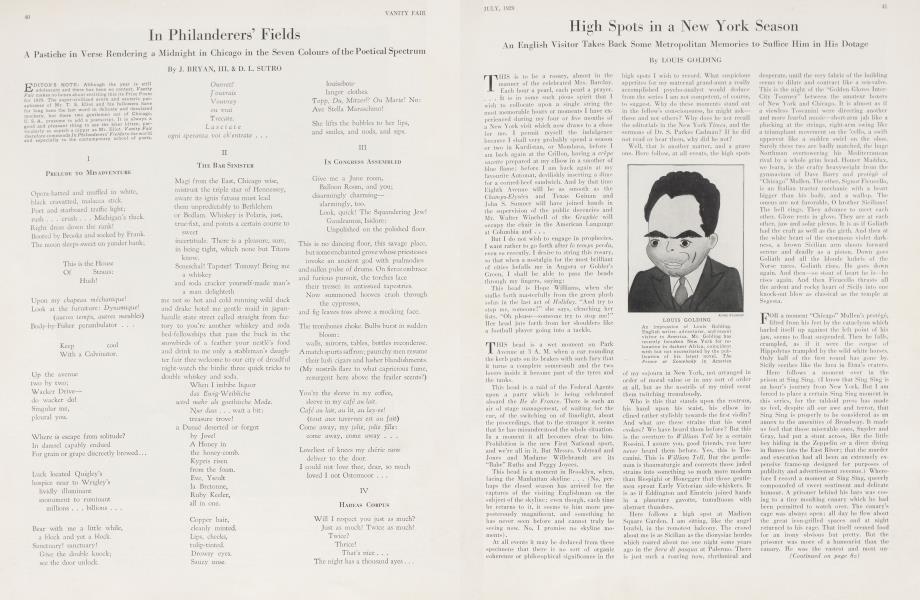
THIS is to be a rosary, almost in the manner of the celebrated Mrs. Barclay. Each hour a pearl, each pearl a prayer. ... It is in some such pious spirit that I wish to collocate upon a single string the most memorable hours or moments I have experienced during my four or five months of a New York visit which now draws to a close for me. I permit myself the indulgence because I shall very probably spend a season or two in Kurdistan, or Mombasa, before I am back again at the Crillon, having a crepe suzette prepared at my elbow in a smother of blue flame; before I am back again at my favourite Automat, devilishly inserting a dime for a corned-beef sandwich. And by that time Eighth Avenue will be as smooth as the Champs-Elysées and Texas Guinan and John S. Sumner will have joined hands in the supervision of the public decencies and Mr. Walter Winchell of the Graphic will occupy the chair in the American Language at Columbia and . . .
But I do not wish to engage in prophecies. I want rather to go forth after le temps perdu, even so recently. I desire to string this rosary, so that when a nostalgia for the most brilliant of cities befalls me in Angora or Golder's Green, I shall be able to pass the beads through my fingers, saying:
This bead is Hope Williams, when she stalks forth masterfully from the green plush sofas in the last act of Holiday. "And try to stop me, someone!" she says, clenching her fists. "Oh please—someone try to stop me!" Her head juts forth from her shoulders like a football player going into a tackle.
THIS bead is a wet moment on Park Avenue at 3 A. M. when a car rounding the kerb puts on its brakes with such fury that it turns a complete somersault and the two lovers inside it become part of the tyres and the tanks.
This bead is a raid of the Federal Agents upon a party which is being celebrated aboard the Ile de France. There is such an air of stage management, of waiting for the cue, of the switching on of limelight, about the proceedings, that to the stranger it seems that he has misunderstood the whole situation. In a moment it all becomes clear to him. Prohibition is the new First National sport, and we're all in it. But Messrs. Volstead and Jones and Madame Willebrandt are its "Babe" Ruths and Peggy Joyces.
This bead is a moment in Brooklyn, when, facing the Manhattan skyline . . . (No, perhaps the closed season has arrived for the raptures of the visiting Englishman on the subject of the skyline; even though, each time he returns to it, it seems to him more preposterously magnificent, and something he has never seen before and cannot truly be seeing now. No, I promise no skyline moments) .
At all events it may be deduced from these specimens that there is no sort of organic coherence or philosophical significance in the high spots I wish to record. What suspicious appetites for my maternal grand-aunt a really accomplished psycho-analyst would deduce from the series I am not competent, of course, to suggest. Why do these moments stand out in the fellow's consciousness, he might ask— these and not others? Why does he not recall the editorials in the New York Times, and the sermons of Dr. S. Parkes Cadman? If he did not read or hear them, why did he not?
Well, that is another matter, and a grave one. Here follow, at all events, the high spots of my sojourn in New York, not arranged in order of moral value or in any sort of order at all, but as the nostrils of my mind scent them twitching tremulously.
Who is this that stands upon the rostrum, his hand upon his waist, his elbow inclined rather stylishly towards the first violin? And what are these strains that his wand evokes? We have heard them before? But this is the overture to William Tell by a certain Rossini. I assure you, good friends, you have never heard them before. Yes, this is Toscanini. This is William Tell. But the gentleman is thaumaturgic and converts those jaded strains into something so much more modern than Respighi or Honegger that those gentlemen sprout Early Victorian side-whiskers. It is as if Eddington and Einstein joined hands in a planetary gavotte, tumultuous with abstract thunders.
Here follows a high spot at Madison Square Garden. I am sitting, like the angel Israfel, in the remotest balcony. The crowd about me is as Sicilian as the dionysiac hordes which roared about me one night some years ago in the fiera di pasqua at Palermo. There is just such a roaring now, rhythmical and desperate, until the very fabric of the building seems to dilate and contract like a sea-valve. This is the night of the "Golden Gloves InterCity Tourney" between the amateur boxers of New York and Chicago. It is almost as if a viewless Toscanini were directing another and more fearful music—short-arm jab like a plucking at the strings, right-arm swing like a triumphant movement on the 'cello, a swift uppercut like a sudden swirl on the oboe. Surely these two are badly matched, the huge Northman overtowering his Mediterranean rival by a whole grim head. Homer Maddux, we learn, is the crafty heavyweight from the gymnasium of Dave Barry and protege of "Chicago" Mullen. The other, Signor Ficucello, is an Italian tractor mechanic with a heart bigger than his body, and a wallop. The omens are not favorable, O brother Sicilians! The bell rings. They advance to meet each other. Glove rests in glove. They are at each other, jaw and solar plexus. It is as if Goliath had the craft as well as the girth. And then at the white heart of the enormous violet darkness, a brown Sicilian arm shoots forward serene and deadly as a piston. Down goes Goliath and all the blonde hubris of the Norse races. Goliath rises. He goes down again. And then—so stout of heart he is—he rises again. And then Ficucello thrusts all the ardent and rocky heart of Sicily into one knock-out blow as classical as the temple at Segesta.
FOR a moment "Chicago" Mullen's protege, lifted from his feet by the cataclysm which hurled itself up against the left point of his jaw, seems to float suspended. Then he falls, crumpled, as if it were the corpse of Hippolytus trampled by the wild white horses. Only half of the first round has gone by. Sicily seethes like the lava in Etna's craters.
Here follows a moment over in the prison at Sing Sing. (I know that Sing Sing is an hour's journey from New York. But I am forced to place a certain Sing Sing moment in this series, for the tabloid press has made us feel, despite all our awe and terror, that Sing Sing is properly to be considered as an annex to the amenities of Broadway. It made us feel that those miserable ones, Snyder and Gray, had put a stunt across, like the little boy hiding in the Zeppelin or a diver diving in flames into the East River; that the murder and execution had all been an extremely expensive frame-up designed for purposes of publicity and advertisement revenue.) Wherefore I record a moment at Sing Sing, queerly compounded of sweet sentiment and delicate humour. A prisoner behind his bars was cooing to a tiny moulting canary which he had been permitted to watch over. The canary's cage was always open; all day he flew about the great iron-grilled spaces and at night returned to his cage. That itself seemed food for an irony obvious but pretty. But the prisoner was more of a humourist than the canary. He was the vastest and most ungainly man I have ever set eyes on. I saw him on the campus (so to speak) later. He did not walk; he wallowed, as a buffalo does through the tangled reeds of marshes. He was serving a sentence for kidnapping, being the most agile kidnapper of our time.
(Continued on page 82)
(Continued from page 41)
I inferred earlier that my "high spots" are "high" because of their intensity rather than their moral elevation. Otherwise I might not include a moment on the illuminated runway in a theatre not far from Irving Place. "High class Burlesk" was the order of the night, "As You Like It," the somewhat familiar description of its genre, and "The Best Show in Town" the modest designation on the program. And certain pretty young maidens tripped up and down the roadway, and some had hair like honey and some had hair like nightshade. And all of them would have caught pneumonia if they had gone out in the costumes they were not wearing to see the Ibsen performance several blocks away. But perhaps they didn't feel Ibsen was necessary, seeing they were all playing burlesk "As You Like It"— though I couldn't remember whether, in the play, it was Rosalind or Touchstone who sang The Way He Loves Is Too Bad and Yes, Judgie Dear.
But it's back at the Madison Square Garden we are now. (I know there ought to have been at least one pious moment of obeisance at the Metropolitan Opera House. I should have registered a Jeritza moment, a Chaliapin moment. But all that emerges out of a dozen operas is Maria Mueller in Der Freischütz warbling away at grandmother's favorite melody through the trellis of her golden hair.) So I am recalling, instead, the wild, wild hour at the conclusion of the SixDay Bicycle Race held at the Garden in March. And I know just how naïve it was of me to be so excited that I had to gargle my voice back for weeks after. And there's no getting away from it; the race is to Franco Georgetti and Gerard Debaets, who are nine unapproachable laps away. But the hysteria centres about the Australian-American team (BelloniBeckman) and the German-American team (Walthour-Deulberg). They are each five laps behind those grim protagonists. They have their eyes and bicycles measured upon each other like rival lovers sworn to a vendetta. Let the French "Red Devil" team steal a lap or two. They can go where devils belong. Poor old McNamara, invincible for so many seasons, let him steal even two or three ... for briefly (as Housman sings) though the laurel grows, it withers sooner than the rose. And they gyrate upon each others' traces, their hearts bursting and pounding. There have been six days and nights of this, you remember; they have hardly slept more than a continuous hour or two in all this eternity of hours. Or do the hours seem to them a sequence of moments flapping by like wings? And Belloni and Beckman are away, all the field after them like hounds in full cry. Have they stolen a march on the "Kid Team"? Have the lads in Columbia Blue been caught napping? They have not. They each gain a lap equally. A sort of torpor descends on the scene, even at the mid point of this last hour. Bleakly the legs grind, like pit-ponies plodding. And of a sudden—it is truly more like an operation of thought disembodied than mere body action—Walthour and Deulberg are away. And Deulberg has received the thrust in the hollow of the back and twangs away like an arrow from a bow-string. And desperately the Italian-Americans are launched on their wheels. But they have only talent. The others are pos-. sessed. This is the pure flame of genius. Pindar would have foamed at the mouth. There is no fighting against anything so beautiful as poetry and so unscrupulous.
There were other moments. One was in Hoboken, when the world hissed at the top-hatted villain as he passed before the curtain, and the top-hatted villain flicked the world from his coat-sleeve, as it were a speck of dust. There was a moment when a mulatto girl smiled in a Harlem night club, tbe slowest, most bewitching smile that ever desolated me. There was a moment ... ah yes, there were two or three, which it were wiser neither to transcribe, nor to remember, even.
Subscribers have complete access to the archive.
Sign In Not a Subscriber?Join Now
