
Sign In to Your Account
Subscribers have complete access to the archive.
Sign In Not a Subscriber?Join NowThe new backgammon
LELIA HATTERSLEY
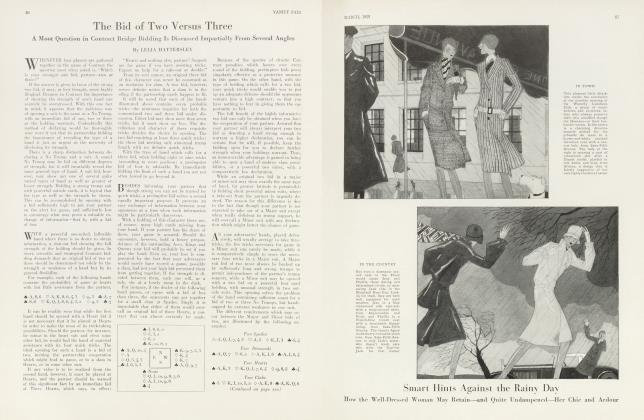
A few theories on doubling and some practical hints for the player who aims for success at Backgammon
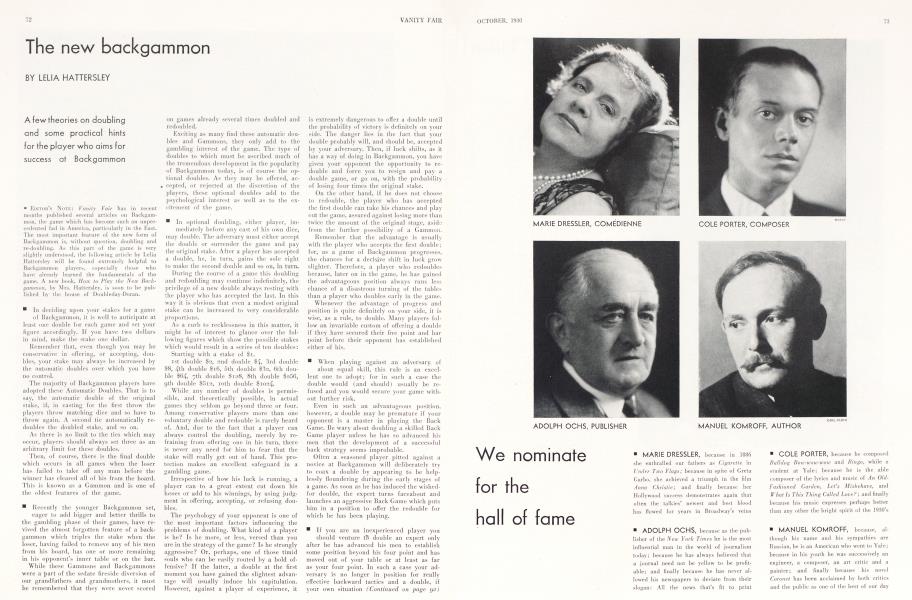
EDITOR'S NOTE: Vanity Fair lias in recent months published several articles on Backgammon, the game which has become such an unprecedented fad in America, particularly in the East. The most important feature of the new form of Backgammon is, without question, doubling and re-doubling. As this part of the game is very slightly understood, the following article by Lelia Hattersley will be found extremely helpful to Backgammon players, especially those who have already learned the fundamentals of the game. A new book, How to Flay the New Backgammon, by Mrs. llattersley, is soon to be published by the house of Doubleday-Doran.
In deciding upon your stakes for a game of Backgammon, it is well to anticipate at least one double for each game and set your figure accordingly. If you have two dollars in mind, make the stake one dollar.
Remember that, even though you may be conservative in offering, or accepting, doubles, your stake may always he increased by the automatic doubles over which you have no control.
The majority of Backgammon players have adopted these Automatic Doubles. That is to say, the automatic double of the original stake, if, in casting for the first throw7 the players throw matching dice and so have to throw again. A second tie automatically redoubles the doubled stake, and so on.
As there is no limit to the ties which may occur, players should always set three as an arbitrary limit for these doubles.
Then, of course, there is the final double which occurs in all games when the loser has failed to take off any man before the winner has cleared all of his from the board. This is known as a Gammon and is one of the oldest features of the game.
Recently the younger Backgammon set, eager to add bigger and better thrills to the gambling phase of their games, have revived the almost forgotten feature of a backgammon which triples the stake when the loser, having failed to remove any of his men from his board, has one or more remaining in his opponent's inner table or on the bar.
While these Gammons and Backgammons were a part of the sedate fireside diversion of our grandfathers and grandmothers, it must be remembered that they were never scored on games already several times doubled and redoubled.
Exciting as many find these automatic doubles and Gammons, they only add to the gambling interest of the game. The type of doubles to which must be ascribed much of the tremendous development in the popularity of Backgammon today, is of course the optional doubles. As they may be offered, accepted, or rejected at the discretion of the players, these optional doubles add to the psychological interest as well as to the excitement of the game.
In optional doubling, either player, immediately before any cast of his own dice, may double. The adversary must either accept the double or surrender the game and pay the original stake. After a player has accepted a double, he, in turn, gains the sole right to make the second double and so on, in turn.
During the course of a game this doubling and redoubling may continue indefinitely, the privilege of a new double always resting with the player who has accepted the last. In this way it is obvious that even a modest original stake can be increased to very considerable proportions.
As a curb to recklessness in this matter, it might he of interest to glance over the following figures which show the possible stakes which would result in a series of ten doubles:
Starting with a stake of Si.
Ist double S2, 2nd double $4, 3rd double $8, 4th double $16, 5th double S32, 6th double $64, 7th double $128, 8th double $256, 9th double $5i2, iotli double $1024.
While any number of doubles is permissible, and theoretically possible, in actual games they seldom go beyond three or four. Among conservative players more than one voluntary double and redouble is rarely heard of. And, due to the fact that a player can always control the doubling, merely by refraining from offering one in his turn, there is never any need for him to fear that the stake will really get out of hand. This protection makes an excellent safeguard in a gambling game.
Irrespective of how his luck is running, a player can to a great extent cut down his losses or add to his winnings, by using judgment in offering, accepting, or refusing doubles.
The psychology of your opponent is one of the most important factors influencing the problems of doubling. What kind of a player is he? Is he more, or less, versed than you are in the strategy of the game? Is he strongly aggressive? Or, perhaps, one of those timid souls who can be easily routed by a bold offensive? If the latter, a double at the first moment you have gained the slightest advantage will usually induce his capitulation. However, against a player of experience, it is extremely dangerous to offer a double until the probability of victory is definitely on your side. The danger lies in the fact that your double probably will, and should be, accepted by your adversary. Then, if luck shifts, as it has a way of doing in Backgammon, you have given your opponent the opportunity to redouble and force you to resign and pay a double game, or go on, with the probability of losing four times the original stake.
On the other hand, if he does not choose to redouble, the player who has accepted the first double can take his chances and play out the game, assured against losing more than twice the amount of the original stage, aside from the further possibility of a Gammon.
Remember that the advantage is usually with the player who accepts the first double; for, as a game of Backgammon progresses, the chances for a decisive shift in luck grow slighter. Therefore, a player who redoubles because, later on in the game, he has gained the advantageous position always runs less chance of a disastrous turning of the tables than a player who doubles early in the game.
Whenever the advantage of progress and position is quite definitely on your side, it is wise, as a rule, to double. Many players follow an invariable custom of offering a double if they have secured their five point and bar point before their opponent has established either of his.
When playing against an adversary of about equal skill, this rule is an excellent one to adopt; for in such a case the double would (and should) usually be refused and you would secure your game without further risk.
Even in such an advantageous position, however, a double may be premature if your opponent is a master in playing the Back Game. Be wary about doubling a skilled Back Game player unless he has so advanced his men that the development of a successful back strategy seems improbable.
Often a seasoned player pitted against a novice at Backgammon will deliberately try to coax a double by appearing to be helplessly floundering during the early stages of a game. As soon as he has induced the wished for double, the expert turns faceabout and launches an aggressive Back Game which puts him in a position to offer the redouble for which he has been playing.
If you are an inexperienced player you should venture to double an expert only after he has advanced his men to establish some position beyond his four point and has moved out of your table or at least as far as your four point. In such a case your adversary is no longer in position for really effective backward tactics and a double, if your own situation is good, would he most advisable.
Continued on page 92
Continued from page 72
Another trick of the old timer at Backgammon consists in forcing a double on his opponent by the implication that it would be poor sportsmanship for him to refuse a double. Do not allow yourself to be bluffed or dared into accepting a double against your better judgment. Questions of good or bad sportsmanship have no more part in the doubles of Backgammon, than in the doubles and redoubles at Contract, both being matters entirely of judgment and common sense.
After you have begun to throw off, if you are well ahead, and the opponent's men are all out of your table, and there is no chance for a Gammon, always double. In doing so you usually induce your adversary to give up at once, for the percentage is all on your side. Thus you eliminate the possibility of a swing of luck which might eventuate in his winning. This is the one situation in which even the merest beginner opposing an expert may be assured that he is doubling with the advantage on his side. With his opponent's men past all of his and powerless to harm him, the tyro need no longer fear that any insidious tactics will be used to turn his probable victory into defeat.
In the reverse position, always give up when such a double is offered you. There is no percentage in playing out a redoubled game which nothing but exceptionally lucky throws can secure for you.
Beside the elements of psychology and relative skill, another factor which enters into the question of doubling when you are ahead is that you may have your opponent at such a disadvantage that a Gammon seems likely. In this case your double may give him a wished for chance to resign and escape paying a double penalty.
The following example may be of use as a gauge from which to judge the advisability of offering a double which you are certain will be refused, or playing to the finish on the chance of scoring a Gammon.
Suppose your opponent has six men outside of his home table where three throws would probably bring them in. At the same time your home table is completely blocked and you have one of the enemies on the bar. In this case the chances are about even of your gammoning him.
Leaving out the contingency of doublet throws for either side, according to probabilities, you could throw off two men before opening your table, but on bearing the third man you would have to open your five or six point. It would then be probable that the adversary would have to throw twice before entering his man, twice more to bring him home, and three times more to bring in his other six men, seven throws in all.
Meanwhile, having twelve men to bear off, you would doubtless be forced to waste one throw in moving up your men; therefore necessitating seven throws to clear your board. Thus, upon the whole, it would be about even whether or not you would score a Gammon.
In this position, you would be unwise to double. For your adversary, being quite certain of ultimately losing the game and having only an even chance of escaping a Gammon, would surely refuse. In a less favorable position, however, you would have more to gain than to lose in offering a double, since you could discount the probability of securing a Gammon, and though the chances of winning the game would still be in your favor, there is always the possibility of losing it.
In short, if you are considering offering a double, should you estimate that you are in as good or better position than that outlined above, do not double. Should you be in a slightly poorer position, double by all means, as you stand to win only the single game in any case and would do well to secure it at once. If, however, your opponent unwisely accepts the double, the possibility of winning tbe game is on your side with the further chance of scoring a Gammon.
Note: This article, in a slightly different form, will form a part of Mrs. Hattersley's new book, "How to play the new Backgammon", which is to bear the imprint of Doubleday, Doran.
Subscribers have complete access to the archive.
Sign In Not a Subscriber?Join Now
