Sign In to Your Account
Subscribers have complete access to the archive.
Sign In Not a Subscriber?Join Now"Quick" and "probable" tricks at Contract
LELIA HATTERSLEY
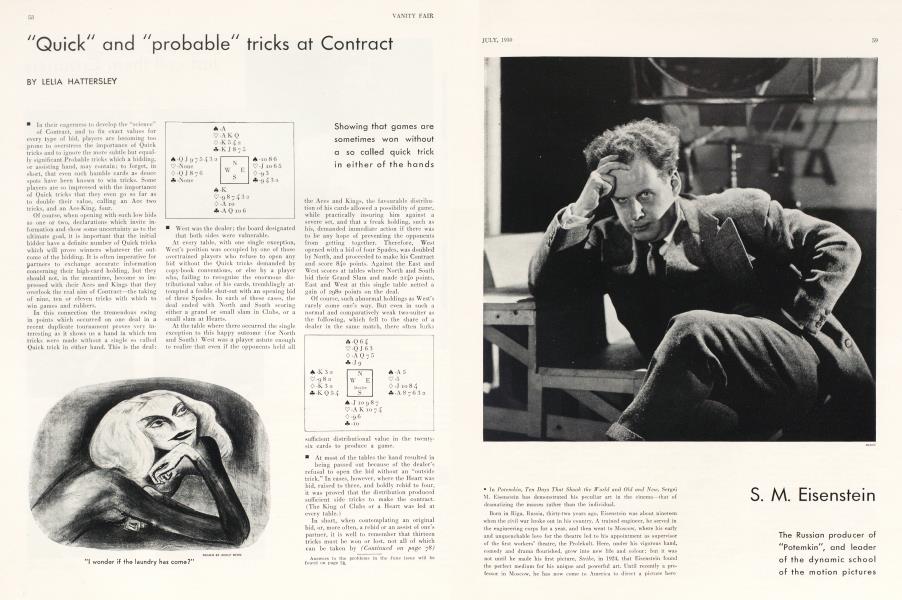
Showing that games are sometimes won without a so called quick trick in either of the hands
In their eagerness to develop the "science" of Contract, and to fix exact values for every type of bid, players are becoming too prone to overstress the importance of Quick tricks and to ignore the more subtle but equally significant Probable tricks which a bidding, or assisting hand, may contain; to forget, in short, that even such humble cards as deuce spots have been known to win tricks. Some players are so impressed with the importance of Quick tricks that they even go so far as to double their value, calling an Ace two tricks, and an Ace-King, four.
Of course, when opening with such low bids as one or two, declarations which invite information and show some uncertainty as to the ultimate goal, it is important that the initial bidder have a definite number of Quick tricks which will prove winners whatever the outcome of the bidding. It is often imperative for partners to exchange accurate information concerning their high-card holding, but they should not, in the meantime, become so impressed with their Aces and Kings that they overlook the real aim of Contract—the taking of nine, ten or eleven tricks with which to win games and rubbers.
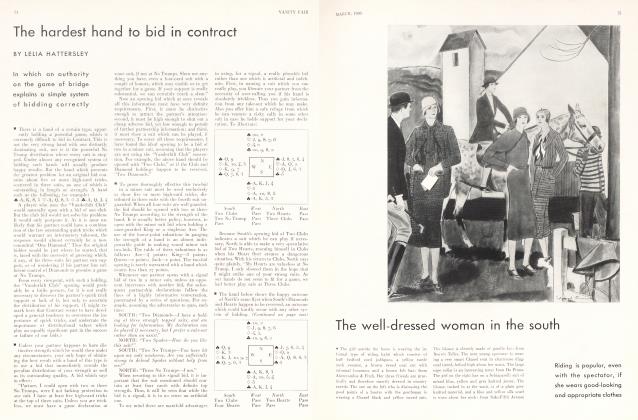
In this connection the tremendous swing in points which occurred on one deal in a recent duplicate tournament proves very interesting as it shows us a hand in which ten tricks were made without a single so called Quick trick in either hand. This is the deal:
West was the dealer; the board designated that both sides were vulnerable.
At every table, with one single exception, West's position was occupied by one of those overtrained players who refuse to open any bid without the Quick tricks demanded by copy-book conventions, or else by a player who, failing to recognize the enormous distributional value of his cards, tremblingly attempted a feeble shut-out with an opening bid of three Spades. In each of these cases, the deal ended with North and South scoring either a grand or small slam in Clubs, or a small slam at Hearts.
At the table where there occurred the single exception to this happy outcome (for North and South) West was a player astute enough to realize that even if the opponents held all the Aces and Kings, the favourable distribution of his cards allowed a possibility of game, while practically insuring him against a severe set, and that a freak holding, such as his, demanded immediate action if there was to be any hope of preventing the opponents from getting together. Therefore, West opened with a bid of four Spades, was doubled by North, and proceeded to make his Contract and score 840 points. Against the East and West scores at tables where North and South bid their Grand Slam and made 2140 points, East and West at this single table netted a gain of 2980 points on the deal.
Of course, such abnormal holdings as West's rarely come one's way. But even in such a normal and comparatively weak two-suiter as the following, which fell to the share of a dealer in the same match, there often lurks sufficient distributional value in the twenty-six cards to produce a game.
At most of the tables the hand resulted in being passed out because of the dealer's refusal to open the bid without an "outside trick." In cases, however, where the Heart was bid, raised to three, and boldly rebid to four, it was proved that the distribution produced sufficient side tricks to make the contract. (The King of Clubs or a Heart was led at every table.)
In short, when contemplating an original bid, or, more often, a rebid or an assist of one's partner, it is well to remember that thirteen tricks must be won or lost, not all of which can be taken by "Quick Tricks," and to realize the sources of the additional or less obvious tricks which are won in every hand. At both Trump and No Trump declarations, many tricks are made by successful finesses, and by the establishment of lower honours or endcards of long suits. Also, at declared trumps, additional tricks are frequently secured by the separate use of a partnership's trumps in ruffing.
(Continued on page 78)
Answers to the problems in the June issue will be found on page 78.
(Continued from page 58)
In making any original bid, since you are in the dark concerning the whereabouts of the outstanding strength, you can only surmise that it is evenly distributed, and that, if allowed to play the hand, you will have an average break of luck. Thus, in estimating the value of a trumpsuit with sound tops, you may figure an even distribution of the trumps which will give you an end-trick for every trump over three. That is, one end-trick in a four-card suit, two in a five-card suit, and three in a six-card suit. A seven-card suit with very strong tops usually yields five end-tricks.
As the bidding develops, a re-appraisal of your hand is frequently necessary. Half-tricks may be counted as full tricks, or perhaps discounted altogether. Or again, assisting hands may double in value after a partner has shown two suits. But, then, the matter of the revaluation of a hand is a subject in itself.
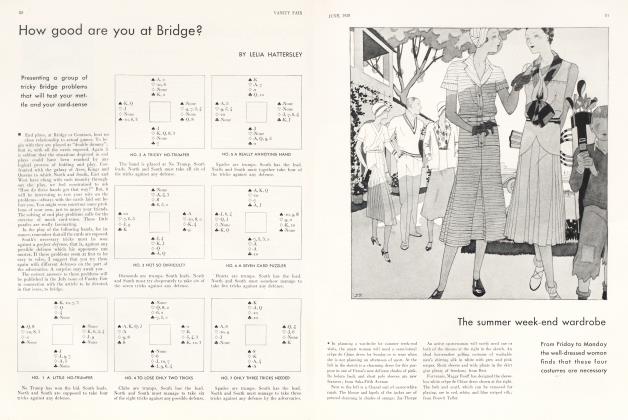
SOLUTIONS TO JUNE PROBLEMS
Hand-No. 1 illustrates a lead throwing contest, beginning with an elimination play by South. South leads the Diamond Ace; all follow.
South leads his second Diamond; West discards a low Heart; North the Queen of Hearts; East takes the trick.
East leads a low Heart (best defense) ; South plays the Jack; North discards a low Spade. South leads the Jack of Spades; West plays low (best defense) ; North plays low.
South leads a Heart. If West holds the trick, North makes a Spade; if East overtakes, South makes a Heart.
Hand No. 2 calls for an important discard and a subsequent squeeze.
South leads the King of Hearts; North plays the 10.
South leads the Spade Jack; North takes the trick with the ace; East must discard a Club. North leads the 6 of Hearts; South finesses the 8.
South leads the Heart Queen; West is squeezed.
In hand No. 3 the necessary six tricks can only be made by several elimination plays and an unusual discard.
South leads the Ace of Clubs; all follow.
South leads the King and then the Jack of Hearts; all follow low. South leads the Spade 4; North trumps.
North leads the Ace of Hearts; South discards the Queen of Clubs.
North leads a Club; South must make his trump.
Hand No. 4 can only be made by a combination of several well-known bridge strategies—elimination, throwing the lead, and a grand coup.
Starting the hand, South, for the purpose of eliminating the suit from West's hand, leads the Jack and then the 10 of Diamonds.
South then leads the 6 of Hearts, throwing the lead to West.
West leads the Spade Ace (best defense) ; North trumps with 5 and South, effecting the grand coup, undertrumps.
North leads a trump; East wins the trick with King (best defense). East leads his Diamond; North trumps.
North leads a Heart and South must make both of his trumps.
Hand No. 5 necessitates the spectacular discard of a commanding trump, for which the stage must be set by a preparatory lead.
South opens with the Ace of Diamonds, and continues with the 5 spot, which West trumps with the Ace (best defense), and North must undertrump.
West has to lead either a fatal Heart to North's tenace, or a trump. If he chooses the latter, East is squeezed, being forced into a discard which either gives South a trick in Diamonds or North a trick in Clubs.
Hand No. 6 can be made only by a process of elimination in preparation for the winning lead.
South leads a Spade, putting North in the lead. North leads his two good Spades; all follow. North leads the Heart 10 which South takes.
South now leads his Spade allowing either East or West to trump. Whichever elects to do so, East and West can make only their two trumps.
In No. 7 the necessary three tricks are secured by the classic end-problem play—the discard of an Ace.
South leads the King of Hearts, North takes the trick.
North leads the Heart Queen; South discards the Ace of Clubs.
North leads his 10 of Club and South trumps, forcing West's Ace, thus North makes his King of trumps.
Subscribers have complete access to the archive.
Sign In Not a Subscriber?Join Now
