

Sign In to Your Account
Subscribers have complete access to the archive.
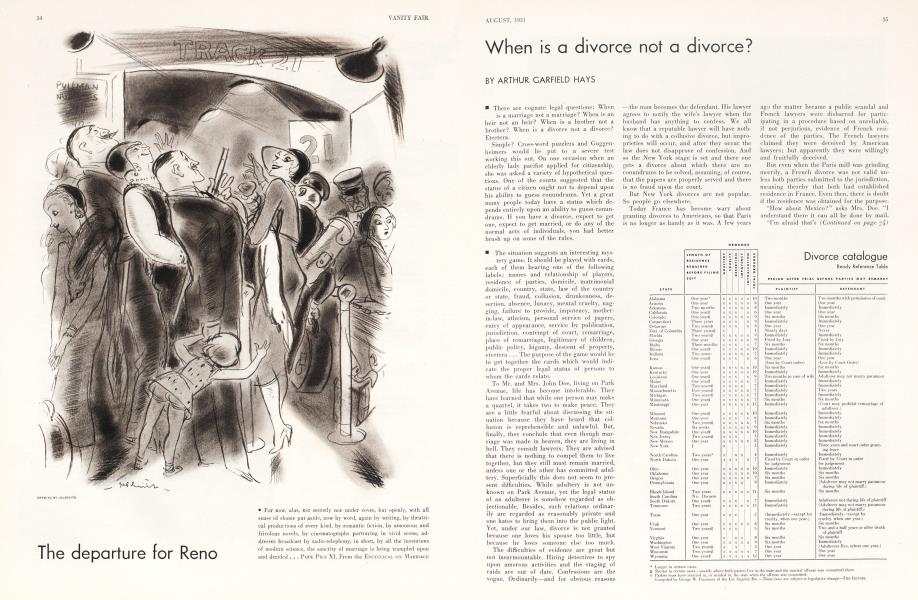
Sign In Not a Subscriber?Join NowWhen is a divorce not a divorce?
ARTHUR GARFIELD HAYS
There are cognate legal questions: When is a marriage not a marriage? When is an heir not an heir? When is a brother not a brother? When is a divorce not a divorce? Etcetera.
Simple? Cross-word puzzlers and Guggenheimers would be put to a severe test working this out. On one occasion when an elderly lady pacifist applied for citizenship, she was asked a variety of hypothetical questions. One of the courts suggested that the status of a citizen ought not to depend upon his ability to guess conundrums. Yet a great many people today have a status which depends entirely upon an ability to guess conundrums. If you have a divorce, expect to get one, expect to get married, or do any of the normal acts of individuals, you had better brush up on some of the rules.
The situation suggests an interesting mystery game. It should be played with cards, each of them bearing one of the following labels: names and relationship of players, residence of parties, domicile, matrimonial domicile, country, state, law of the country or state, fraud, collusion, drunkenness, desertion, absence, lunacy, mental cruelty, nagging, failure to provide, impotency, motherin-law, atheism, personal service of papers, entry of appearance, service by publication, jurisdiction, contempt of court, remarriage, place of remarriage, legitimacy of children, public policy, bigamy, descent of property, etcetera . . . The purpose of the game would be to get together the cards which would indicate the proper legal status of persons to whom the cards relate.
To Mr. and Mrs. John Doe, living on Park Avenue, life has become intolerable. They have learned that while one person may make a quarrel, it takes two to make peace. They are a little fearful about discussing the situation because they have heard that collusion is reprehensible and unlawful. But, finally, they conclude that even though marriage was made in heaven, they are living in hell. They consult lawyers. They are advised that there is nothing to compel them to live together, but they still must remain married, unless one or the other has committed adultery. Superficially this does not seem to present difficulties. While adultery is not unknown on Park Avenue, yet the legal status of an adulterer is somehow regarded as objectionable. Besides, such relations ordinarily are regarded as reasonably private and one hates to bring them into the public light. Yet, under our law, divorce is not granted because one loves his spouse too little, but because he loves someone else too much.
The difficulties of evidence are great but not insurmountable. Hiring detectives to spy upon amorous activities and the staging of raids are out of date. Confessions are the vogue. Ordinarily—and for obvious reasons —the man becomes the defendant. His lawyer agrees to notify the wife's lawyer when the husband has anything to confess. We all know that a reputable lawyer will have nothing to do with a collusive divorce, but improprieties will occur, and after they occur the law does not disapprove of confession. And so the New York stage is set and there one gets a divorce about which there are no conundrums to be solved, assuming, of course, that the papers are properly served and there is no fraud upon the court.
But New York divorces are not popular. So people go elsewhere.
Today France has become wary about granting divorces to Americans, so that Paris is no longer as handy as it was. A few years ago the matter became a public scandal and French lawyers were disbarred for participating in a procedure based on unreliable, if not perjurious, evidence of French residence of the parties. The French lawyers claimed they were deceived by American lawyers; but apparently they were willingly and fruitfully deceived.
But even when the Paris mill was grinding merrily, a French divorce was not valid unless both parties submitted to the jurisdiction, meaning thereby that both had established residence in France. Even then, there is doubt if the residence was obtained for the purpose.
"How about Mexico?" asks Mrs. Doe. "I understand there it can all be done by mail.
"I'm afraid that's out of the question," answers the lawyer. "The Mexican courts would have no jurisdiction whatever and such a divorce certainly would not accord with the public policy of the State of New York."
(Continued on page 74)
STATE
If NOTH OF RESIDENCE REQUIRED •BEFORE FILING SUIT
ADULTUY CIUELTY DISUTIOP4 IMPOTINCY INTOXICATION TOTAL GROUNDS
Divorce catalogue Ready Reference Table PIRIOD AFTER TRIAL RITORI PARTUS MAY RIMARRY
PLAINTIFF
DEFENDANT
Alabama One year* X X X X X 10 Two months Two months with permission of court
Arizona One year x X x x 8 One year One year
Arkansas Two months X X X X X 8 Immediately Immediately
California One year# x X X x 6 One year One year
Colorado One yearS x X X X x 9 Six months Six months
Connecticut Three years X X X X 9 Immediately Immediately
Delaware Two yearsS X X X X 8 One year One year
Dist. of Columbia Three yearsS x 1 Ninety days Never
Florida Two yearsS X X X X x 9 Immediately Immediately
Georgia One year X X X X X 9 Fixed by Jury Fixed by Jury
Idaho Three months x x X x 7 Six months Six months
Illinois One yearS X x X x x 10 Immediately Immediately
Indiana Two years X X X X X 7 Immediately Immediately
One yearS x x x x 6 One year One year
(Less by Court order) (Less by Court Order)
Kansas One yearS X x x x x 10 Six months Six months
Kentucky One year x x X x X 10 Immediately Immediately
Louisiana One yearS x x x x 9 Ten months in case of wife Adulterer may not marry paramour
Maine One yearS X x X x x 7 Immediately Immediately
Maryland Two yearsS x X X x 7 Immediately Immediately
Massachusetts Five yearsS x x X X X 7 Immediately Two years
Michigan Two yearsS x x X X X 7 Immediately Immediately
Minnesota One yearS x x X x X 7 Six months Six months
Mississippi One year x X X X X 11 Immediately (Court may prohibit remarriage of
adulterer.)
Missouri One yearS X X X X X 10 Immediately Immediately
Montana One year x x x X 6 Immediately Immediately
Nebraska Two yearsS x x x x x 7 Six months Six months
Nevada Six weeks x x x x x 9 Immediately Immediately
New Hampshire One yearS x x X x X 10 Immediately Immediately
New Jersey Two yearsS x x x 3 Immediately Immediately
New Mexico One year x x x x X 8 Immediately Immediately
New York † x 1 Immediately Three years and court order grant-
ing leave
North Carolina Two years* x x x 4 Immediately Immediately
North Dakota One year x x x X 7 Fixed by Court in order Fixed by Court in order
for judgement for judgement
Ohio One year x x x x X 10 Immediately Immediately
Oklahoma One year X x x x X 10 Six months Six months
Oregon One year X x X x X 7 Six months Six months
Pennsylvania One year X x x x 9 Immediately (Adulterer may not marry paramour
during life of plaintiff.)
Rhode Island Two years X X X X X 11 Six months Six months
South Carolina N o Divorce
South Dakota One yearS x x x x 7 Immediately Adulterers not during life of plaintiff
Tennessee Two years x x x x 13 Immediately (Adulterer may not marry paramour
during life of plaintifT.)
Texas One year x x X 5 (Immediately—except lor (Immediately—except for
cruelty, when one year.) cruelty, when one year.)
Utah One year x x x x x 8 Six months Six months
Vermont Two yearsS x x x 5 Six months Two and a half years or after death
of plaintifT
Virginia One year X x x 8 Six months Six months
Washington One year x x x X x 9 Six months Immediately
West Virginia Two yearsS x X 3 One year (Adulterers five, others one year.)
Wisconsin Two yearsS X X X x X 7 One year One year
Wyoming One yearS x x x x x 12 One year One year
* Longer in certain cases.
# Shorter in certain cases—usually where both parties live in the state and the marital offense was committed there.
† Parties must have married in, or resided in, the slate when the offense was committed.
Compiled by George W. Fcnimore of the Los Angeles Bar.—These laws are subject to legislative CHANGE-THE EDITORS.
(Continued from page 35)
"But a Mexican lawyer advised a friend of mine, that it was valid."
"A Mexican lawyer would."
"Well, how do people get away with it?" asks the lady.
"It's a method and not a divorce," answers the lawyer.
Let me illustrate:—A client of mine, Mr. Streeter, had been separated from his wife for three years. He had fallen in love with another girl whom he wanted to marry. Wives are always solicitous to save erring and departed husbands from designing women. Streeter had gone to Mexico, obtained a divorce and had had the foresight to remarry in Mexico. The divorce was good there; the remarriage was good there. In the meantime Mrs. Streeter had not received her customary allowance. Her lawyer came to see me. I told him I had news for him.
"Your client's husband has been divorced."
"Impossible," said the lawyer, "I saw him here only a month or so ago. His wife has had no notice."
"But it's a fact," I replied. "I'll tell you more—your client's husband has married again."
"Well, I'll fix him," replied the wife's lawyer. "If he comes back here I'll have him prosecuted for bigamy."
"You can't do that," I answered. "Bigamy is marrying a second time within this state."
"I'll prosecute him for perjury."
"You can't do that," I responded, "because if he committed perjury it was in Mexico and he is not going back there again."
"Well, I'll have him prosecuted for violating the White Slave Act, traveling with the lady from state to state," was the next threat.
"You can't do that, because he didn't travel back with his new wife."
"Oh, well, I suppose my client will have to get a divorce."
We then had luncheon together, arranged a financial settlement and fee. Divorce proceedings were brought in New York State, with the new wife named as correspondent. After the divorce was granted, the parties again married in Connecticut. Why Connecticut? Because the New York decree, in its usual form, enjoined the husband from marrying again for three years. Violation meant contempt of court, but the order applied and could apply only within the state.
"You are making it very hard," says Mrs. Doe. "What shall I do?"
"Better get a Reno divorce."
"But I heard those are no good."
"Well, if you establish a residence and have your husband enter an appearance, thus submitting himself to the jurisdiction of the court, you probably will be safe, because under the United States Constitution the judgment of one state is entitled to full faith and credit in all other states."
"Then what questions arise about Reno divorces?"
"Questions of jurisdiction; that is, whether the court has any right whatever to consider the case. This question has been decided differently in different states."
For instance, Charlie Andrews was living unamicably with his wife, Katie, in Boston. Mr. Andrews went to South Dakota, boarded at an hotel in Sioux Falls,—even voted there in one election. The wife appeared in the case by counsel, first contested, then after a financial settlement consented to the divorce. Mr. Andrews returned to Massachusetts and there married an alluring lady who may have been the cause, but certainly seemed the solution of his marital difficulties; two children were born, whereupon Mr. Andrews departed this life. Both ladies claimed to be the widow. The matter came to court over a controversy as to who was entitled to administer the estate. The first wife was assisted by a statute in Massachusetts—Tather an unusual one which limits the effect of divorces obtained in other states. It was held by the Supreme Court that Katie, the first wife, was the widow, and that Annie, the second wife, and her children, were out of luck. It occurs to me that if (a) Charlie had married Annie in South Dakota, or perhaps (b) married Annie in any state other than Massachusetts, or (c) had made a will so that the ladies would not have fought about this estate, or (d) had taken the precaution to die somewhere other than Massachusetts, then perhaps the controversy would never have arisen. I make these suggestions as a basis for hypothesis.
Many years ago Frank M. Baker went to jail for guessing wrong. He was charged with having married two ladies: Sally West in Ohio, and later Eunice Nelson in New York. In the interim Sally had obtained a divorce in Ohio for "gross neglect of duty". Jurisdiction over Frank was had by publication. Frank was charged with bigamy in New York. It was held that the Ohio judgment was not effective and that Frank was guilty of bigamy. The court, however, pointed out "we are aware that there are decisions of the courts of sister states to the contrary of the authorities in this state." The trouble with Frank was that he chose the wrong state.
I can imagine the shock of consternation Frank's dilemma will bring to many of Vanity Fair's readers. Our best citizens have obtained decrees of divorce in other states or countries and have married again.
To the contemplated mystery game to which I referred, some people would add a card called "Federal Uniform Divorce Law", on the theory that the more cards there are, the simpler the game. Divorce laws, like prohibition laws, are based not on rationality, but on theological dogma. Federal laws restrict, never enlarge, opportunities for freedom.
If you can answer the question of jurisdiction, the rest is easy. That's the catch. In general, a divorce is a divorce when granted by a court having ^jurisdiction over both parties. Otherwise, a divorce is not a divorce —in law. In social practice, however, it may prove as useful as the real article.
Subscribers have complete access to the archive.
Sign In Not a Subscriber?Join Now
