Sign In to Your Account
Subscribers have complete access to the archive.
Sign In Not a Subscriber?Join NowThe screen
PARE LORENTZ
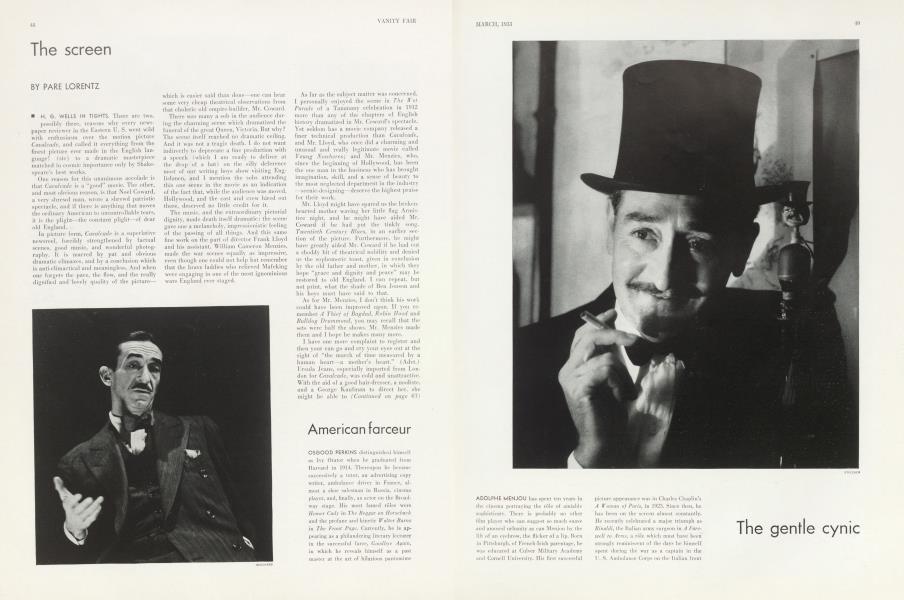
H. G. WELLS IN TIGHTS. There are two, possibly three, reasons why every newspaper reviewer in the Eastern U. S. went wild with enthusiasm over the motion picture Cavalcade, and called it everything from the finest picture ever made in the English language! (sic) to a dramatic masterpiece matched in cosmic importance only by Shakespeare's best works.
One reason for this unanimous accolade is that Cavalcade is a "good movie. The other, and most obvious reason, is that Noel Coward, a very shrewd man, wrote a shrewd patriotic spectacle, and if there is anything that moves the ordinary American to uncontrollable tears, it is the plight—the constant plight—of dear old England.
In picture form, Cavalcade is a superlative newsreel, forcibly strengthened by factual scenes, good music, and wonderful photography. It is marred by pat and obvious dramatic climaxes, and by a conclusion which is anti-climactical and meaningless. And when one forgets the pace, the flow, and the really dignified and lovely quality of the picture— which is easier said than done—one can hear some very cheap theatrical observations from that choleric old empire-builder, Mr. Coward.
There was many a sob in the audience during the charming scene which dramatized the funeral of the great Queen, Victoria. But why? The scene itself reached no dramatic ceiling. And it was not a tragic death. I do not want indirectly to deprecate a fine production with a speech (which I am ready to deliver at the drop of a hat) on the silly deference most of our writing boys show visiting Englishmen, and I mention the sobs attending this one scene in the movie as an indication of the fact that, while the audience was moved, Hollywood, and the cast and crew hired out there, deserved no little credit for it.
The music, and the extraordinary pictorial dignity, made death itself dramatic: the scene gave one a melancholy, impressionistic feeling of the passing of all things. And this same fine work on the part of director Frank Lloyd and his assistant, William Cameron Menzies, made the war scenes equally as impressive, even though one could not help but remember that the brave laddies who relieved Mafeking were engaging in one of the most ignominious wars England ever staged.
As far as the subject matter was concerned. I personally enjoyed the scene in The Wet Parade of a Tammany celebration in 1912 more than any of the chapters of English history dramatized in Mr. Coward's spectacle. Yet seldom has a movie company released a finer technical production than Cavalcade, and Mr. Lloyd, who once did a charming and unusual and really legitimate movie called Young Nowheres; and Mr. Menzies, who, since the beginning of Hollywood, has been the one man in the business who has brought imagination, skill, and a sense of beauty to the most neglected department in the industry —scenic-designing—deserve the highest praise for their work.
Mr. Lloyd might have spared us the broken-hearted mother waving her little flag Armistice night, and he might have aided Mr. Coward if he had put the tinkly song, Twentieth Century Blues, in an earlier section of the picture. Furthermore, he might have greatly aided Mr. Coward if he had cut a shoddy bit of theatrical nobility and denied us the sophomoric toast, given in conclusion by the old father and mother, in which they hope "grace and dignity and peace" may be restored to old England. I can repeat, but not print, what the shade of Ben Jonson and his boys must have said to that.
As for Mr. Menzies, I don't think his work could have been improved upon. If you remember A Thief of Bagdad, Robin Hood and Bulldog Drummond, you may recall that the sets were half the shows. Mr. Menzies made them and I hope he makes many more.
I have one more complaint to register and then your can go and cry your eyes out at the sight of "the march of time measured by a human heart—a mother's heart." (Advt.) Ursula Jeans, especially imported from London for Cavalcade, was cold and unattractive. With the aid of a good hair-dresser, a modiste, and a George Kaufman to direct her, she might be able to compete with any one of forty young actresses already sold down the river to Hollywood.
(Continued on page 63)
(Continued from page 48)
BOO. As a concomitant means of relaxation comparable to reading detective stories, the horror picture probably serves some purpose. Since Dracula first started the intermittent wave of supernatural melodramas we have bad some dandy fairy tales. The boys are running a risk, however, at the present, of carrying the thing too far, and if they don't have the Parent Teachers Association or some other such organization on their necks they will be indeed fortunate.
I don't see any objection to these grisly comedies except that, in The Island of Lost Souls and in the latest boo epic, The Wax Museum, they strive too much for veracity and reality, instead of making a fairy tale, such as The Old Dark House, which was funny, or Frankenstein, which only in one scene tried to be real and earnest.
I objected to The Island of Lost Souls merely because it was dull, and, too, because of a gruesome conclusion in an operating room. The half-men, what-is-its, were pretty funny, being for the most part wrestlers who looked almost natural even in make-up. The great love scene between a stranger and a girl—made right smack from a panther!—failed to come off, and only Charles Laughton, and his queer, stylized acting, give the show any authority.
This one followed the usual horror routine—the monster almost got his hands on the white body of the heroine which, insofar as Hollywood's plots are concerned, gets us right back where we were in Griffith's day.
There is no good sexy assault scene in The Wax Museum. The monster in this one is a crazed sculptor who preserves his girls in wax because he has been burned so horribly he can no longer use his hands. The picture is done in color, and some of the scenes are excellent—ghostly, severely cold in design, and unreal. On the other hand. Glenda Farrell is obnoxiously flip as a reporter who unearths the Wax Museum's story, and Lionel Atwill, even under a horrible make-up that might rate a few screams, couldn't move me. I still could tell it was Atwill.
Had the director kept his story under control The Wax Museum might have been a good horror production. He had one too many plots, and far too much dialogue. The pantomime and the atmosphere sets of the museum are excellent. The newspaper office, and the dialogue therein, was cock-eyed.
If they don't try for sex appeal by having the heroine carried around under the gorilla's arm, the producers try for sympathy by having a little love story in these Grimm tales. They might remember The Cabinet of Dr. Caligari, or the German version of Dracula, or the French Wax Museum, and keep their mood logical from beginning to end.
THE SHAKERS AGAIN. Sex has not entirely disappeared from the screen, but like the horse in transportation, it is a minor necessity in the movie industry these days. An old-fashioned reactionary myself, I must say that I find the new fashion in picture plots a mixed blessing, and it was a pleasant surprise to discover Mae West, swan bed and all, in a movie version of her great play, Diamond Lil.
With less care, the whole production might have become one of those "For Men Only" jobs; or, worse yet, it might have been one of those self-conscious satires on the Gay Nineties: one of those dull plays in which even the extras think themselves too, too, funny in make-up, and consequently go about giggling with uncontrollable laughter at the whole thing.
She Done Him Wrong is played straight, and to the hilt, and as a result it is good fun. Miss West sings Easy Rider, I Like A Sloiv Man and Frankie and Johnny as though Stanford White and Harry K. Thaw really were sitting in the front row. John Bright kept a good melodramatic pace in the manuscript. The production itself is surprisingly good; the sets and lighting, and the general direction, handled by Lowell Sherman, are 'way above par.
What most producers will fail to understand is that this picture is not just smutty, and that, although definitely a burlesque show, it has a certain beery poignancy, and, above all, a gusto about it which makes it a good show.
In an attempt to capture the same trade—a trade which has disappeared since burlesque shows lost their Jimmy Savos and their Clark and McCulloughs and their beef—Hot Pepper is just a hundred percent wrong. It is disguised as a romantic comedy. There is no comedy in it. Victor McLaglen and Edmund Lowe bawl at each other in What Price Glory fashion, and roar like Tarzan, but that, oddly enough, isn't very funny.
The advertisements might lead you to believe that Hot Pepper is as frank as the pictures released by the government during the war to teach young boys the facts of life. Lupe Velez runs around in her underwear, wriggles and screams, but shows absolutely no knowledge, or understanding, of the honorable profession of shaking. She is neither cute nor attractive, and the whole production is dull and cheap simply because it is just smutty where it should he lusty. There is a world of difference, and Miss West demonstrates it in She Done Him Wrong. That, indeed, is the only way to handle burlesque. Just put a nickel in the piano and yell for the girls.
MR. ROGERS AND A PRIZE HOG. A pungent, good-humored novel of Ioway, called State Fair, has been turned, almost miraculously, into a good-humored, pungent motion picture. The director, Henry King, has told a good story well; he has ahly characterized some yeomen from the empire of tall corn; he has used music better than most American directors; and he made even Janet Gaynor fairly human at times.
The novel itself could have been used by Mr. King to make a distinguished esoteric name for himself if he had wanted to go to the trouble. It takes a wealthy farmer, his wife, and their two children to the state fair, and allows the children to have their first love affairs while the farmer is winning a prize for his Hampshire boar, and his wife is triumphing in the mince-meat arena.
When I saw how well Mr. King was doing the job I began to wish he had designed his picture after Sunrise, and had given us an impressionistic, kaleidoscopic, musical melodrama, rather than a straight narrative; but for years I have been lamenting the lack of Americana in motion picture plots, and now that I find genuine farm people on the screen I'm not going to complain.
Among the many pleasant surprises in this movie, is that ubiquitous, homespun, humorist Will Rogers. For the first time since his silent picture days, Mr. Rogers is made to act and not comment. He plays stooge to a champion hog called Blue Boy, and he does it with a great deal of skill. Not once does he step forth to mention Hoover, Mussolini, or any of his autograph-signers. And, forced to go to work, he becomes a top-notch actor and comedian. What humor Mr. Rogers engages in is to the point, a fact which may be explained by the vague presence of Frank Craven in and out the picture, and, also, by the fact that Paul Green had something to do with the scenario.
The bit parts—such as the professors from Ames who judge the hogs,— and the carnival barkers—are all well done. Louise Dresser, Lew Ayres, Norman Foster and Sally Eilers seem, under Mr. King's supervision, far better than usual and, although at times you may want to kick her squarely in the teeth, Janet Gaynor becomes under the same gifted hand almost as winsome as she earnestly sets out to be.
I congratulate Mr. King, Mr. Rogers, Mr. Craven, Mr. Green, Iowa, and Blue Boy. State Fair is a good job.
WHEH! The Secret of Madame Blanche is a re-write of all the re-writes of Madame X that have been utilized to put young actresses through their paces. Irene Dunne is the actress sent over the hurdles in this one—she is asked to carry Lionel Atwill and Phillips Holmes and another actor almost as bad; an impossible weight; and she seldom can even get off the ground.
Parachute Jumper is a wry attempt to turn Fairbanks Jr. into Fairbanks Sr.; The Vampire Bat—well I think Atwill is in this one; at least it seems as though he is; and Hard to Handle is another Cagney knockabout comedy, worn in fabric, and sans the services of Bright and Glasman, who used to write dialogue for him. Hello Everybody is a movie in which Kate Smith sings; and Tonight Is Ours is merely a mild sedative neither pretty nor clever. MRS. JOLSON. 42nd Street returns us to the backstage musical movie. It is a good return in this case: fast, wellpaced, pleasant to watch; and it has fair music, and the very attractive Mrs. Jolson to recommend it.
Subscribers have complete access to the archive.
Sign In Not a Subscriber?Join Now
