
Sign In to Your Account
Subscribers have complete access to the archive.
Sign In Not a Subscriber?Join NowTHE EDITOR'S UNEASY CHAIR
Our "Trick" cover and how to do the trick
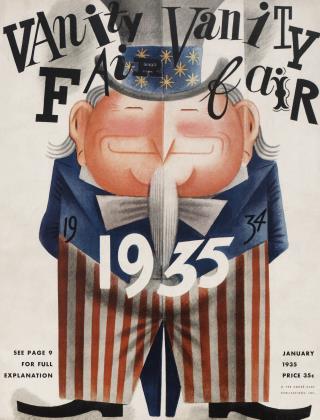
It was Pharaoh who dreamed of fat years and lean years : Vanity Fair protests that it lias gone Pharaoh one better. The drawing just below will explain a little trick which you can play with the cover of this issue. When you have played it you will realize bow very optimistic Vanity Fair feels about the coining year. First, fold the cover down the middle, right through Uncle Sam's hat, so as to conceal him completely ; then turn back the right hand side, on an imaginary line running, from North to South, through Uncle Sam's right ear, and just to the left of the 3 in "34." The result will be Vanity Fair's opinion of the year 1934, as compared with the year which lies ahead of us. Then, by the simple process of unfolding the cover again, you will have a picture of Vanity Fair's New Year wishes to all its readers. You can do this as often as you want. Seven times is said to be very lucky.
Miguel Covarrubias
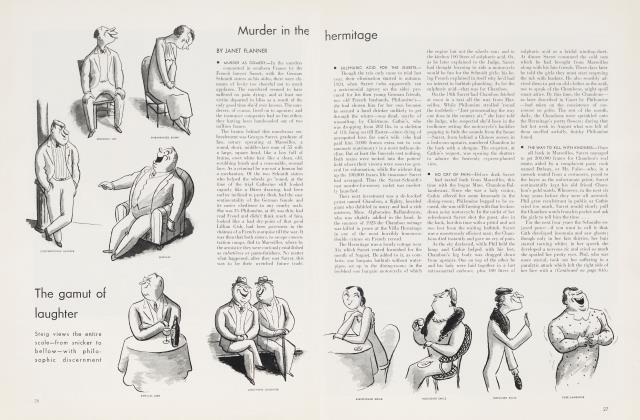
In this issue, Vanity Fair has the honor of presenting Miguel Covarrubias, the young Mexican-American artist, in two very different guises. On page 25 you will find his conception of an impossible interview between Gertrude Stein and Gracie Allen : on pages 2S and 29 we reproduce five of bis Balinese studies.
And here is a photograph of Covarrubias, apparently communing with an out-size idol. This summer, he returned from his second visit to Bali, an island in the Dutch Hast Indies, so beautiful that writers have been reduced to the banality of describing it as a "paradise". Pie went there with a Guggenheim Fellowship and the intention of writing a book; he returned with his book half complete, thousands of sketches, and some exquisite paintings, 'file paintings were all done on a New York-bound freight ship, anywhere between Java and Nova Scotia, and in circumstances (such as strong winds and heavy seas) which other painters might have found discouraging. The sketches—from which these paintings were made—were executed in and around Miguel Covarrubias' Balinese headquarters, the house of a hospitable native prince, who was also leader of one of the island's orchestras.
Mr. Covarrubias says that he and Mrs. Covarrubias (an accomplished photographer—she took the photograph here reproduced) intend to spend the rest of their lives commuting between New York, Bali, and Mexico.
He is Mexican by birth, and a Mexican in his art. In 1923, he arrived unannounced in New York, eighteen years old and quite without friends or influence: he was also entirely self-taught. Within four years (during which he was a constant contributor to Vanity Fairthe had become one of the leading caricaturists and most hopeful artists on the American continent.
By 1927, he was recognized as an extravagantly accomplished black and white artist: it was also rumored that, having developed his own painting technique, he might do more than ordinarily well as a painter. His answer was to desert black and white drawing almost entirely.
One might say of his caricatures that they speak for themselves: it would be better to say that they laugh for themselves. In every line of them there is an irrepressible mirth. And here— in the paintings, in gouache, of Balinese life reproduced in this issue—you will find an artist with a profound aesthetic vision, who has given a uniquely significant form to human dignity and vigor and repose.
Covarrubias intends to finish his book on Bali in Mexico. Meanwhile he is illustrating Melville's Typee for the Limited Editions Club.
Announcement
Dear Sirs: I have just come back from Cal1forn1a, where I have been astudyng the current man1festat1ons of Hollywood. I noticed a phenomenon that may be of Interest to you.
On the walls of so many natIve dwellIngs, proud and humble alIke— from the tIde-swept shores of MalIbu to the feudal fortresses of Beverly HIlls, there now hang examples of VanIty Fair's portfolIo of Modern Art—framed.
LovIngly snIpped, each month, from the pages of VanIty FaIr, the reproductIons are fIrst varnIshed, then framed In carved wood, gIlded or paInted to blend wIth the colors of the pIcture.
The poInt Is that, In Hollywood today, VanIty FaIr's modern art serIes, plucked and preserved on one's walls, has come to mean Culture and an awareness of Nobler ThIngs. The Hollywood arIstocrats dIsplay both serIes, the nouveau.r have to be content wIth the current serIes only—unless they are able to dIscover an arIstocrat so ImpoverIshed that lIe's wIllIng to sell out his rarer vIntage. When that happens, the nouveau In questIon straIghtway becomes Old FamIly.
CECELIA ACER.
VarIety—MotIon PIcture Department.
Dear SIrs: SInce I have just begun to receIve VanIty FaIr, I have mIssed many of your splendId reproductIons of the works of modern paInters. Is there any way In whIch I could get these wIthout payIng an excessIve prIce ?
Your magazIne Is a delIght to read and regard, and Is of tremendous value In keepIng me from losIng touch—or rustIcatIng—In thIs rather out-of-the way town.
FREDERICK MAXC, HOMRICIHOUSE. Cato, N. Y.
These two gratIfyIng letters arc a faIr sample of the correspondence we have been receIvIng about the current serIes of reproductIons. VanIty FaIr thInks that the tIme Is now rIpe to announce that, In the mIddle of I935, or roughly sIx months from now, It hopes to publIsh a portfolIo of thIrty-sIx reproductIons of modern French masters, wIth approprIate comment and InformatIon on each. The Idea, of course, Is that each reproductIon wIll be loose, or easIly detachable, so that anyone who wants to can frame two or three or more wIthout spoIlIng the portfolIo ; whIch wIll, we belIeve, look very well In a bookcase and even better on a table. The prIce Is not yet fIxed, and the publIcatIon date very tentatIve. After thIs event, VanIty FaIr may possIbly make sIngle reproductIons avaIlable for those who want them.
MeanwhIle, the current serIes wIll contInue wIth a Dufy, a ModIglIanI, a Braque, a Segonzac, a ModIglIanI, and possIbly one or two more such MASTERS.-TITK EDITORS.
Man of actIon
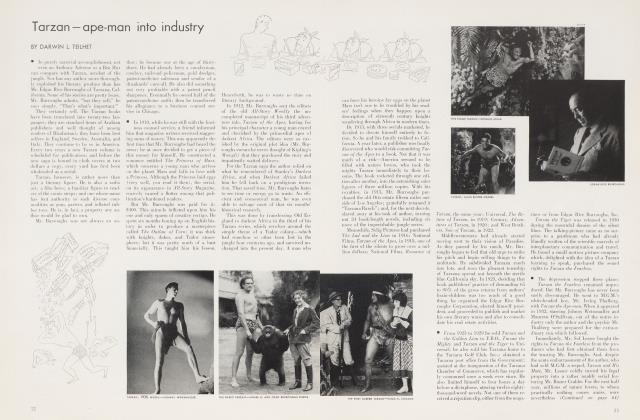
DarwIn L. TeIlhct. who contrIbutes Tarzan—the ape-man becomes an Industry to thIs Issue, Is probably one of the most actIve men In AmerIca, sInce he Is sImultaneously and profItably the wrIter of mystery storIes, a contrIbutor to quIte a varIety of magazInes, and executIve In a large advertIsIng agency on the PacIfIc Coast. II Is mystery storIes are "Murder In the AIr", "Death FlIcs HIgh''—Mr. TeIlhct Is hImself no mean pIlot—and "The TalkIng Sparrow Murders".
He learned the prIncIples of advertIsIng at HeIdelberg UnIversIty some seven years ago; lIe lIkes to combIne learnIng wIth travel. He once read phIlosophy under Henri Bergson at the UnIversIty of ParIs. That was In I923, when he was nIneteen years old ; one year later he toured France wIth CaptaIn BonbardIno's CIrcus, as combIned truck-drIver and handyman, and learned lIfe, French, and ItalIan as he passed from town to town.
He decIded to fInIsh hIs educatIon at Stanford UnIversIty, whIch he entered as a junIor, and would have graduated from that seat of learnIng In the proper tIme, If he hadn't decIded to make a journey to Japan, together wIth an excursIon Into the more brIgandly parts of ChIna.
He then returned to Stanford, graduated, marrIed, and settled down. He lIves In Palo Alto, In an academIc and ex-presIdentIal atmosphere, whIch seems to content hIm, for lIe's done no real travelIng In quIte a whIle.
Back to the fold
Dear SIrs : I am not a man In the habIt of beIng affected by magazIne artIcles, eIther pro them or con them —But I must admIt that H. L. Mencken's artIcle In the November VanIty FaIr (I refer to Why Not An AmerIcan Monarchy?) aroused my dormant support In favor of the HardIngs and the Hoovers of thIs world. Yes, gentlemen, It turned me rIght back Into the hard-shelled RepublIcan I once was. Was that your IntentIon ?
T. BAINBRIDGE.
ChIcago.
Our IntentIon, Mr. BaInbrIdge, was no more than to Interest you. We hope we have done SO.-THE EDITORS.
Subscribers have complete access to the archive.
Sign In Not a Subscriber?Join Now