Sign In to Your Account
Subscribers have complete access to the archive.
Sign In Not a Subscriber?Join NowTwo heads are better
Than one: a report on love and war as they arise among our best-known pairs of literary and theatrical collaborators
JOHN KOBLER
It's a rare moment when somewhere in the world one potential Proust or would be Lewis isn't whispering to another: "Why don't you I I collaborate? With my creative genius I your sense of plot. . . .
With these few fatal words there begins, all too often, that curious artistic phenomenon known as the Literary Partnership, which can he defined as a magnificent adventure in self-control I suppression of the ego. It can also he defined, more suceinctly, as a bust. Because, for every successful collaboration, there are thousIs of young hopefuls who yearly go down to defeat like Thessalian warriors shackled together in battle.
However, if the improbable occurs, if vour literary Mutts and Jeffs can establish some sort of working formula, an adjustment, a compromise, a clear delineation of who shall do what—then their chance of triumph is reasonably assured.
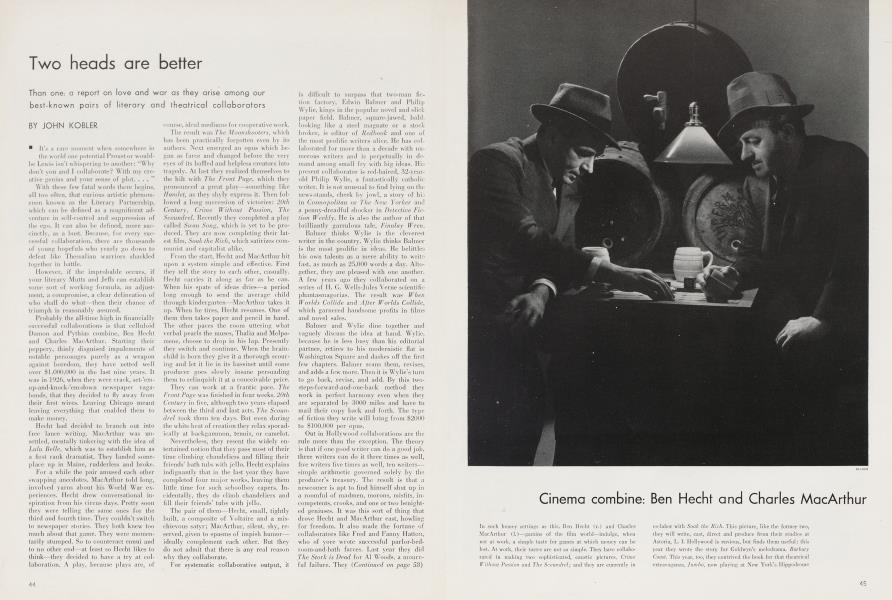
Probably the all-time high in financially successful collaborations is that celluloid Damon and Pythias combine, Ben Hecht and Charles MacArthur. Starting their peppery, thinly disguised impalements of notable personages purely as a weapon against boredom, they have netted well over $I,000,000 in the last nine years. It was in I926, when they were crack, set-'emup-I-knock-'em-down newspaper vagabonds, that they decided to fly away from their first wives. Leaving Chicago meant leaving everything that enabled them to make money.
Hecht had decided to branch out into free lance writing. MacArthur was unsettled, mentally tinkering with the idea of Lulu Hello, which was to establish him as a first rank dramatist. They lIed someplace up in Maine, rudderless I broke.
For a while the pair amused each other swapping anecdotes. MacArthur told long, involved yarns about his World War experiences. Hecht drew conversational inspiration from his circus days. Pretty soon they were telling the same ones for the third I fourth time. They couldn't switch to newspaper stories. They both knew too much about that game. They were momentarily stumped. So to counteract ennui I to no other end—at least so Hecht likes to think—they decided to have a try at collaboration. A play, because plays are, of
course, ideal mediums for cooperative work.
The result was The Moonshooters. which has been practically forgotten even by its authors. Next emerged an opus which began as farce I changed before the very eves of its baffled I helpless creators into tragedy. At last they realized themselves to the hilt with The Front Page, which they pronounced a great piny—something like Hamlet, as they shyly express it. Then followed a long succession of victories: 20th Century, Crime Without Passion, The Scoundrel. Recently they completed a play called Swan, Song, which is yet to he produced. They are now completing their latest film, Soak the Rich, which satirizes communist I capitalist alike.
From the start, Hecht and MacArthur hit upon a system simple and effective. First they tell the story to each other, casually. Hecht carries andt along as far as he can. When his spate of ideas dries—a period long enough to send the average child through kindergarten—MacArthur takes it up. When he tires, Hecht resumes. One of them then takes paper andI pencil in hI. The other paces the room uttering what verbal pearls the muses, Thalia and Melpomene, choose to drop in his lap. Presently they switch and continue. When the brainchild is born they give it a thorough scouring and lot it lie in its bassinet until some producer goes slowly insane persuading them to relinquish it at a conceivable price.
They can work at a frantic pace. The Front Page was finished in four weeks. 20th Century in five, although two years elapsed between the third I last acts. The Scoundrel took them ten days. But even during the white heat of creation they relax sporadically at backgammon, tennis, or camelot.
Nevertheless, they resent the widely entertained notion that they pass most of their time climbing chIeliers I filling their friends' bath tubs with jello. Hecht explains indignantly that in the last year they have completed four major works, leaving them little time for such schoolboy capers. Incidentally, they do climb chIeliers and fill their friends' tubs with jello.
The pair of them—Hecht, small, tightly built, a composite of Voltaire and a mischievous satyr; MacArthur, silent, shy, reserved, given to spasms of impish humor— ideally complement each other. But they do not admit that there is any real reason why they collaborate.
For systematic collaborative output, it is difficult to surpass that two-man fiction factory, Edwin Balmer and Philip V v lie. kings in the popular novel and slick paper field. Balmer, square-jawed, bald, looking like a steel magnate or a stock broker, is editor of Redbook and one of the most prolific writers alive. He has collaborated for more than a decade with numerous writers and is perpetually in demI among small fry with big ideas. His present collaborator is red-haired, 32-year-old Philip Wylie, a fantastically catholic writer. It is not unusual to find lying on the news-stIs, cheek by jowl, a story of his in Cosmopolitan or The New Yorker and a penny-dreadful shocker in Detective Fiction Weekly. He is also the author of that brilliantly garrulous tale, Finnlay Wren.
Balmer thinks Wylie is the cleverest writer in the country. Wylie thinks Balmer is the most prolific in ideas. He belittles his own talents as a mere ability to writefast, as much as 25,000 words a day. Altogether, they are pleased with one another. A few years ago they collaborated on a series of H. G. Wells-Jules Verne scientific phantasmagorias. The result was When Worlds Collide and After Worlds Collide, which garnered hIsome profits in films and novel sales.
Balmer and Wylie dine together and vaguely discuss the idea at hI. Wylie, because he is less busy than his editorial partner, retires to his modernistic flat in Washington Square and dashes off the first few chapters. Balmer scans them, revises, I adds a few more. Then it is Wylie's turn to go back, revise, I add. By this two-steps-forward-and-one-back method they work in perfect harmony even when they are separated by 3000 miles I have to mail their copy back and forth. The type of fiction they write will bring from $2000 to $I00,000 per opus.
Out in Hollywood collaborations are the rule more than the exception. J he theory is that if one good writer can do a good job, three writers can do it three times as well, five writers five times as well, ten writers— simple arithmetic governed solely by the producer's treasury. The result is that a newcomer is apt to find himself shut up in a roomful of madmen, morons, misfits, incompetents, crooks, and one or two benighted geniuses. It was this sort of thing that drove Hecht and MacArthur east, howling for freedom. It also made the fortune of collaborators like Fred and Fanny Hatton, who of yore wrote successful parlor-bedroom-and-bath farces. Last year they did The Stork is Dead for AI Woods, a mournful failure. They (Continued on page 58) are today a trifle out of date.
(Continued from page 44)
Their working methods are unique. Fred sits at one typewriter, Fanny at another. They carry out IIE-SHE conversations on paper. Fanny makes a snappy comment and writes it down. Fred tries to find a snappier comeback and puts that down, making for what used to pass as very witty stuff.
A perilous, if not altogether impossible, form of collaboration is the man and wife team. A scattered few have practiced it successfully. The distinguished historians, Charles I Mary Beard, are among them. Mr. and Mrs. Bruce Gould, editors of the Ladies' Home Journal, write popular love stories under a joint nom-de-plume. Mrs. S. J. Perelman contributes to her husbI's flights of literary buffoonery.
No one is more conversant with the dangers of mixed doubles in writing than Paul Sifton, who with his wife, Claire, penned those two succes destime, 1931 and Midnight.
The Siftons are none of your placid, easy-going collaborators. They labor in incessant turmoil. Extravagant things are said, and quarrels are frequent. It is a happy thing, however, that they do plays and not musical shows, for the latter are by far the most nervewracking medium of collaborators. The Siftons know nothing of the tribulations of Cole Porter and Moss Hart, of George Kaufman and Moss Hart, of the Gershwin brothers, Ira and George, of Howard Dietz and Arthur Schwartz.
In musical shows generally, and songs particularly, collaboration is inevitable. Rarely is a composer versatile enough to hIle both words and music effectively. Hence the union of lyricist-producer Howard Dietz, grayhaired, velvet-voiced, 39-year-old, and Arthur Schwartz, former lawyer and amateur song-writer.
When a backer gives them a show to do they leave their wives and take a room together in a downtown hotel. One of them sings or whistles a few bars of melody. The other fits words in. They don't write songs as songs, but as scenes. They describe musically, seeking to characterize a scene I an actor. For Fred Astaire they conceived the idea of a scene wherein the cleated Nijinski would dance as he dressed. That suggested something bright I happy—"New Sun in the Sky", I in this case a gay melody was built around what they call an eight-bar phrase in words. For Eleanor Powell in their current At Home Abroad they created "The Lady With the Taps" in a similar way.
In translations, Eden and Cedar Paul, English marital writing team, practically corner the market—as far as German works go. Emil Ludwig, Jacob Wassermann, Thomas Mann and many others have at one time or another been interpreted to the Englishreading public by the Pauls. France's ace writing team, until divorce split it, was Colette and Willy, whose subtle studies of marriage and adultery gained readers the world over. Against Colette I Willy American letters place John Emerson I Anita Loos, authors of The Whole Towns Talking.
Among newcomers in the collaboration game are Dr. John Haynes Holmes and Reginald Lawrence. Arthur Kaplan and John Whedon. Damon Runyon and Howard Lindsay, recently represented on Broadway, respectively, in If This Be Treason, Life Is So Short, and A Slight Case of Murder.
While the writers mentioned so far collaborate largely as a business enterprise, with less regard for the quality of their output, there is ample evidence to prove that literary partnerships can and have produced works of enduring merit. As co-authors of Philaster and The Maid's Tragedy, Francis Beaumont and John Fletcher are almost synonymous with Elizabethan drama. They not only looked alike but wrote alike, so much so that it is virtually impossible to tell who composed what lines.
Emile Erckmann and Alexdre Chatrian, the French writers, who collaborated during the latter part of the I9th Century are still represented in the repertory of the Comédie Franqaise by those old stIbys, Id Ami Fritz and Le Juif Polonais.
Fifty years ago, the facile gift of Sir William Gilbert for quips, paradoxes and grotesque situations, combined with the jaunty melodies of Sir Arthur Sullivan made up one of the most renowned collaborations of all time. It broke up only when Sullivan, knighted, and impressed with a sense of dignity and sobriety, took to writing grI opera and church music.
When all the technical problems of collaboration have been solved there still remains that red-eyed monster lurking in wait to destroy the best intentioned teams—egotism. Horrid Example No. and is the break-up of that fluent triumvirate, Paul Armstrong, Wilson Mizner, and Jack Lait. In the early I900's they fascinated a nation with their underworld "mellers", of which the late Paul Armstrong, author of Alias Jimmy Valentine, was the guiding spirit. Mizner, that almost legendary flaneur and wit, inserted the sparkling quips. Lait, the only member of the trio still alive, did much of the actual writing.
But regardless of who penned each line, Armstrong, opinionated I stubborn, would announce, "and guess and knew what and meant when I wrote that."
Armstrong's conceit broke up the partnership. Years later he died, broke, friendless. Only after much persuasion was Lait able to drag Mizner to the funeral parlor where their former colleague's body lay.
Because he had been an atheist, his relatives had been unable to procure the services of a priest. A Salvation Army novice delivered the eulogy. Leaning against the back wall of the cold, dismal room, Lait and Mizner heard him declaim:
"I never knew the deceased. and never heard of him until a few minutes ago. But and am informed he was a writer of Broadway plays I a player along Broadway. Perhaps in the hereafter he will be remembered more for his playing than his plays—"
Mizner turned to Lait and muttered from the corner of his mouth:
"That's one line the son of a bitch won't be able to say he wrote."
Subscribers have complete access to the archive.
Sign In Not a Subscriber?Join Now
