Sign In to Your Account
Subscribers have complete access to the archive.
Sign In Not a Subscriber?Join NowThe blind spot
JOHN VAN DRUTEN
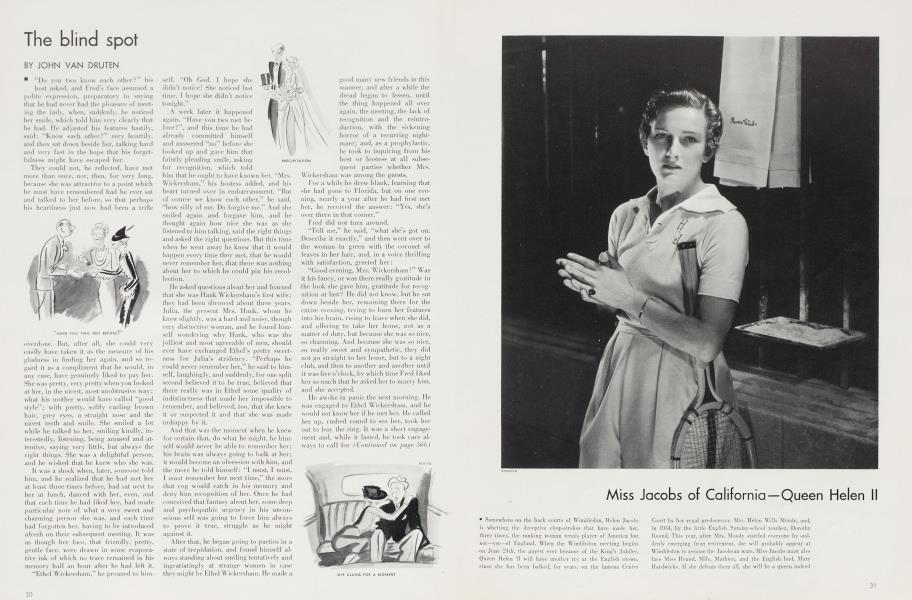
"Do you two know each other?" his host asked, and Fred's face assumed a polite expression, preparatory to saying that he had never had the pleasure of meeting the lady, when, suddenly, he noticed her smile, which told him very clearly that he had. He adjusted his features hastily, said: "Know each other?" very heartily, and then sat down beside her, talking hard and very fast in the hope that his forgetfulness might have escaped her.
They could not, he reflected, have met more than once, nor, then, for very long, because she was attractive to a point which he must have remembered had he ever sat and talked to her before, so that perhaps his heartiness just now had been a trifle overdone. But, after all, she could very easily have taken it as the measure of his gladness in finding her again, and so regard it as a compliment that he would, in any case, have genuinely liked to pay her. She was pretty, very pretty when you looked at her, in the nicest, most unobtrusive way; what his mother would have called "good style"; with pretty, softly curling brown hair, grey eyes, a straight nose and the nicest teeth and smile. She smiled a lot while he talked to her, smiling kindly, interestedly, listening, being amused and attentive, saying very little, but always the right things. She was a delightful person, and he wished that he knew who she was.
It was a shock when, later, someone told him, and he realized that he had met her at least three times before, had sat next to her at lunch, danced with her, even, and that each time he had liked her, had made particular note of what a very sweet and charming person she was, and each time had forgotten her, having to be introduced afresh on their subsequent meeting. It was as though her face, that friendly, pretty, gentle face, were drawn in some evaporative ink of which no trace remained in his memory half an hour after he had left it.
"Ethel Wickersham," he groaned to himself. "Oh God, I hope she didn't notice! She noticed last time. I hope she didn't notice tonight."
A week later it happened again. "Have you two met before?", and this time he had already committed himself and answered "no" before she looked up and gave him that faintly pleading smile, asking for recognition, which told him that he ought to have known her. "Mrs. Wickersham," his hostess added, and his heart turned over in embarrassment. "But of course we know each other," he said, "how silly of me. Do forgive me." And she smiled again and forgave him, and he thought again how nice she was as she listened to him talking, said the right things and asked the right questions. But this time when he went away he knew that it would happen every time they met, that he would never remember her, that there was nothing about her to which he could pin his recollection.
He asked questions about her and learned that she was Hank Wickersham's first wife; they had been divorced about three years. Julia, the present Mrs. Hank, whom he knew slightly, was a hard and noisy, though very distinctive woman, and he found himself wondering why Hank, who was the jolliest and most agreeable of men, should ever have exchanged Ethel's pretty sweetness for Julia's stridency. "Perhaps he could never remember her," he said to himself, laughingly, and suddenly, for one split second believed it to be true, believed that there really was in Ethel some quality of indistinctness that made her impossible to remember, and believed, too, that she knew it or suspected it and that she was made unhappy by it.
And that was the moment when he knew for certain that, do what he might, he himself would never be able to remember her; his brain was always going to balk at her; it would become an obsession with him, and the more he told himself: "I must, I must, I must remember her next time," the more that cog would catch in his memory and deny him recognition of her. Once he had conceived that fantasy about her, some deep and psychopathic urgency in his unconscious self was going to force him always to prove it true, struggle as he might against it.
After that, he began going to parties in a state of trepidation, and found himself always standing about smiling tentatively and ingratiatingly at strange women in case they might be Ethel Wickersham. He made a good many new friends in this manner, and after a while the dread began to lessen, until the thing happened all over again, the meeting, the lack of recognition and the reintroduction, with the sickening .horror of a recurring nightmare; and, as a prophylactic, he took to inquiring from his host or hostess at all subsequent parties whether Mrs. Wickersham was among the guests.
For a while he drew blank, learning that she had gone to Florida, but on one evening, nearly a year after he had first met her, he received the answer: "Yes, she's over there in that corner."
Fred did not turn around.
"Tell me," he said, "what she's got on. Describe it exactly," and then went over to the woman in green with the coronet of leaves in her hair, and, in a voice thrilling with satisfaction, greeted her:
"Good evening, Mrs. Wickersham!" Was it his fancy, or was there really gratitude in the look she gave him, gratitude for recognition at last? He did not know, but he sat down beside her, remaining there for the entire evening, trying to burn her features into his brain, rising to leave when she did, and offering to take her home, not as a matter of duty, but because she was so nice, so charming. And because she was so nice, so really sweet and sympathetic, they did not go straight to her home, but to a night club, and then to another and another until it was five o'clock, by which time Fred liked her so much that he asked her to marry him, and she accepted.
He awoke in panic the next morning. He was engaged to Ethel Wickersham, and he would not know her if he met her. He called her up, rushed round to see her, took her out to buy the ring. It was a short engagement and, while it lasted, he took care always to call for her if they went out together, never to meet her any place, in restaurants or other people's houses, where he might fail to recognize her. There was a dreadful day when he passed her on Fifth Avenue, thinking "I know that woman" as he did so, and she came up abreast of him as he stood waiting for the light to change, laid her hand on his arm and said "Darling, what's the matter? Didn't you see me?" He passed it off apologetically with a remark about business and preoccupation, but he was in a cold sweat for the remainder of the day, and urged the precipitation of their marriage all he could.
Continued on page 56b
Continued from page 30
It was she who insisted on a Church wedding, and he on her wearing a proper wedding dress so that, since he might not fetch her, he would at least be able to recognize her as the one in white satin with the veil.
It was a very happy marriage. He was right in his estimate of her as the nicest, sweetest woman he had ever met; they were free, frank and open with each other, with only one reservation. They neither of them ever mentioned the number of times it had taken him to recognize her before he proposed. Everyone in New York noticed and remarked on how devoted they were, how they never went anywhere without each other, how Fred seemed always to be devouring her with his eyes, following her with them if she left his side for a moment. He had little peculiarities about her, forbidding her ever to wear a hat in her own home during the day, when there were other women present, even at lunch if he were going to be there; he gave her a large, very striking and unusual brooch which he insisted on her wearing always, even with dresses or with other jewelry that it did not suit. He was very uxorious, and was apt at large parties, when he could not see her in the crowd, to shout loudly: "Where's my wife? I want my wife," and to go on shouting until she came to him from wherever she was and stood beside him, saying: "Darling, you are absurd," with a funny, pleading, frightened smile, in answer to the look of relief that passed across his face.
And then one night, about six months after they were married, came their first separation. It was for an evening only, but it was the first time that they accepted separate engagements. There was an invitation to a party at which Fred, for business reasons, felt that he ought to be present. They had arranged to dine with Ethel's family, whom Fred had never liked. Ethel did not care much for them either, but she had a sweet, strict sense of duty towards them.
"You go to the party, darling," she said, "I'll make your peace with the family, and, if I can, I'll get away early and join you at the Warburtons'. How's that?"
All the old panic flooded back.
"No, don't do that," he said, with sudden urgency. "Don't you come on. I'll leave there early. It's only a question of showing up for a little while. I'll be away by 12, and come straight home to you. Don't you come on."
He kissed her lovingly as he said good-bye to her while she was dressing.
"Do you mind if I don't wear your brooch tonight, darling?" she asked. "Mother's never liked* it, and if you won't be there . . ."
In a way it was relief to be without her at the party, to be free of that perpetual sense of watchfulness, and yet he missed her sweetness, realized afresh how very happy they were in their marriage. He watched the clock for the earliest moment at which he could leave and rejoin her. It was a big.party and he passed through the crowds, exchanging greetings as he went. His host, Bill Warburton, came up to him with a woman whose face, a pretty one, seemed vaguely familiar.
"Do you know this charming lady?" Bill asked. His tone was facetious, so that Fred replied, "I think so," with an equally ironic gravity.
The three of them stood talking for a while, and then Bill left them.
"Glad to see me?" she enquired sweetly, intimately, so Fred was taken momentarily aback. He had not thought that their previous acquaintance, whatever it was, justified quite that degree of familiarity.
"What do you think?" was his answer, and then other people came up to them so that they were swept into a group for the next hour, without chance of private conversation. He was surprised at the number of times that she smiled at him, and then, as the group broke up, she moved beside him.
"Want to go?" she whispered. "Let's."
Fred felt that a feather would have been an adequate weapon for flooring him. Who was this woman? Obviously, in the words of Aubrey Tanqueray, they were not strangers to each other, but it was a little brazen, he thought, the way she did not mind their being seen leaving together.
At the entrance, where the doorman hailed a taxi for them, someone delayed him for a moment, so that she ran ahead to escape the wind.
"I've told him the address," she said, as he settled down beside her, and then, when the taxi started, nestled against him.
"God, she's a pushover," Fred thought, as his arm went dutifully around her.
"I'm glad you hadn't left," she said, and turned her face to his. He kissed her, wonderingly, and she lay back restfully against him. He was acutely embarrassed.
"Look, darling," he said after a minute. "There's something, maybe, that I ought to tell you."
"What's that?"
"Well, you probably don't know. After all, it's some time since we've seen each other, but . . . Well, I'm a married man now. Maybe, you hadn't heard. It did all happen rather suddenly, but, well, I'm crazy about my wife . . . so . . . Well, you understand . . . she's waiting home for me, so if I leave you at your door . . ."
He had not known quite what reaction he expected, but it was not what he received. She drew away from him, turned, looking at him.
"Don't, Fred," she said. "Don't talk like that. I don't like it."
Continued on page 58
Continued from page 56b
"I'm sorry," he replied. "But it's true."
"Don't, Fred," she repeated, and now there was fear in her voice. "Please don't go on."
"Yes, but . . ."
"I tell you I don't like it. You do it too well."
"Hell," he said angrily. "You think I'm kidding."
"Well, aren't you? Aren't you?" She stared at him as they passed a street lamp, which enabled them to read each others' features. Hers were aghast. "Fred! Fred!" she cried, and then: "Oh, God, I knew it. Oh, I knew it," and burst into tears, refusing his gestures and his words of comfort. Once only she stopped, looking up to say: "I'm glad you're crazy about her, all the same," and then wept again until the taxi stopped, to his surprise, at his apartment.
"Good night," she said, "you go to your wife ... if she's there."
"She will be," he replied. "Where shall I tell him . . . for you?"
"I'm going to an hotel," she answered. "I'll tell him. Good-bye, Fred." She caught at his sleeve as he was going. "Kiss me good-bye," she said.
He kissed her, and she clung for a moment. Then he left her, puzzled and dismayed. Women, he told himself, were unaccountable. Ethel was not home when he entered the apartment. "She's stayed late at her mother's," he thought, and sat down to wait for her. He waited all night.
Next day he heard from her lawyers. The grounds were "Mental cruelty."
Subscribers have complete access to the archive.
Sign In Not a Subscriber?Join Now

