

Sign In to Your Account
Subscribers have complete access to the archive.
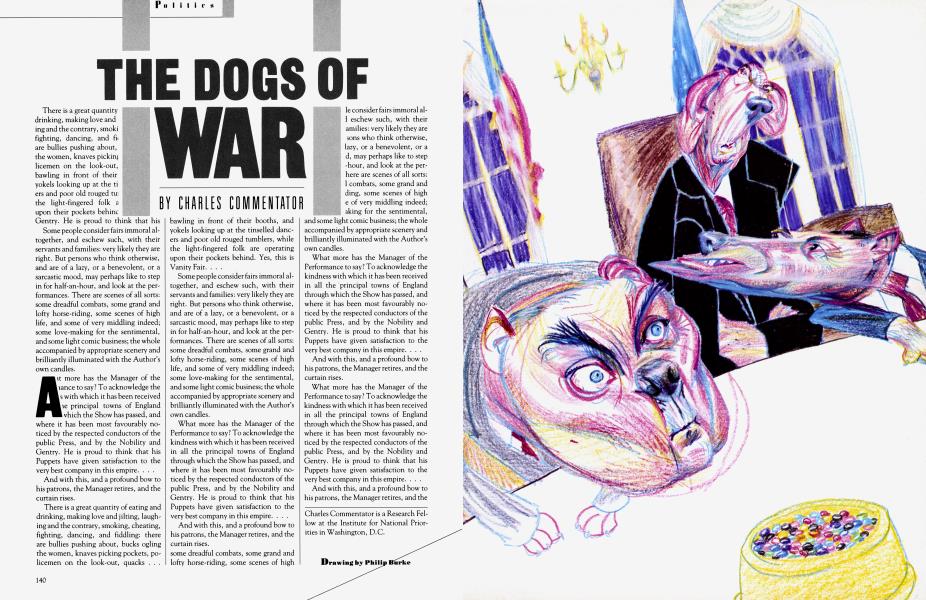
Sign In Not a Subscriber?Join NowTHE DOGS OF WAR
Politics
CHARLES COMMENTATOR
There is a great quantity drinking, making love and ing and the contrary, smoki fighting, dancing, and fi are bullies pushing about, the women, knaves picking licemen on the look-out, bawling in front of their yokels looking up at the ti ers and poor old rouged tui the light-fingered folk a upon their pockets behinc Gentry. He is proud to think that his
Some people consider fairs immoral altogether, and eschew such, with their servants and families: very likely they are right. But persons who think otherwise, and are of a lazy, or a benevolent, or a sarcastic mood, may perhaps like to step in for half-an-hour, and look at the performances. There are scenes of all sorts: some dreadful combats, some grand and lofty horse-riding, some scenes of high life, and some of very middling indeed; some love-making for the sentimental, and some light comic business; the whole accompanied by appropriate scenery and brilliantly illuminated with the Author’s own candles.
At more has the Manager of the ance to say? To acknowledge the s with which it has been received e principal towns of England vhich the Show has passed, and where it has been most favourably noticed by the respected conductors of the public Press, and by the Nobility and Gentry. He is proud to think that his Puppets have given satisfaction to the very best company in this empire. . . .
And with this, and a profound bow to his patrons, the Manager retires, and the curtain rises.
There is a great quantity of eating and drinking, making love and jilting, laughing and the contrary, smoking, cheating, fighting, dancing, and fiddling: there are bullies pushing about, bucks ogling the women, knaves picking pockets, policemen on the look-out, quacks . . . bawling in front of their booths, and yokels looking up at the tinselled dancers and poor old rouged tumblers, while the light-fingered folk are operating upon their pockets behind. Yes, this is Vanity Fair. . . .
Some people consider fairs immoral altogether, and eschew such, with their servants and families: very likely they are right. But persons who think otherwise, and are of a lazy, or a benevolent, or a sarcastic mood, may perhaps like to step in for half-an-hour, and look at the performances. There are scenes of all sorts: some dreadful combats, some grand and lofty horse-riding, some scenes of high life, and some of very middling indeed; some love-making for the sentimental, and some light comic business; the whole accompanied by appropriate scenery and brilliantly illuminated with the Author’s own candles.
What more has the Manager of the Performance to say? To acknowledge the kindness with which it has been received in all the principal towns of England through which the Show has passed, and where it has been most favourably noticed by the respected conductors of the public Press, and by the Nobility and Gentry. He is proud to think that his Puppets have given satisfaction to the very best company in this empire. . . .
And with this, and a profound bow to his patrons, the Manager retires, and the curtain rises.
some dreadful combats, some grand and lofty horse-riding, some scenes of high le consider fairs immoral al1 eschew such, with their amilies: very likely they are sons who think otherwise, lazy, or a benevolent, or a d, may perhaps like to step -hour, and look at the perhere are scenes of all sorts: 1 combats, some grand and ding, some scenes of high e of very middling indeed; aking for the sentimental, and some light comic business; the whole accompanied by appropriate scenery and brilliantly illuminated with the Author’s own candles.
What more has the Manager of the Performance to say? To acknowledge the kindness with which it has been received in all the principal towns of England through which the Show has passed, and where it has been most favourably noticed by the respected conductors of the public Press, and by the Nobility and Gentry. He is proud to think that his Puppets have given satisfaction to the very best company in this empire. . . .
And with this, and a profound bow to his patrons, the Manager retires, and the curtain rises.
What more has the Manager of the Performance to say? To acknowledge the kindness with which it has been received in all the principal towns of England through which the Show has passed, and where it has been most favourably noticed by the respected conductors of the public Press, and by the Nobility and Gentry. He is proud to think that his Puppets have given satisfaction to the very best company in this empire. . . .
And with this, and a profound bow to his patrons, the Manager retires, and the ing and the contrary, smoking, cheating, fighting, dancing, and fiddling: there are bullies pushing about, bucks ogling the women, knaves picking pockets, policemen on the look-out, quacks . . . bawling in front of their booths, and yokels looking up at the tinselled danc-
Charles Commentator is a Research Fellow at the Institute for National Priorities in Washington, D.C.
There is a great quantity of eating and drinking, making love and jilting, laughing and the contrary, smoking, cheating, fighting, dancing, and fiddling: there are bullies pushing about, bucks ogling the women, knaves picking pockets, policemen on the look-out, quacks . . . bawling in front of their booths, and yokels looking up at the tinselled dancers and poor old rouged tumblers, while the light-fingered folk are operating upon their pockets behind. Yes, this is Vanity Fair. . . .
Some people consider fairs immoral altogether, and eschew such, with their servants and families: very likely they are right. But persons who think otherwise, and are of a lazy, or a benevolent, or a sarcastic mood, may perhaps like to step in for half-an-hour, and look at the performances. There are scenes of all sorts: some dreadful combats, some grand and lofty horse-riding, some scenes of high life, and some of very middling indeed; some love-making for the sentimental, and some light comic business; the whole accompanied by appropriate scenery and brilliantly illuminated with the Author’s own candles.
O more has the Manager of the nee to say? To acknowledge the with which it has been received e principal towns of England vhich the Show has passed, and where it has been most favourably noticed by the respected conductors of the public Press, and by the Nobility and Gentry. He is proud to think that his Puppets have given satisfaction to the very best company in this empire. . . .
And with this, and a profound bow to his patrons, the Manager retires, and the curtain rises.
There is a great quantity of eating and drinking, making love and jilting, laughing and the contrary, smoking, cheating, fighting, dancing, and fiddling: there are bullies pushing about, bucks ogling the women, knaves picking pockets, policemen on the look-out, quacks.
Subscribers have complete access to the archive.
Sign In Not a Subscriber?Join Now

